



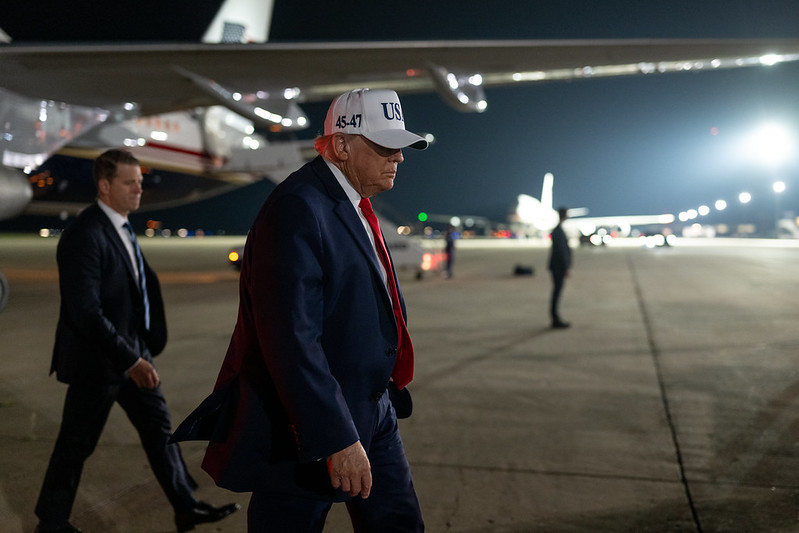
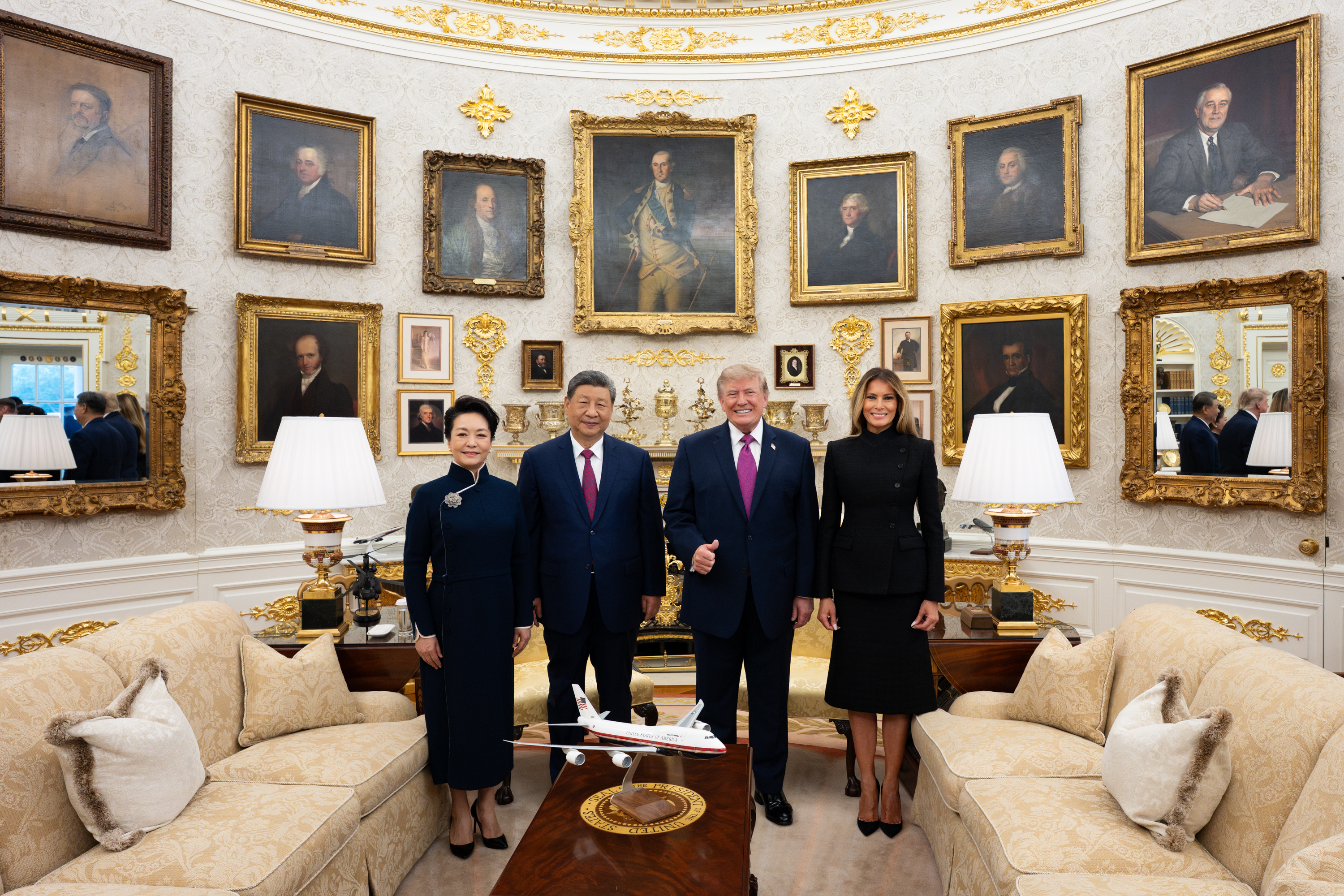
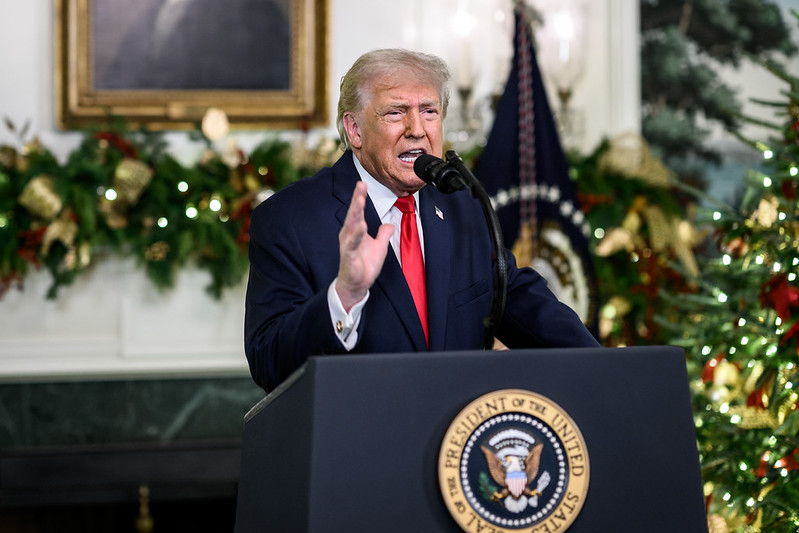
In the 2026 midterm elections, Trump lost Republican majorities in both the House of Representatives and the Senate. The Republican Party also lost its majority of governorships. Picture source: Picture source: The White House, November 2, 2026, flickr, https://www.flickr.com/photos/whitehouse/55628172435/.
Prospects & Perspectives No. 61
President Trump’s Foreign Policy Dilemma After the Midterm Elections
By Cheng- Yi Lin
U.S. President Trump has had two major setbacks since he first assumed the presidency in January 2017. The first was his failure to win re-election in 2020. The second was the midterm elections in November 2026, in which Trump lost a majority of seats in both the House of Representatives and the Senate. The Republican Party’s majority in gubernatorial seats has also been reduced to a minority.
Since World War II, six sitting presidents have lost control of both houses of Congress in midterm elections: Harry S. Truman in 1946, Dwight Eisenhower in 1954, Ronald Reagan in 1986, Bill Clinton in 1994, George W. Bush in 2006, and Barack Obama in 2014. Bush lost 30 seats in the House and six seats in the Senate. President Obama, who led the Democrats in fierce criticism of Trump in the 2026 midterm elections, suffered a crushing defeat in the 2010 midterm elections, with Democrats losing 63 seats in the House of Representatives. Trump lost 41 seats in the House in the 2018 midterm elections but gained two seats in the Senate.
The blame game
Despite his hard work campaigning in red states, Trump became the target of every criticism — including for the loss of the Republican majority in Congress. Trump will remain a fighter who never admits defeat and will use more vetoes to battle the Democrats in Congress. In addition, Trump will continue to wield the big stick on the international stage to force further concessions from allies and adversaries. If President Bush’s Iraq War dragged down the 2006 midterm elections, Trump’s Iran War was a major reason for the Republican defeat in 2026. By election day, the Iran War had dragged on for eight months, raising questions about the affordability of oil prices and the cost of living in the U.S. This made Trump, who was known for his alleged economic prowess, the primary reason for his defeat. A September 2026 Emerson College poll showed that the Iran War was the most important factor for voters when deciding who to vote for, scoring 3.87 out of 1-5, surpassing employment (3.80), tariffs (3.72), oil prices (3.69), and immigration (3.69).
Challenges ahead
With the loss of control of both the Senate and the House of Representatives, President Trump faces more serious challenges in domestic politics and lawsuits than in foreign policy. Strong opposition and rigorous oversight from the Democrats are inevitable. While Trump has lost the ability to pass major domestic legislation, as commander-in-chief he retains unilateral executive power and can still leverage U.S. national strength to influence issues related to Iran, Russia, Ukraine, China, and North Korea, or in trade tariffs and foreign policy. The Democratic-controlled Congress will use various levers of power to constrain and influence the strategic landscape of Trump's remaining two years in office.
The Democrats will reduce or limit military funding for Trump’s Iran war, condemn his choice of the war, reopen hearings and investigations into the War Powers Act, and use Defense Secretary Pete Hegseth as a scapegoat. Before the midterm elections, both Democratic and Republican members of the House of Representatives had resolutions on ending the Iran war, but neither was put to a vote. The Democrats, who hold a majority in both houses of Congress, are highly likely to use this case to attack President Trump, weaken his political influence, and expedite the end of the Iran war.
On the Ukraine war, Trump has at times ostensibly sided with Russia, forcing Ukrainian President Volodymyr Zelenskyy to accept territorial concessions in exchange for peace, and even halting Patriot missile deliveries and intelligence sharing. The Democrats, in conjunction with moderate Republicans, may first pressure Trump to halt the lifting of sanctions on Russian diesel exports and investigate Elon Musk’s order to slow down the speed of Starlink, making it difficult for Ukrainian drones to strike targets in Russian-occupied eastern Ukraine. Ukraine and European countries welcome a Democratic-controlled Congress that can restrain Trump’s pro-Russian policies.
The Senate, responsible for confirming high-ranking diplomatic, military, and judicial officials, can potentially obstruct President Trump’s appointments. The problem is that nearly 50% of the ambassadorial positions overseas remain vacant in the Trump administration. Unless Trump actively nominates replacements, the Democratic-controlled Senate is unlikely to expedite the reduction of these vacancies. Trump has shunned multilateralism and withdrawn from dozens of international organizations and mechanisms. Therefore, the chances of the Senate requiring a two-thirds majority to force Trump to sign an international treaty are virtually zero. Democrats will question Trump’s cuts to international assistance programs and weakening U.S. leadership. Human rights and climate change issues will potentially figure more prominently in U.S. foreign policy.
Democrats face structural limitations in attempting to check the president’s foreign policy. Trump has veto powers and has declared his intention to be “Mr. Veto" for the remaining two years, allowing him to veto legislation restricting his overseas deployments or foreign policy. It will be difficult for Democrats to combine with Republican members to overcome Trump’s veto powers with a two-thirds majority. Trump is adept at issuing executive orders and engaging in direct diplomacy with foreign leaders, such as a potential trilateral meeting between the U.S., China, and Russia at the APEC summit in Shenzhen later this year and the G20 summit in Miami, which clearly extricated Vladimir Putin from international isolation and sanctions. Trump’s insistence on striking Iran could lead to a flurry of military action before the 120th Congress takes office on January 3, 2027, forcing Iran to further compromise.
Trump, Taiwan and China
President Trump broke with President Reagan’s Six Assurances, using arms sales to Taiwan as a bargaining chip in U.S.-China negotiations. While he stated that his Taiwan policy remained unchanged, Xi Jinping has identified direct channels to constrain U.S. arms sales to Taiwan. Although Trump stated he would speak with Taiwanese President Lai Ching-te, no such call has been made. Fortunately, during the UN General Assembly debate in September and at the G20 foreign ministers’ sideline meeting in Atlanta in October, Secretary of State Marco Rubio, along with Japanese Foreign Minister Toshimitsu Motegi and South Korean Foreign Minister Cho Hyun, issued statements emphasizing the importance of peace and stability across the Taiwan Strait, encouraging a peaceful resolution to cross-Strait issues, opposing any unilateral changes to the status quo, or supporting Taiwan’s meaningful participation in appropriate international organizations.
In late-September, four Republican senators — Mitch McConnell (Kentucky), John Cornyn (Texas), Lisa Murkowski (Alaska), and Thom Tillis (North Carolina) — sent a letter to Rubio and Secretary of War Hegseth. McConnell chairs the Senate Appropriations Committee's Defense Subcommittee. These senior senators pointed out that the State Department had not yet provided Taiwan with the US$300 million as per the Foreign Military Financing Congress appropriated for Taiwan, and that the Department of Defense had not allocated the US$1 billion in dedicated funding to Taiwan under the Taiwan Security Cooperation Initiative. They also opposed the Trump administration’s delay in announcing the sale of US$14 billion in weapons to Taiwan, arguing that it undermined U.S. credibility in its defense of Taiwan and other countries, and even suggested freezing arms sales to Taiwan, in comparison to the 2021 freeze on aid to Ukraine.
On the same day Xi Jinping arrived in Washington, D.C., on September 23, a total of 17 Democratic senators, including Jeanne Shaheen (New Hampshire), Chris Coons (Delaware), Patty Murray (Washington), Jack Reed (Rhode Island), Mark Warner (Virginia), Elizabeth Warren (Massachusetts), and Andy Kim (New Jersey), issued a statement stipulating that as President Trump seemingly withdraws from longstanding security commitments, the Chinese military continues its coercive actions against Taiwan, and calling for Trump to stand with Taiwan and not allow China to veto U.S. support for Taiwan’s defense.
For Taiwan, Trump is the president under whose administration the U.S. has sold the most weapons to Taipei in U.S. history. It is hoped that the new U.S. Congress will help him resolve this thorny issue.
(Dr. Lin is an Adjunct Research Fellow at the Institute of European and American Studies, Academia Sinica.)
Related Content
The Impact of the 2026 U.S. Midterm Elections on Trump’s Policy Towards Taiwan and China
Trump-Xi Summit and the Security Situation in the Taiwan Strait
The New U.S.-China Paradigm Will Constrain but Not Collapse the U.S.-Taiwan Relationship
After Two Trump-Xi Summits: Competing Within Limits
Second Thomas Shoal Redux and Beijing’s Strategic Limitations

Reading Korea’s Early Autumn Winds: Trump Abruptly Scales Down a Major Joint Exercise
Washington Reassures (and Worries) Taiwan

The G7 Leaders’ Summit in France: An Unexpected Success
The Trump-Xi Summit: What It Was Not is More Important than What It Was
What Does the U.S. War Against Iran Mean for the Indo-Pacific?
Implications of the U.S. Tariff Policy on Global Economics and Taiwan’s Response
The Indo-Pacific and the U.S. National Defense Strategy: From Rebalancing to Retrenchment
 Facebook
 Youtube
 Twitter