

Reading Korea’s Early Autumn Winds: Trump Abruptly Scales Down a Major Joint Exercise


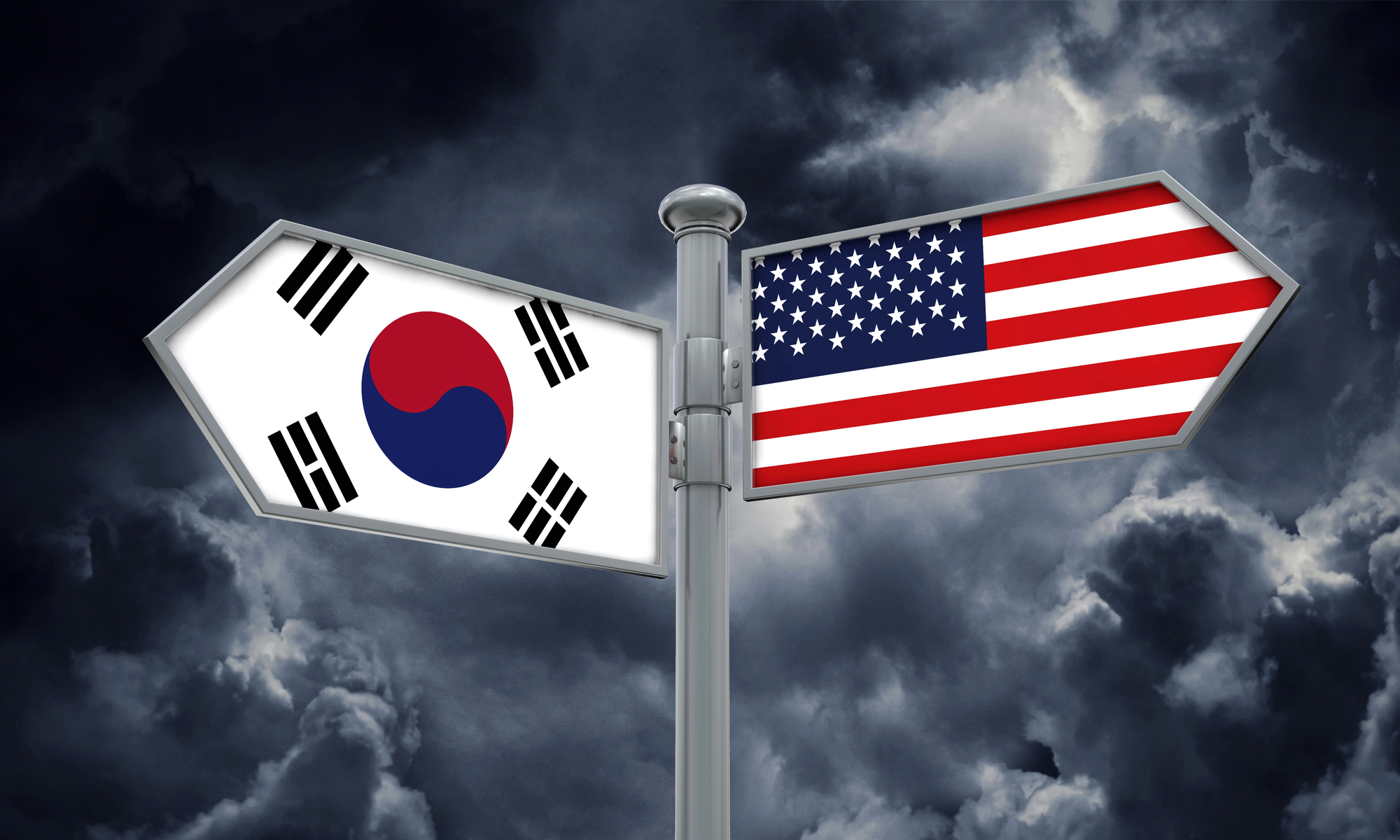
U.S. President Donald Trump’s announcement of an abrupt scaling down, via his Truth Social account, of the Ulchi Freedom Shield joint military exercise with South Korea on August 16 sent a minor shockwave rippling across the network of U.S. allies and partners. Picture source: Depositphotos.
Prospects & Perspectives No. 52
Reading Korea’s Early Autumn Winds: Trump Abruptly Scales Down a Major Joint Exercise
By Joel Atkinson
U.S. President Donald Trump’s announcement of an abrupt scaling down, via his Truth Social account, of the Ulchi Freedom Shield joint military exercise with South Korea on August 16 sent a minor shockwave rippling across the network of U.S. allies and partners.
Ulchi Freedom Shield is one of the two main annual joint exercises, and a target of longstanding ire from North Korea. The informal, sudden, and dismissive way Trump announced its reduction meant it was seized on as a straw in the wind by policymakers and pundits trying to glean which direction an unpredictable Trump was taking the U.S.’ global role — and hopefully shape where it ends up.
Some time has passed since the announcement, and we can therefore take stock of the episode, and consider the implications for South Korean security and the wider impact on the East Asian region.
In large part, the episode garnered the attention it did because of its wording:
Based on my very good relationship with Kim Jong Un, of North Korea, I am not happy with the fact that the United States has, long ago, agreed to participate in Joint Military Exercises with South Korea. These exercises are not only costly, with much of these costs paid for by the United States of America (as usual!), but send a signal that is totally inappropriate and hostile, to a Country that, as long as Donald J. Trump has been President, has been unthreatening and respectful. Therefore, and based on the fact that it is too late to cancel, I have instructed Secretary of War, Pete Hegseth, to substantially reduce the Joint Military Exercises! While somewhat unrelated (?), I recently asked the President of South Korea if they would like to join us in the Denuclearization of the Islamic Republic of Iran, and they said, “No thanks!”
For many observers, the immediate reaction to this was skepticism. Ulchi Freedom Shield is not something one simply “substantially reduces” hours before it is due to start. Trump is correct in that it is costly, with much of that cost non-refundable. It is simply not feasible to stop the huge and complicated machinery that is the U.S.-South Korea combined force while it is in motion. One could surmise that Trump’s social media post was the product of a prior decision to scale down the exercise, or was simply more Trump noise that would not amount to much in reality.
That, however, was only partially right. The exercise was slated for 11 days, with Part 1 practicing repelling a North Korean invasion and Part 2 a northwards counterattack. The exercise was cut down to five days, with seven of the planned 14 field exercises going ahead, with the remainder possibly pushed back until later and spread out. Much of Part 1 occurred as planned, though with troop withdrawals impacting the exercises. Part 2, which was much more simulation-based with less associated sunk costs, seems to have been dropped entirely.
And U.S. Forces Korea (USFK) commander Xavier Brunson certainly did not look like someone carrying out a well-thought-through plan to scale down the exercise when he arrived in Seoul to inform the Korean government. With the thousands of hours he and his subordinates and partners in the Korean military had put into preparing for the exercise, it is not difficult to imagine that he was not happy that much of this effort had been wasted and his command made to look superfluous, even ridiculous.
An Alliance against North Korea — or Iran?
At the time, it was tempting to point out that we should not assume Seoul was opposed to Trump’s move. Rather than “straining” the alliance, as critics in the U.S. Congress and elsewhere charged, Trump and Korean President Lee Jae Myung were, in a real sense, pulling in the same direction. The leftwing Lee administration has become increasingly desperate in its efforts to bring Trump to talk with Pyongyang, and that side of politics has long suggested a reduction in joint exercises as a way to encourage that.
The Korean rightwing opposition, which is relatively more anti-North Korea and pro-U.S., chose to ignore that context and focus instead on the damage highlighted by the Iran aspect of Trump’s announcement. Rather than focus on Trump’s evident warmth toward Kim Jong Un, it criticized Lee for being, in their view, a poor steward of the alliance, which remains very popular in Korea.
And indeed, it seems increasingly likely Iran was foremost in Trump’s mind. There has since been reporting that the Korean military is preparing for possible contributions to the Iran effort, which has sparked a debate on whether that is a price worth paying for Trump’s possible cooperation on other issues. And separate from Ulchi Freedom Shield, a navy/marine exercise originally planned for September was also cancelled, with the demands of the Iran war cited as the reason.
We have not seen any movement on the North Korean side. What is going on behind the scenes is anyone’s guess. But there has been no real shift in North Korea’s public stance. And as no such Kim-Trump meet up has materialized, we can at least be sure that Trump’s announcement was not in order to seize such an opportunity presented by Pyongyang.
The way the winds blow
So whichever way you look at it, the episode was not a positive sign for Korea-U.S. cooperation for the remainder of the Trump term. Trump still views the alliance as something he could dispense with, or leverage for other goals. International and domestic politics mean Seoul cannot just follow Trump on everything even if it wanted to. And even if it did, it is not obvious that would strengthen cooperation in any fundamental sense. In addition to the Iran-related deployment, the next flashpoint is likely to be the yawning gap in perceptions between the two administrations on what the tariff-reduction-related deal for South Korean investment in the U.S. entails.
The post-Trump trends are even harder to discern. Elbridge Colby has praised South Korea as something of a model ally because its defense spending as a percentage of GDP is relatively high. However, this is rooted in the public’s nervousness about North Korea rather than the burden-sharing issues more relevant to other partnerships. And at least some of that spending works as stimulus to South Korea’s domestic arms industry, creating economies of scale for a booming export sector. Korea is also able to leverage its privileged access to U.S. tech and the network of U.S. allies and partners to serve global markets. As such, South Korea’s political economy is less resistant to a high level of spending than most.
There are also fundamental questions about whether South Korea’s level of spending and capabilities translate into a tolerable burden on the United States. It remains debatable whether even a South Korean level of spending is sufficient to deter a nuclear-armed North Korea without U.S. support, despite the country’s economy being many multiples the size of the North’s. And the left has long pushed for more autonomy and self-reliance in conjunction with the reordering of relationships with North Korea and China. This could mean the U.S.’ bigger problem of deterring China gets even bigger, and the problem of deterring North Korea gets shifted onto the alliance with Japan.
We can see this with the notable differences between Washington and Seoul on China. Brunson’s description of Korea as a “dagger” aimed at China in May this year may have helped him justify USFK in Washington (though if it did, Trump’s Ulchi Freedom Shield decision showed no signs of it). But it alarmed the many South Koreans who are against involvement in a war with China over Taiwan or the use of USFK in such a contingency. We see the same tensions in the Lee administration’s hard slog regarding Washington’s support for developing nuclear-powered submarines, with Washington clearly not fully convinced they would serve the interests of the alliance as opposed to South Korean military autonomy or exports. Similarly, an autonomy-seeking Seoul is pushing for an expeditious transfer of wartime command authority of the combined force (so-called OPCON), hoping to have Trump push it through in the face of resistance from the Pentagon and Congress.
The only way out is through
At this point it is difficult to determine how whoever succeeds Trump, Democrat or Republican, will orient the relationship onto a more stable footing. A Biden-esque effort to double down on “alliances” would be insufficient. We can see from Iran that the U.S. does not have the material capacity or the bandwidth or credibility to continue to do everything everywhere all at once. And the damage to U.S. bases in the Middle East also indicates what an even more potent Chinese, or even just North Korean, missile barrage could do to U.S. forces “inside the A2/AD [anti-access/area denial] bubble,” as Brunson put it. If deterring China really is its goal, it cannot do so without making significant tradeoffs.
So rather than a straw indicating a prevailing wind, we can think of Trump’s early autumn exercise decision as one straw in a haystack caught up in a whirlwind. Things are definitely moving, but we do not know where they will end up.
(Dr. Atkinson is a professor in the Graduate School of International and Area Studies, Hankuk University of Foreign Studies, Seoul.)
Related Content
Second Thomas Shoal Redux and Beijing’s Strategic Limitations
Washington Reassures (and Worries) Taiwan
The G7 Leaders’ Summit in France: An Unexpected Success
What Does the U.S. War Against Iran Mean for the Indo-Pacific?
Implications of the U.S. Tariff Policy on Global Economics and Taiwan’s Response
Trump’s National Security Strategy and the Future of the World Order
President Trump’s National Security Strategy and Tensions Across the Taiwan Strait
The Honduran Presidential Election: Impact on Ties with Taiwan
Boycotts, Power Politics, and the Future of the G20
Recent U.S.-China-South Korea Summitry and Implications for Taiwan
Taiwan-U.S. Trade Talks: No Simple Way Ahead
The U.S.-India Partnership Will Survive, Maybe Even Thrive
 Facebook
  Youtube
  Twitter