



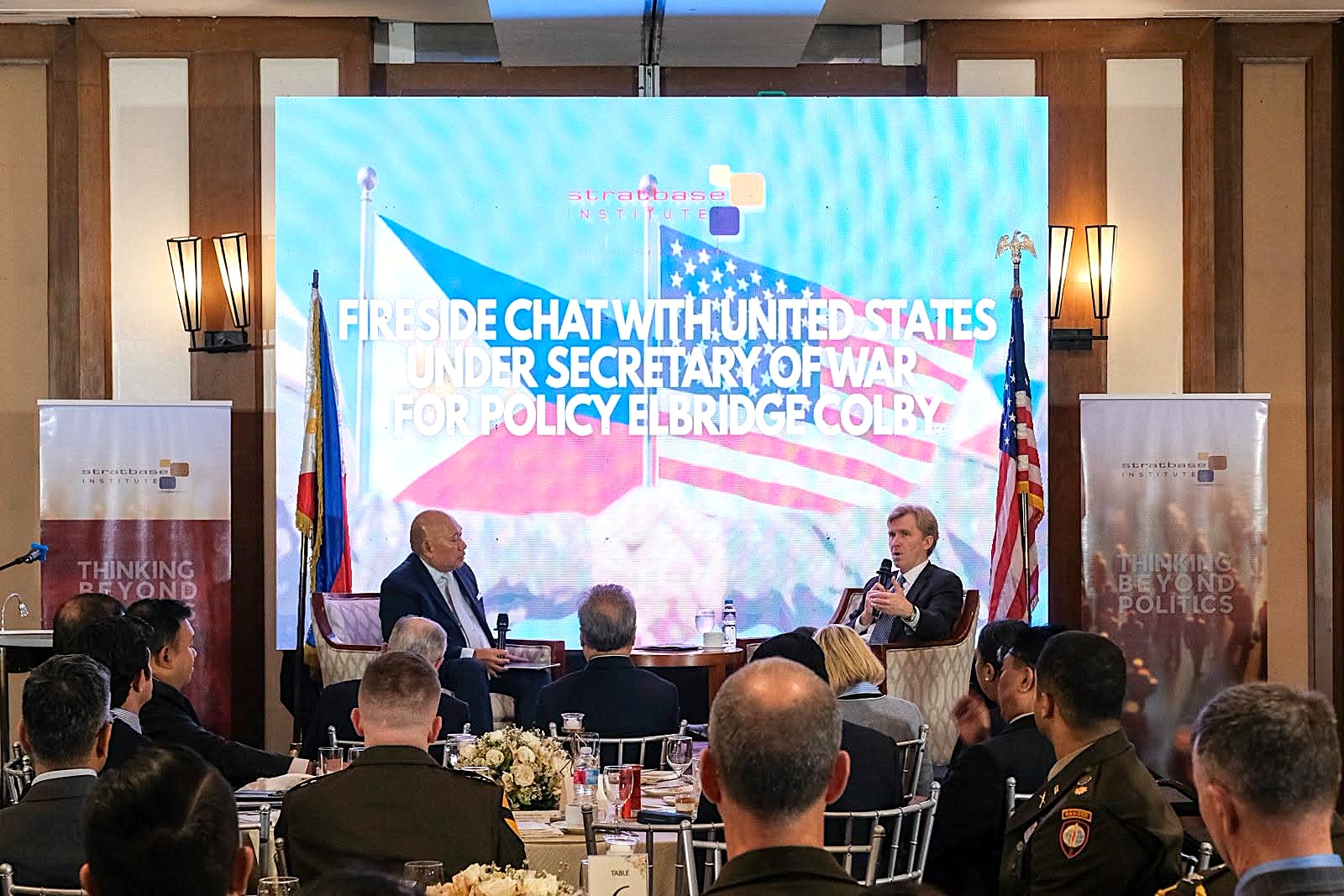
As U.S. President Donald Trump and Chinese leader Xi Jinping engaged in their summit pageantry in Washington, D.C., in late September, Beijing engaged in a renewed spate of coercive activities against the U.S. ally, the Philippines, in the South China Sea. Picture source: Stratbase Institute, August 11, 2026, Facebook, .
Prospects & Perspectives No. 54
Second Thomas Shoal Redux and Beijing’s Strategic Limitations
By Collin Koh
As U.S. President Donald Trump and Chinese leader Xi Jinping engaged in their summit pageantry in Washington, D.C., in late September, Beijing engaged in a renewed spate of coercive activities against the U.S. ally, the Philippines, in the South China Sea. This time, following a series of close brushes in Scarborough Shoal, the focus of attention has shifted back to another terrestrial feature located well within the Philippine exclusive economic zone but contested by the People’s Republic of China – Second Thomas Shoal.
One may recall that Second Thomas Shoal was the site of one of the most serious Sino-Philippine clashes back in June 2024. This incident was as close as the two countries (and potentially the U.S., given its mutual defense treaty obligations to Manila) came to war. It was also a key source of motivation behind the provisional understanding reached between Beijing and Manila the following month.
This provisional understanding, the details of which have not been made public, revolved around the Filipino rotational and resupply (RoRe) missions to the BRP Sierra Madre, a Philippine Navy landing ship which was grounded on Second Thomas Shoal in 1999 and which since serves as an outpost. While Beijing insisted that all RoRe missions would be granted under its permission and purview, Manila argued otherwise. Nonetheless, while both capitals pressed their own interpretations of this provisional understanding, the missions since then had been carried out smoothly with little issue, save for an incident in July.
The relative calm at Second Thomas Shoal, buttressed by this provisional understanding, is no more. As Trump and Xi wined and dined in Washington, Chinese forces obstructed the RoRe mission, forcing the Filipinos to temporarily suspend the attempt. Unlike in the past, this time Beijing had deployed the People’s Liberation Army Navy (PLAN) alongside its paramilitary forces, chiefly the China Coast Guard. This follows the pattern seen in Scarborough Shoal, where the PLAN no longer contents itself with lurking over the horizon while its “white hull” counterparts spearhead frontline maritime sovereignty and rights assertion duties. It is now part of the frontline.
A more active PLAN role in maritime coercion within the South China Sea may have been unique thus far in the context of the Sino-Philippine dispute in the West Philippine Sea. While PLAN assets were observed from time to time loitering in the exclusive economic zones of other concerned Southeast Asian parties, such as Indonesia, Malaysia and Vietnam, they did not engage in active assertion duties alongside the paramilitary forces. Against the Filipinos, Beijing has elected to demonstrate escalation dominance for two likely reasons.
More resilient and confident Philippines
Firstly, the Filipinos have proven themselves to be much more resilient than in the past. During the previous presidencies, especially across the 1990s to early 2000s, Manila had mainly chosen to appease Beijing, cognizant of its relative economic and military weakness. First, China’s seizure and then island-building on Mischief Reef, well within the Philippine EEZ, have been a watershed event. Manila focused on internal security while neglecting its West Philippine Sea (WPS) interests, the grounding of the BRP Sierra Madre in 1999 notwithstanding. Manila resolutely started to fight back in the aftermath of the April 2012 Scarborough Shoal incident, which led to a legal challenge launched against Beijing. The 2016 arbitral award, constituted under the auspices of the United Nations Convention on the Law of the Seas, marked a major turning point for the long string of previous setbacks for the Philippines – dealing a massive legal and reputational blow to the PRC.
The Rodrigo Duterte administration that governed the Philippines in 2016-2022 failed to capitalize on this instrumental legal victory. But the current Ferdinand Marcos Jr. administration chose to emphasize the arbitral award, which now serves as the chief legal basis for Manila’s pursuit of its WPS interests. This approach also involves the institutionalization of the assertive transparency strategy that aims to publicize Beijing’s coercive maritime behavior. Public support for the administration’s handling of the country’s WPS interests remains significantly high. At the same time, the Philippines enjoys access to greater diplomatic and security capacity-building support from extra-regional actors, mainly in the West.
In a major 180-degree shift from its previous internal security focus, the Philippines is now heavily invested in reinvigorating its external defense posture, mainly oriented at securing its WPS interests in the face of PRC aggression. Flush with newfound military and coastguard capabilities, Manila seeks to enforce the 2016 arbitral award by stepping up patrols at key WPS features, including Scarborough and Second Thomas Shoals despite confronting the PRC’s numerical supremacy. Beijing’s supposedly tried-and-tested formula of intimidating its weaker rivals through sheer numbers seems to have failed to gain traction with Manila judging from the persistent Filipino assertion of maritime presence at those features, in particular Scarborough Shoal where Philippine forces continue to defy PRC pressure to support Filipino fisherfolk operating in the vicinity – despite Beijing’s lawfare acts, such as unilaterally declaring a “national nature reserve” at the feature along with associated domestic legal instruments aimed at enforcing it.
Testing Trump’s red lines
The second reason is plausibly due to Beijing’s continued uncertainty about Washington’s commitments in the South China Sea. It is true that the ongoing Middle East conflict has sucked away significant American naval forces from the Pacific theatre, leaving a strategic-operational vacuum that not least unsettles U.S. allies and partners. Trump’s war with Iran, without any clear endgame in sight, opens up a strategic opportunity. Yet Beijing likely believes it still needs to prod for the red lines. Washington continues to openly proclaim its enduring commitment to the 1951 Mutual Defense Treaty with Manila. Despite its naval capacity shortfalls due to the Middle East diversion, American forces still participated substantially in the last Exercise Balikatan in the Philippines. When Undersecretary of War for Policy Elbridge Colby visited Manila in early August, he described the country as a “model ally” for stepping up military modernization efforts. When he remarked that Trump 2.0 is seeking stronger allies and partners not dependent on U.S. protection, he seemed to imply that the Philippines would need to hold up against the PRC on its own even more into future. Manila’s intensification of military engagements with foreign partners, besides its stepping up WPS patrols, checked those boxes. Filipino resilience demonstrated thus far surely earns the “model ally” title even if there remains a yawning PRC power preponderance.
Second Thomas Shoal is a key focal point for Beijing to test out Washington’s commitment to Manila. The Marcos Jr. administration has resisted offers for direct American involvement in the RoRe missions at the height of at-times violent incidents between Philippine and PRC forces in 2023-2024. The Americans stood up Task Force Ayungin in late 2024 to ostensibly support those missions and nothing more than that. It is therefore plausible that the PRC leadership seeks to decipher how far Washington would go in supporting its allies despite the current Middle East quagmire. That way, Beijing could have a better idea how Trump 2.0 would respond to potential contingencies across the various Indo-Pacific geopolitical flashpoints, not least Taiwan.
Vertical escalation
At the same time, it is also clear that Beijing has been exhausting its coercive toolkit against a more resilient Philippines. Its widening of strategic pressure against Manila across WPS flashpoints from Scarborough to Second Thomas Shoal represents more of a vertical than horizontal escalation. It behoves both Manila and Washington to be aware of this strategic limitation that confronts Beijing, and continue to step up resilience. For the Philippines, it means keeping up with assertive transparency and maintaining a robust presence across WPS.
For Washington, it means keeping up with tangible commitments to its security alliance with Manila, while encouraging other interested and likeminded regional and extra-regional actors to remain invested in South China Sea peace and stability.
(Collin Koh is senior fellow at the Institute of Defence and Strategic Studies, a constituent unit of the S. Rajaratnam School of International Studies based at Nanyang Technological University, Singapore.)
Related Content
Reading Korea’s Early Autumn Winds: Trump Abruptly Scales Down a Major Joint Exercise
In a Year of Global Upheaval, ASEAN Scrapes by, Divided but Resilient
Washington Reassures (and Worries) Taiwan
The G7 Leaders’ Summit in France: An Unexpected Success
What Does the U.S. War Against Iran Mean for the Indo-Pacific?
Implications of the U.S. Tariff Policy on Global Economics and Taiwan’s Response
Trump’s National Security Strategy and the Future of the World Order
President Trump’s National Security Strategy and Tensions Across the Taiwan Strait
The Honduran Presidential Election: Impact on Ties with Taiwan
Boycotts, Power Politics, and the Future of the G20
Recent U.S.-China-South Korea Summitry and Implications for Taiwan
Taiwan-U.S. Trade Talks: No Simple Way Ahead
 Facebook
  Youtube
  Twitter