

In a Year of Global Upheaval, ASEAN Scrapes by, Divided but Resilient


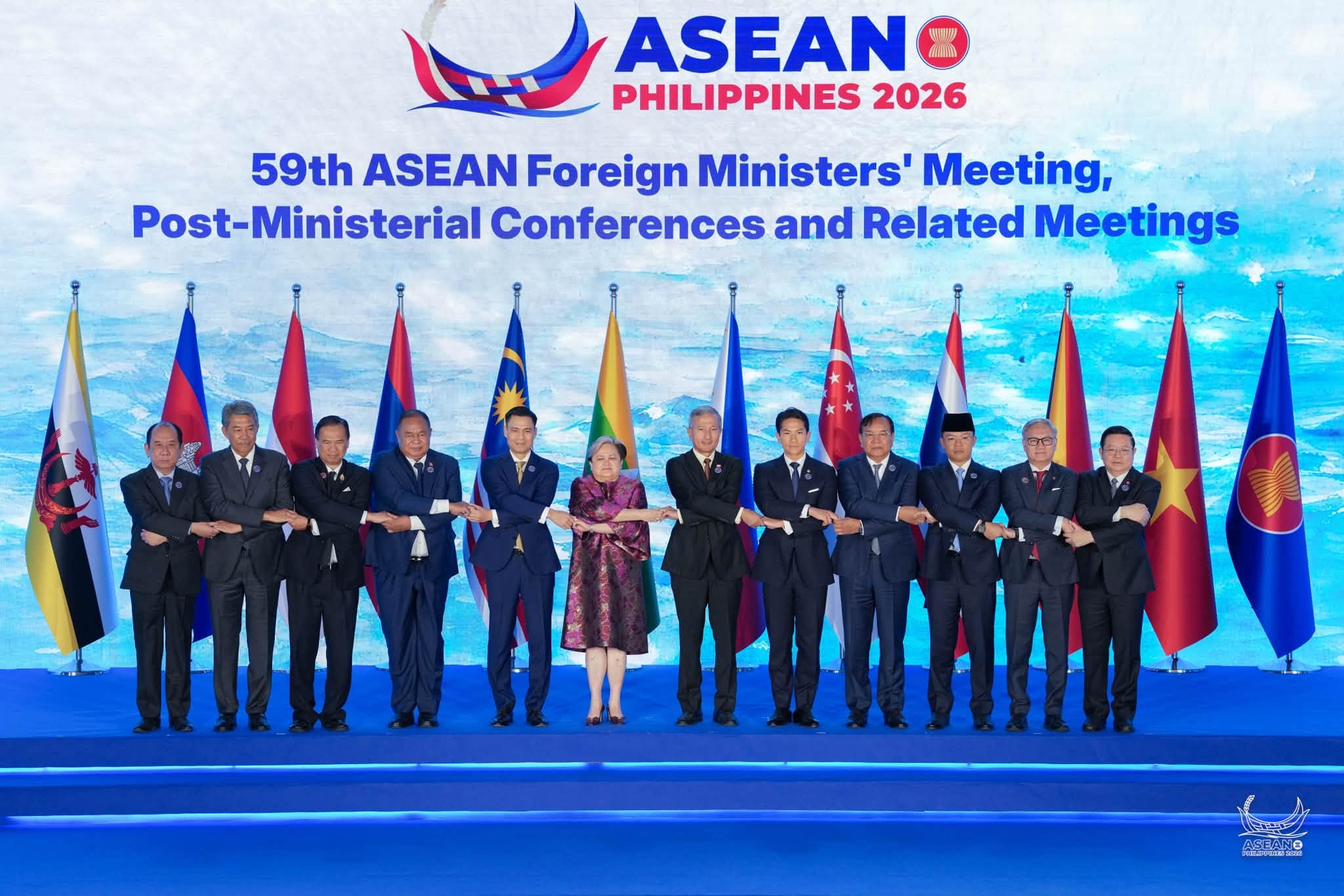
When Southeast Asia’s top diplomats gathered in Manila in July for the annual Association of Southeast Asian Nations (ASEAN) Foreign Ministers Meeting, there was a long list of pressing international issues testing the bloc’s unity and resilience against external shocks. Picture source: ASEAN 2026 PH, July 21, 2026, Facebook, https://www.facebook.com/photo.php?fbid=122137022853111248&set=pb.61583337463309.-2207520000&type=3.
Prospects & Perspectives No. 48
In a Year of Global Upheaval, ASEAN Scrapes by, Divided but Resilient
By Hunter Marston
When Southeast Asia’s top diplomats gathered in Manila in July for the annual Association of Southeast Asian Nations (ASEAN) Foreign Ministers Meeting, there was a long list of pressing international issues testing the bloc’s unity and resilience against external shocks.
Policymakers from across the region have been struggling to contain the economic fallout and political upheaval triggered by the rise in energy prices linked to ongoing conflict in the Middle East. The foreign ministers “expressed serious concern” about renewed fighting between the United States and Iran following the breakdown of the latest ceasefire in May. In a standalone statement focused on “the rapidly evolving situation in the Middle East,” the ministers urged restraint by all parties and upheld the importance of freedom of navigation and international law.
Maritime tensions surrounding the summit
The South China Sea remains a pressing concern for ASEAN member states but to varying degrees. For the Philippines, territorial disputes with China are a vital national security interest. In recent years, Beijing has ramped up its incursions into the Philippines’ exclusive economic zone, including regular patrols by the China Coast Guard (CCG) and maritime militia presence, as well as the use of other “illegal, coercive, aggressive, and deceptive” tactics to challenge Manila’s sovereignty.
For instance, China deployed what the Philippines called “a movable platform” near the opening of Scarborough Shoal in June, prompting Manila to submit a diplomatic protest to demand that Beijing remove the object.
The following month, as ASEAN ministers were gathering in Manila, Chinese and Philippine forces clashed near Second Thomas Shoal. Manila accused the Chinese personnel of causing a serious head injury to a Filipino service member after hitting him with a wooden baton. Days later, the Philippine Coast Guard said that a China Coast Guard vessel had directed a water cannon at a Philippine ship in a close and dangerous encounter around Scarborough Shoal.
Not all ASEAN member states share the Philippines’ concern, however. On the 10th anniversary of the Arbitral Tribunal’s ruling in the Philippines’ South China Sea case, no fellow ASEAN member made a reference to the ruling, though a group of 14 Western democracies, including the United States, United Kingdom, Canada, and Australia, released a statement reaffirming their support for the legally binding decision.
As usual, ASEAN included a brief reference to the situation in the South China Sea near the end of its joint communiqué which came out of the meeting. On page 38 (of 42), the communiqué noted that “concerns were expressed by some Ministers on the land reclamations, activities, serious incidents in the area, including actions that put the safety of all persons at risk…which have eroded trust and confidence, increased tensions, and may undermine peace, security, and stability in the region.”
The document also acknowledged members’ hopes that negotiations on a Code of Conduct for the South China Sea would be concluded by the end of the year, though it remains far from clear that such an agreement will materialize. Even if ASEAN and China successfully conclude a Code of Conduct by the end of the year, most analysts doubt it will be legally binding and therefore expect it to have little practical impact on the situation.
Myanmar continues to rend ASEAN
The ongoing crisis in Myanmar is another delicate subject for ASEAN, which remains divided over how to resolve the civil war which has raged since the February 2021 coup. Myanmar’s former commander-in-chief Min Aung Hlaing has been on a diplomatic charm offensive since becoming president following largely unopposed elections in January. He has visited India, China, Russia, Laos, and Thailand in an effort to secure political legitimacy.
While Thailand has been urging ASEAN to reengage Naypyitaw, Philippine Secretary of Foreign Affairs Maria Theresa Lazaro, who is concurrently special envoy for Myanmar, insists that Myanmar’s normalization is “still far off.”
In their communiqué ASEAN members expressed “deep concern” over the ongoing conflict in Myanmar and reaffirmed their position that the Five Point Consensus, which calls on all parties to cease fighting and engage in dialogue, remains the preferred path to a diplomatic resolution.
However, Naypyitaw has rejected the consensus, which it characterizes as a violation of ASEAN’s norm of non-interference in the internal affairs of member states.
What is ASEAN’s role amidst a fraying global order?
More broadly, the summit brought together top diplomats from China, Russia, and the United States who attended the East Asia Summit Foreign Ministers Meeting and engaged in sideline meetings. Chinese Foreign Minister Wang Yi and U.S. Secretary of State Marco Rubio met to discuss Chinese leader Xi Jinping’s upcoming visit to Washington at the end of September. While tensions between the Philippines and China in the South China Sea risked overshadowing the meeting, the Trump administration has softened its criticism of Beijing in the run-up to the summit.
Whether ASEAN succeeds in maintaining agency amidst global disorder presents a Rorschach test for regional analysts. Critics will continue to deride the bloc as weak and ineffectual, while its defenders will insist it remains essential to resolving issues of collective interest.
The summit shows that both sides of the debate may be right. ASEAN’s detractors are correct that the regional bloc has failed to resolve some of the thorniest security issues of the day, including territorial disputes in the South China Sea and the unending conflict in Myanmar. On the other hand, the fact that senior officials from the world’s most powerful countries opted to travel to Manila for the summit at all suggests that global support for multilateral institutions remains strong.
For now, it seems that ASEAN still has a role to play. Whether it eventually finds the will and wherewithal to play a more robust role in regional security remains in question, though in this era of geopolitical uncertainty a more involved and coherent ASEAN could offer much-needed support to the embattled regional order.
(Hunter S. Marston is Director of the Southeast Asia Program and Project Lead for the Asia Power Index at the Lowy Institute.)
Related Content
Re-Establishing Deterrence in Taiwan’s Maritime Periphery Following the China-Indonesia Naval Exercise
China’s Naval Projection Sends Important Signals Across the Indo Pacific
The 2024 Shangri-La Dialogue and its Aftermath
Elections in India and Indonesia: Implications for the Indo-Pacific
Second Thomas Shoal Redux and Beijing’s Strategic Limitations

The BRICS Summit 2026: Cracks and Momentum Amid Global Instability
The Pacific Islands Forum’s Leaders Meeting in Palau: Steering a Course Between Charybdis and Scylla?

The G7 Leaders’ Summit in France: An Unexpected Success

Maritime Security in Southeast Asia: Still Business as Usual?
What Does the U.S. War Against Iran Mean for the Indo-Pacific?
Japan’s High-Stakes Snap Election and Japan’s Role in the Indo-Pacific
The Indo-Pacific and the U.S. National Defense Strategy: From Rebalancing to Retrenchment
 Facebook
  Youtube
  Twitter