



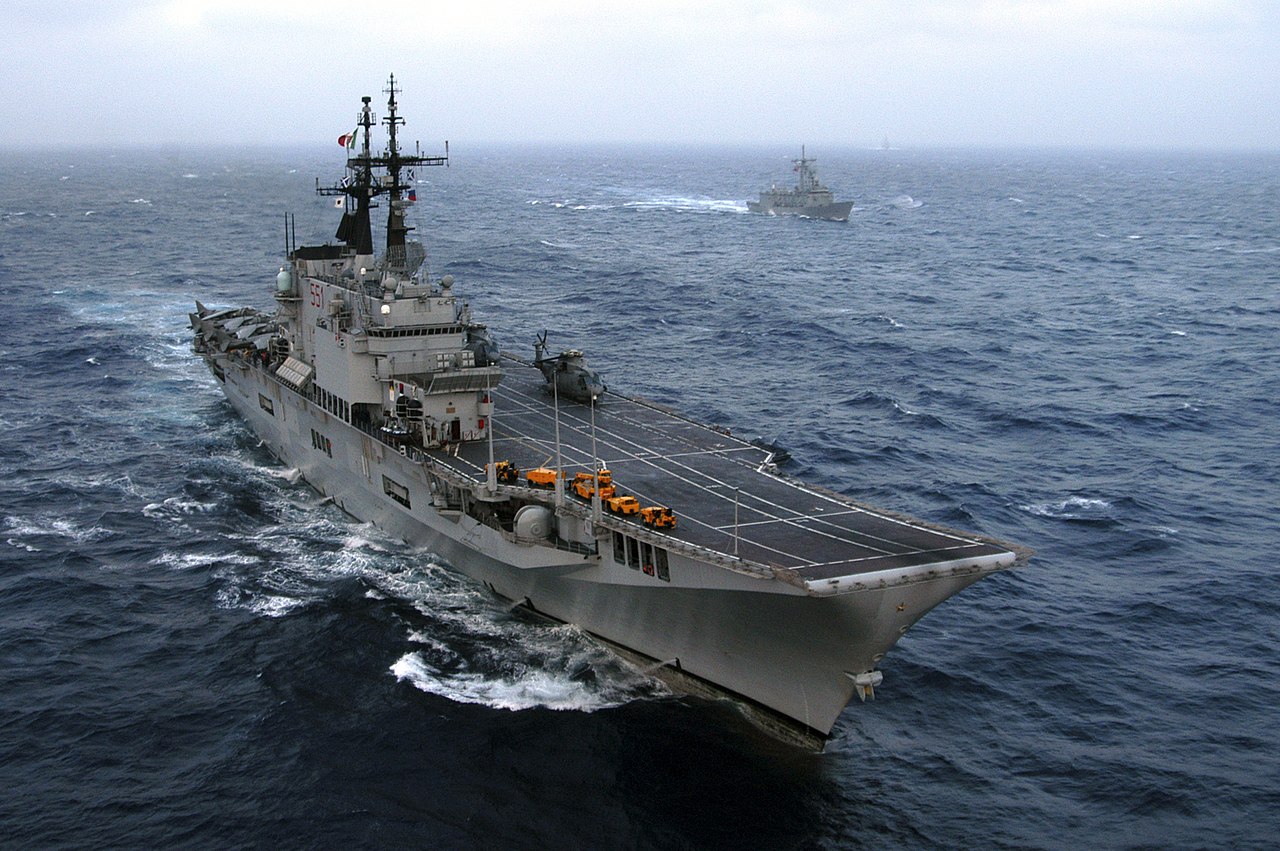
Hegseth’s call at this year’s Shangri-La Dialogue for “less Shangri-La, more ships, more subs” and praising some Southeast Asian countries notwithstanding, ultimately, where choices have to be made, Southeast Asian political elites controlling the state coffers would be more sensitive to election cycles and hence prioritize socioeconomic well-being over substantially increasing and sustaining defense investment. Picture source: U.S. Navy, July 12, 2004, Wikipedia, https://en.wikipedia.org/wiki/Italian_aircraft_carrier_Giuseppe_Garibaldi.
Prospects & Perspectives No. 33
Maritime Security in Southeast Asia:
Still Business as Usual?
By Collin Koh
The interim Iran-U.S. deal to end the war has come as a major relief to Southeast Asian countries that are grappling with the economic impact of the energy supply shocks. As recently as late May, the downbeat tone struck at the Shangri-La Dialogue that was held in the very same region. Multiple crises around the world – the Middle East and Ukraine, flashpoints over Taiwan and the Korean Peninsula – constitute enough reasons for countries to rearm. After all, Europe is rearming; what about countries in the Indo-Pacific?
Perhaps not so for Southeast Asia. Or maybe a better descriptor is that it is more nuanced.
A spotty history of defense investment
At the last Shangri-La Dialogue, U.S. Secretary of War Pete Hegseth brought along more or less the same message he had used during last year’s iteration: allies need to spend more on defense and not expect Washington to solely underwrite global security. Indo-Pacific allies, such as Japan and the Republic of Korea, were lauded for doing their part, whereas European allies were admonished. Surprisingly, even some Southeast Asian countries were singled out for praise.
And that is a rarity of sorts. Southeast Asia has never been customarily identified as a noteworthy role model for defense investments. Given its diverse and complex geography, Southeast Asia is never a monolithic strategic construct but a collection of many different sovereign and independent nation-states each with its own extant national interests that very well dictate their defense and security priorities. Yet there is one consistent pattern: many in Southeast Asia have chronically underspent on defense. It does not help that economic crises from time to time put the brakes on defense spending and military procurement. The Asian Financial Crisis in 1997-1998 is a good example.
The maritime geography of Southeast Asia, and the prevalence of the maritime dimension in the various Indo-Pacific flashpoints, decidedly shapes contemporary defense and security investments in the region. This trend toward favoring maritime forces, which started since the end of the Cold War, has been more or less maintained throughout the recent two decades and looks set to persist. And it is in this area that we witness some of the most significant capability modernization efforts.
Classical threat perceptions do not always serve as the primary motivation in Southeast Asia. The discourse about some sort of naval arms race in Southeast Asia in the earlier decades was entirely misplaced: none of this sort ever happened and at best, limited forms of arms competition would be a better way to describe those dynamics. Threat perceptions over the past two decades have largely been shaped by a general sense of regional uncertainty, and the desire to “catch up with the Joneses” vis-à-vis regional peers. Conflicts faraway from Southeast Asia play an outsized role in shaping arms dynamics. If anything, the outbreak of war in Ukraine serves as a new catalyst for regional modernization efforts since 2022.
We also must not forget the growing specter of kinetic conflicts erupting in the region, such as the case of Taiwan. At the last Shangri-La Dialogue, for instance, Lieutenant General Bambang Trisnohadi, Chief of Staff, Territorial Affairs, Indonesian National Armed Forces was especially candid when he stressed the need to enhance the country’s “diplomatic, military and economic resilience in order to withstand this pressure” from external partners over securing access to vital sea lines of communications in times of a hypothetical Taiwan conflict. Indonesia is not alone in Southeast Asia seeking to improve “resilience” via military, not least, maritime forces buildup.
Yet it would be a huge mistake to view such efforts to date as transformative for Southeast Asia. Qualitative enhancement to Southeast Asian fleets, be it navy or coastguard, is real. Yet it is far from transformative as one might imagine.
Still traditional, not transformative
Despite all the upbeat talk about the game-changing nature of drone warfare since 2022, Southeast Asia has been painfully slow in procuring unmanned systems, both air and maritime, on a significant scale. In this sector, unmanned aerial systems have dominated due to their importance for maritime domain awareness. Otherwise, where unmanned maritime systems are concerned, progress is slow and uneven. Indonesia inducted its latest indigenous unmanned undersea vehicle capable of launching lightweight torpedoes. The Philippines, due to the exigency of its South China Sea tensions with the People’s Republic of China (PRC), has steadily been inducting unmanned sea vehicles. Singapore arguably stood out with a concerted manned-unmanned systems approach, with its Multi-Role Combat Vessel (MRCV), the navy’s largest surface combatant ever developed to date locally, designed to serve as a drone mothership.
Drones are indeed not the central focus of Southeast Asia’s naval buildup; manned platforms are, and for good reason. Much of the region’s surface fleets are in need of recapitalization, in some cases the situation is dire, to say the least. Unmanned systems take time to integrate within the existing traditional naval system architectures, and it is uncertain whether they can fully supplant manned platforms in fulfilling many of the longstanding mission mandates for regional navies and coastguards.
Procurement priorities observed to date are instructive. The Indonesian Navy recently commissioned a pair of former Italian multipurpose combat vessels, and the country is building its largest surface combatant, the Balaputradewa-class “Red and White Frigate.” Most notably, it has also purchased a second-hand aircraft carrier from Italy. Malaysia advanced its long-delayed Littoral Combat Ship program and launched two of its new quartet of Littoral Mission Ship Batch-II in a Turkish yard. Myanmar, often mistakenly viewed as solely preoccupied with security woes on land, is churning out new surface combatants in its shipyards, including a new class of guided-missile frigate. Singapore is not only building the MRCVs, but also has a new offshore patrol vessel program being implemented at a German yard. Thailand is now shortlisting candidates to build a new frigate. Even Cambodia, which recently fought a border clash with Thailand, is inducting new PRC-built corvettes.
The undersea domain is yet another arena. Notwithstanding the discourse on securing critical undersea infrastructure (CUI) since the Baltic Sea incidents in 2022, Southeast Asia’s primary answer: more submarines. Conflating submarine procurement with the desire for CUI protection would be a huge mistake. On the sidelines of the Shangri-La Dialogue, some Southeast Asian countries along with Australia, New Zealand, European powers and Qatar signed onto the Guiding Principles for Underwater Infrastructure Defence Exchanges (GUIDE). This framework is less likely to evolve into a concrete action plan for securing CUI than regional states are to continue pursuing submarines.
Missing the forest for the trees
The story can go on about how Southeast Asia’s maritime security emphasis remains still short of transformative to adequately meet emerging challenges. What truly needs to transform is defense and security governance – not least for capital-intensive maritime forces buildup that consumes so much of the budgets.
Defense planning for many in the region is not necessarily carried out in the most prudent and well thought-out manner. Procurements from a bewildering array of suppliers, misgovernance in the defense sector – especially endemic corruption – impose significant fiscal, logistical and operational consequences. It is true that on average, the latest warship that enters service of any Southeast Asian navy is larger and more capable than the one it is designed to replace. Yet it is one thing to have a spanking new warship, quite another about the availability of fuel supplies to keep it underway when it is the most needed.
Hence, Hegseth’s call at this year’s Shangri-La Dialogue for “less Shangri-La, more ships, more subs” and praising some Southeast Asian countries notwithstanding, ultimately, where choices have to be made, Southeast Asian political elites controlling the state coffers would be more sensitive to election cycles and hence prioritize socioeconomic well-being over substantially increasing and sustaining defense investment. Finally, the fact of the matter is that without necessary defense and security governance reforms, Southeast Asia’s maritime security capacity-building looks set to remain uneven and piecemeal in some areas. There will still be headlines-splashing news about the procurement of spanking new warships and submarines, yet Southeast Asia will continue to confront persistent maritime security gaps.
(Collin Koh is Senior Fellow at the Institute of Defence and Strategic Studies, a constituent unit of the S. Rajaratnam School of International Studies based at Nanyang Technological University, Singapore.)
Related Content
Re-Establishing Deterrence in Taiwan’s Maritime Periphery Following the China-Indonesia Naval Exercise
In a Year of Global Upheaval, ASEAN Scrapes by, Divided but Resilient
The G7 Leaders’ Summit in France: An Unexpected Success

What Does the U.S. War Against Iran Mean for the Indo-Pacific?
Japan’s High-Stakes Snap Election and Japan’s Role in the Indo-Pacific

The Indo-Pacific and the U.S. National Defense Strategy: From Rebalancing to Retrenchment

The “Justice Mission 2025” PLA Exercise and Japan’s National Security
Trump’s National Security Strategy and the Future of the World Order
Old Partners and New Friends: Despite Steady Growth, Taiwan-Europe Relations Need ‘Futureproofing’

President Trump’s National Security Strategy and Tensions Across the Taiwan Strait

Implications of the U.S.-Australia Summit’s Enhanced Bilateral Cooperation for the Indo-Pacific
The Harder They Fall: Strategies for Countering Russia and China
 Facebook
  Youtube
  Twitter