

Japan’s High-Stakes Snap Election and Japan’s Role in the Indo-Pacific



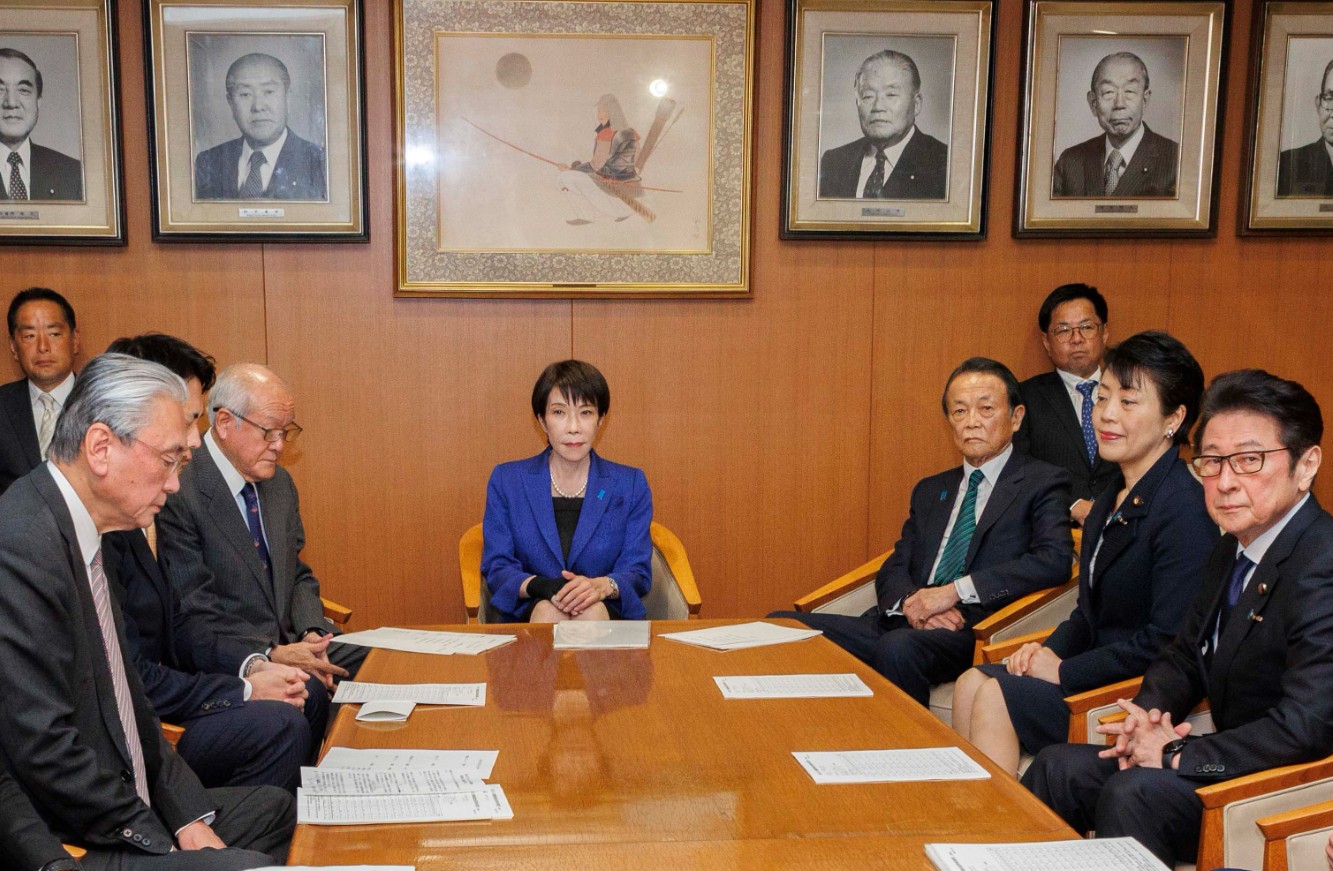
The February snap election locks in Takaichi’s position and extends Japan’s trajectory as a pivotal, conservative Indo-Pacific actor; the strategic question is whether her government can translate this compressed, surprise-driven victory into a sustainable domestic consensus that can carry Japan through the sharper great-power competition. Picture source: 【公認】チームサナエが日本を変える, December 19, 2026, X, https://x.com/TakaichiKoenkai/status/2024400447432511925/photo/4.
Prospects & Perspectives No. 12
Japan’s High-Stakes Snap Election and Japan’s Role in the Indo-Pacific
By Athena Tong
Takaichi Sanae’s February snap election has handed her a markedly strong domestic mandate, positioned to reinforce Japan’s path as a security actor in the Indo-Pacific. This result not only strengthens her position at home but also raises the stakes and expectations among partners, especially regarding Taiwan, economic security, and defense burden-sharing.
The gamble that paid off
Takaichi dissolved the Lower House on January 23 and scheduled the election for February 8, resulting in the shortest post-war campaign on record, surprising even many in her own party. Notably, this was also Japan’s first winter Lower House election in 36 years.
Officially, she cited the need for a renewed mandate for her cabinet and coalition (formed in October 2025), as well as for her inflation-focused spending plans, which had unsettled markets. However, the timing seemed designed to capitalize on her soaring approval ratings (around 70%) and to head off any gradual decline in support amid mounting economic concerns and China-related tensions.
The timing had a marked effect on voter behavior. Perhaps due to the inclement weather, early voting hit unprecedented levels, with a record 27,017,098 people casting their ballots in advance. This accounted for 26.1% of all eligible voters as of January 26, an increase of nearly 6% compared with the previous Lower House election.
The gamble paid off. The Liberal Democratic Party (LDP) on its own took 316 of 465 seats, the first time since 1945 that a single party has secured a two-thirds majority in the Lower House. The Takaichi administration will be able to override the Upper House on most legislation and can initiate constitutional revision processes, particularly around Article 9, provided she can maintain intra-party cohesion; although the LDP will still need to secure a two-thirds majority in the Upper House and a referendum to guarantee a formal revision.
The victory was largely a personal mandate, with many disaffected conservatives and younger voters returning to support the LDP under Takaichi, while some opposition voters unhappy with party realignments, like the new Centrist Reform Alliance, stayed home or voted for other candidates. Takaichi is now, in the short term, significantly insulated from factional challenges that might otherwise have tried to replace her before the next regular election.
This mandate is hardly a carte blanche, though. Polls show that voters were focused above all on daily concerns like the cost of living, with security coming second; abstract issues such as constitutional revision or identity politics trailed far behind. In many ways, the landslide reflects the opposition’s weakness and fragmentation more than it does a sweeping endorsement of every plank in Takaichi’s conservative agenda.
Security mandate and Indo-Pacific signaling
Takaichi entered the campaign already closely associated with a sharper line on China and an unusually explicit linkage between Taiwan’s security and Japan’s own survival. Her speech in the Diet in November 2025 indicated that a Chinese attack or blockade of Taiwan could constitute a “survival-threatening situation” under Japan’s security laws, a major step away from the previous de facto strategic ambiguity.
Chinese foreign ministry spokespeople depicted her remarks as gross interference, warning that Japan would be treated as an aggressor if it “dared” to intervene militarily in a cross-Strait crisis.
Against that backdrop, the snap election result looks like an endorsement of continuity and even acceleration in Japan’s Indo-Pacific role:
- Taiwan contingency planning. With a stronger Lower House position, Takaichi is better placed to push incremental but politically sensitive adjustments around base use, host-nation support, and legal authorities for rear-area support in a Taiwan contingency, even if she stops short of explicit “collective self-defense for Taiwan.”
- Alliance burden-sharing. The United States has been pressing Tokyo to move faster on munitions stockpiles, cyber and space capabilities, and integration into allied command-and-control; a two-thirds majority would reduce legislative friction for the budgetary and institutional reforms needed to meet these expectations.
- Mini-lateral security networking. Japan remains a stable anchor for Indo-Pacific mini-lateralism, for QUAD and AUKUS-adjacent cooperation, and for infrastructure or economic security “mini-lats,” all of which are easier to sustain when Tokyo’s leadership appears durable.
At the same time, the election result likewise sharpens anxieties in Beijing. Beijing has already responded to Takaichi’s Taiwan comments with economic measures and cultural/people-to-people restrictions, and the LDP’s landslide victory will likely be seen as “anti-China” stances winning votes in Japan. That perception could harden Beijing’s stance, making de-escalation more difficult and strengthening a narrative of zero-sum competition in the East China Sea and Taiwan Strait.
Domestic fault lines and long-term Indo-Pacific impact
The February election continues a trend that’s been apparent since the late Abe years: Japan’s foreign and security policy is relatively unified and driven by elites, while domestic socioeconomic issues still lack adequate attention. Smaller opposition parties such as Sanseito and the Democratic Party for the People gained traction by channelling voter frustration over inflation and cost‑of‑living pressures, but fragmentation among the opposition and a snap-election timetable constrained in‑depth policy debate. Takaichi’s campaign messaging leaned heavily on stability, crisis management, and continuity with Abenomics‑style policies, offering fewer detailed new economic measures than her broader promises might suggest. Out of this context, three deeper tensions emerge for Japan’s Indo-Pacific ambitions.
First, there is a gap between strategic ambition and domestic capacity. Raising defense spending, hardening infrastructure, and diversifying supply chains are all capital-intensive; doing them while an aging society also demands more social spending will force tradeoffs that no 16-day campaign can resolve. Failure to manage that trade-off risks fueling a future anti-military or anti-alliance backlash that could weaken the very Indo-Pacific commitments being expanded today.
Second, there is a narrative vulnerability. Takaichi’s landslide will intensify China’s information operations that depict her as a reckless, externally controlled hawk whose Taiwan stance endangers the ordinary Japanese public. If domestic scandals, an economic slowdown, or an incident in the East China Sea occur, Beijing and aligned media will be quick to frame any resulting discontent among the Japanese public as a repudiation of “confrontational” Indo-Pacific policies rather than of her domestic governance. Managing that cognitive battleground will be as important as the hardware of deterrence.
Third, as Japan becomes a more central security actor in the region, partners will expect it to lead norm-setting on matters such as economic security, critical infrastructure security, and digital governance. This opens space for Tokyo to shape Indo-Pacific rules on everything from rare earths to undersea cables and data flows, but it also exposes it to criticism if its domestic politics on immigration, civil liberties, or historical memory are seen as out of sync with the image it projects abroad.
Taken together, the February snap election locks in Takaichi’s position and extends Japan’s trajectory as a pivotal, conservative Indo-Pacific actor; the strategic question is whether her government can translate this compressed, surprise-driven victory into a sustainable domestic consensus that can carry Japan through the sharper great-power competition that her own Taiwan and China policies are helping to crystalize.
(Athena Tong is a Visiting Researcher at the University of Tokyo, a Research Associate and Program Lead at the China Strategic Risks Institute, and a Non-resident Vasey Fellow at Pacific Forum.)
Related Content
Japan-Taiwan Relations After the Japanese House of Representatives Election
The “Justice Mission 2025” PLA Exercise and Japan’s National Security
Re-Establishing Deterrence in Taiwan’s Maritime Periphery Following the China-Indonesia Naval Exercise
In a Year of Global Upheaval, ASEAN Scrapes by, Divided but Resilient
The G7 Leaders’ Summit in France: An Unexpected Success

Maritime Security in Southeast Asia: Still Business as Usual?

What Does the U.S. War Against Iran Mean for the Indo-Pacific?
The Indo-Pacific and the U.S. National Defense Strategy: From Rebalancing to Retrenchment

Trump’s National Security Strategy and the Future of the World Order
Old Partners and New Friends: Despite Steady Growth, Taiwan-Europe Relations Need ‘Futureproofing’
President Trump’s National Security Strategy and Tensions Across the Taiwan Strait

Prime Minister Takaichi’s First Test in the Face of China’s Anger
 Facebook
  Youtube
  Twitter