


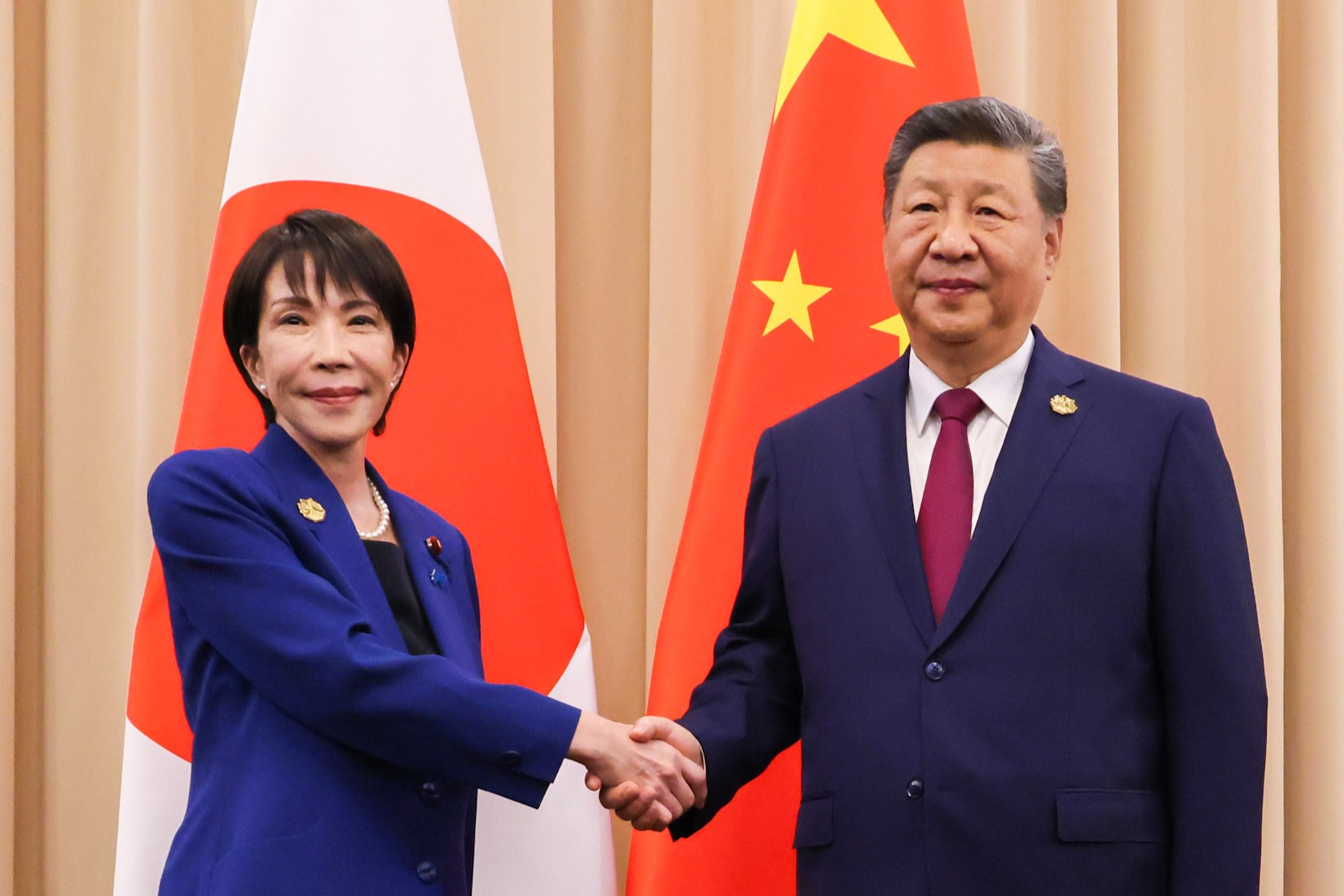
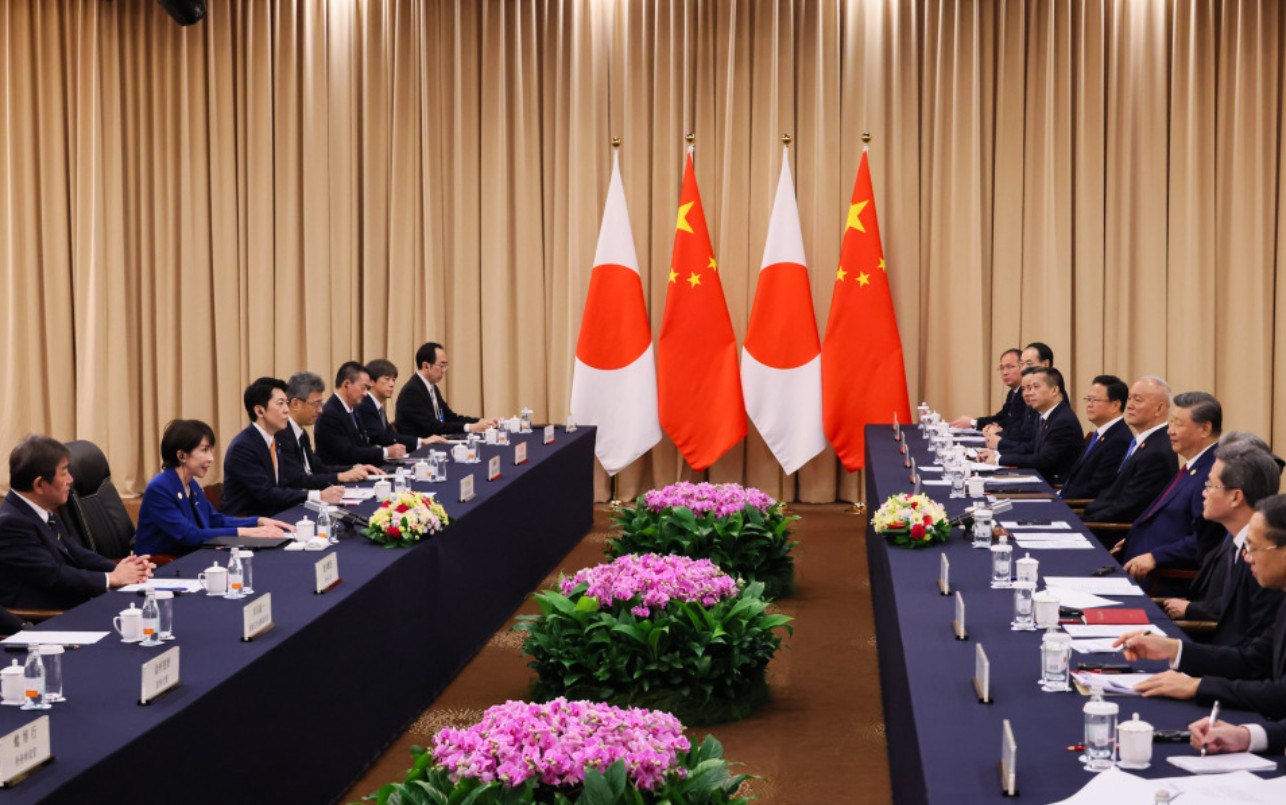
In her response to an opposition lawmaker’s question in the Diet on Nov. 7, Japanese Prime Minister Sanae Takaichi stated that a military contingency in the Taiwan Strait would represent “a situation threatening Japan’s survival.” The remarks were widely seen as an indication of the conditions that could compel the Japanese military to become involved in a conflict over Taiwan. Picture source: 首相官邸ホームページ, October 31, 2025, Wikipedia, https://en.wikipedia.org/wiki/Sanae_Takaichi#/media/File:Japan-China_Summit_Meeting_at_the_APEC_South_Korea_2025_(cropped).jpg.
Prospects & Perspectives No. 67
Prime Minister Takaichi’s First Test in the Face of China’s Anger
By Wen-Sheng Hsieh
Overview of the incident
In her response to an opposition lawmaker’s question in the Diet on Nov. 7, Japanese Prime Minister Sanae Takaichi stated that a military contingency in the Taiwan Strait would represent “a situation threatening Japan’s survival.” The remarks were widely seen as an indication of the conditions that could compel the Japanese military to become involved in a conflict over Taiwan. The next day, Xue Jian, Consul of China to Japan, posted a comment on X implying that Prime Minister Takaichi should be beheaded for daring to make this remark. This provoked anger among both Japan’s ruling and opposition parties, as well as the general public, with many calling for Xue’s expulsion from the country.
The Chinese government began boycott actions against Japan on Nov. 13, and summoned the Japanese ambassador to China to lodge a protest. Chinese officials recommended “postponing or delaying” travel to Japan, city-to-city exchanges, and upcoming movies or cultural events. Imports of Japanese seafood and beef, which had previously been reopened, were “technically” suspended, citing reasons such as incomplete documentation.
The Chinese government has also delayed the Trilateral Meeting of Culture Ministers among China, Japan, and Korea in Macau, as well as the China–Japan–Korea trilateral summit that was scheduled to take place in Japan. It even invoked the “Enemy State Clause” in the UN Charter to criticize Japan, even though the clause was annulled by the UN General Assembly in 1995, with China itself supporting the annulment.
With Prime Minister Takaichi refusing to retract her remarks, the incident entered its third week on Nov. 23. China again escalated in its response, including the first public statement by China’s Minister of Foreign Affairs Wang Yi. During a phone call on Nov. 24, Chinese leader Xi Jinping hinted to U.S. President Donald Trump that the United States should not intervene in affairs concerning the Taiwan Strait.
China’s reactions up to November 25
Takaichi, a right-winger, became the Liberal Democratic Party (LDP) president in October. Shortly thereafter, the Komeito Party, which had long served as a moderating counterbalance, withdrew from the ruling coalition. Personal and political networks between China and the Takaichi administration are extremely weak. The Chinese government had planned to foster a healthy relationship with Takaichi as a way to counterbalance the returning Trump administration. That is why at the end of October, Xi and Takaichi held a summit in South Korea, where the atmosphere was quite positive.
As a diplomat, Xue Jian’s comment crossed a red line. His comments were ostensibly made in his personal capacity to curry favor with the Chinese leadership back home. Despite the Chinese government’s fierce criticism of Takaichi, the fact that Xue quickly deleted the online comment and has since kept silent supports that theory.
After remaining largely silent for nearly a week, the Chinese government finally launched its “boycott” measures. This interval was likely spent determining how to frame and characterize the incident, as well as preparing for its countermeasures.
However, China’s initial boycotts merely recommended postponements or imposed “technical” suspensions, rather than using the stronger language of “bans” or “cutoffs” seen in the past. These measures were flexible — potentially escalatory but also reversible — and clearly suggested an intention to “test” the limits of the Takaichi administration.
Japan’s reaction
Prime Minister Takaichi maintains that her remarks did not go beyond the positions held by previous administrations. Therefore, she not only refused to retract her statement in the Diet, but it is also highly unlikely that she would do so under pressure from China. Otherwise, it could not only endanger her administration but also leave Japan subject to Chinese coercion in future.
After China began escalating the situation, Takaichi appeared to choose a low-key, cooling-off approach while extending gestures of goodwill toward Beijing. Among other things, she stated that she would no longer comment on specific cases and that she had no intention of presenting her views as the government’s “unified position.” She also reiterated that the advancement of the “strategic mutually beneficial relationship” between Japan and China — discussed during her Oct. 31 meeting with Xi — remains “unchanged.”
Meanwhile, both the opposition Komeito Party and the Constitutional Democratic Party sought, in their own ways, to prompt Takaichi to reaffirm that Japan’s position on Taiwan has not changed, in hopes of securing China’s understanding and thereby resolving the standoff.
International reactions and possible future developments
The United States, through its ambassador to Japan, has actively reaffirmed that the U.S.–Japan alliance remains rock solid.
However, although President Trump personally requested phone calls with both Xi and Takaichi, he has so far maintained an outsider’s posture toward the recent tensions between Japan and China, refraining from expressing any clear public stance. His position appears to be that both sides should exercise restraint.
Following Wang Yi’s public remarks, China noticeably shifted toward addressing the international community — including the UN, the International Atomic Energy Agency (IAEA), and World War II Allied Powers such as the U.S., the UK, and France — in an effort to portray the Takaichi administration as steering Japan back toward militarism.
Yet none of these countries echoed Beijing’s narrative; instead, they urged China to show restraint and emphasized the importance of peace in the Taiwan Strait.
Elsewhere in Asia, Vietnam and Thailand both recently issued public statements underscoring the importance of peace and stability in the Taiwan Strait for the region, calling on all parties to contribute constructively to regional peace and development.
In addition, China sought to use the Dokdo/Takeshima issue to court South Korea, but Seoul did not follow its lead. Given that President Lee Jae-myung currently maintains good relations with both Chinese and Japanese leaders, South Korea may be positioned to play a key mediating role.
At the end of the day, China needs Japanese investment, but its increasingly security-first approach has left it in a difficult position. As a result, Beijing has little choice but to continue escalating pressure on Japan while hoping that Sanae Takaichi will eventually offer a justification that allows China to climb down.
Originally, had the situation begun to show signs of becoming prolonged, China might have opted to launch military exercises similar to those conducted after U.S. House Speaker Nancy Pelosi’s 2022 visit to Taiwan — both to test and delineate Japan’s new thresholds for “situations threatening Japan’s survival” and to create a face-saving off-ramp for itself. This is an aspect that Taiwan should pay particular attention to. However, following Trump’s phone conversation with Xi, the likelihood of such a move now appears to have dropped considerably.
(Wen-Sheng Hsieh is Secretary-General, Taiwan National Policy Research Association.)
Related Content
Compromises in Domestic Politics and Foreign Policy: The Aftereffects of Takaichi’s Victory in the LDP Presidential Election
Japan’s High-Stakes Snap Election and Japan’s Role in the Indo-Pacific
Japan-Taiwan Relations After the Japanese House of Representatives Election
The “Justice Mission 2025” PLA Exercise and Japan’s National Security
PM Kishida’s State Visit to Washington: Impact on the Alliance and the Indo-Pacific
 Facebook
  Youtube
  Twitter