

The Indo-Pacific and the U.S. National Defense Strategy: From Rebalancing to Retrenchment


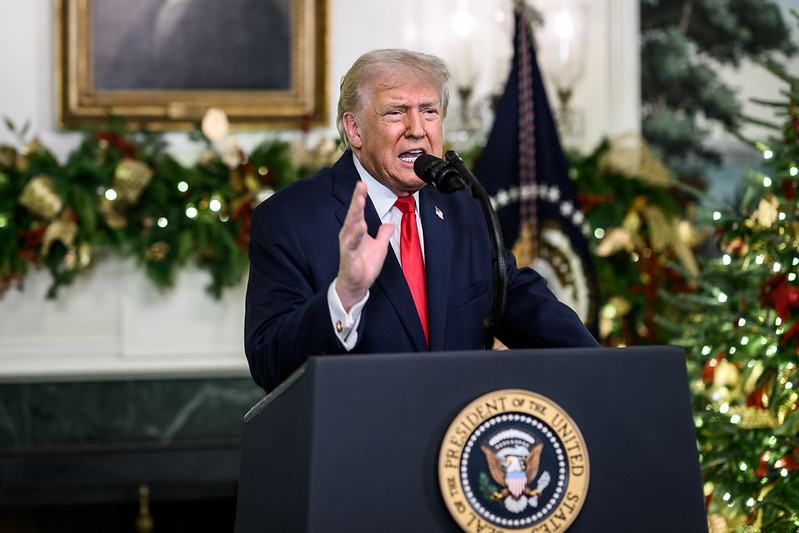
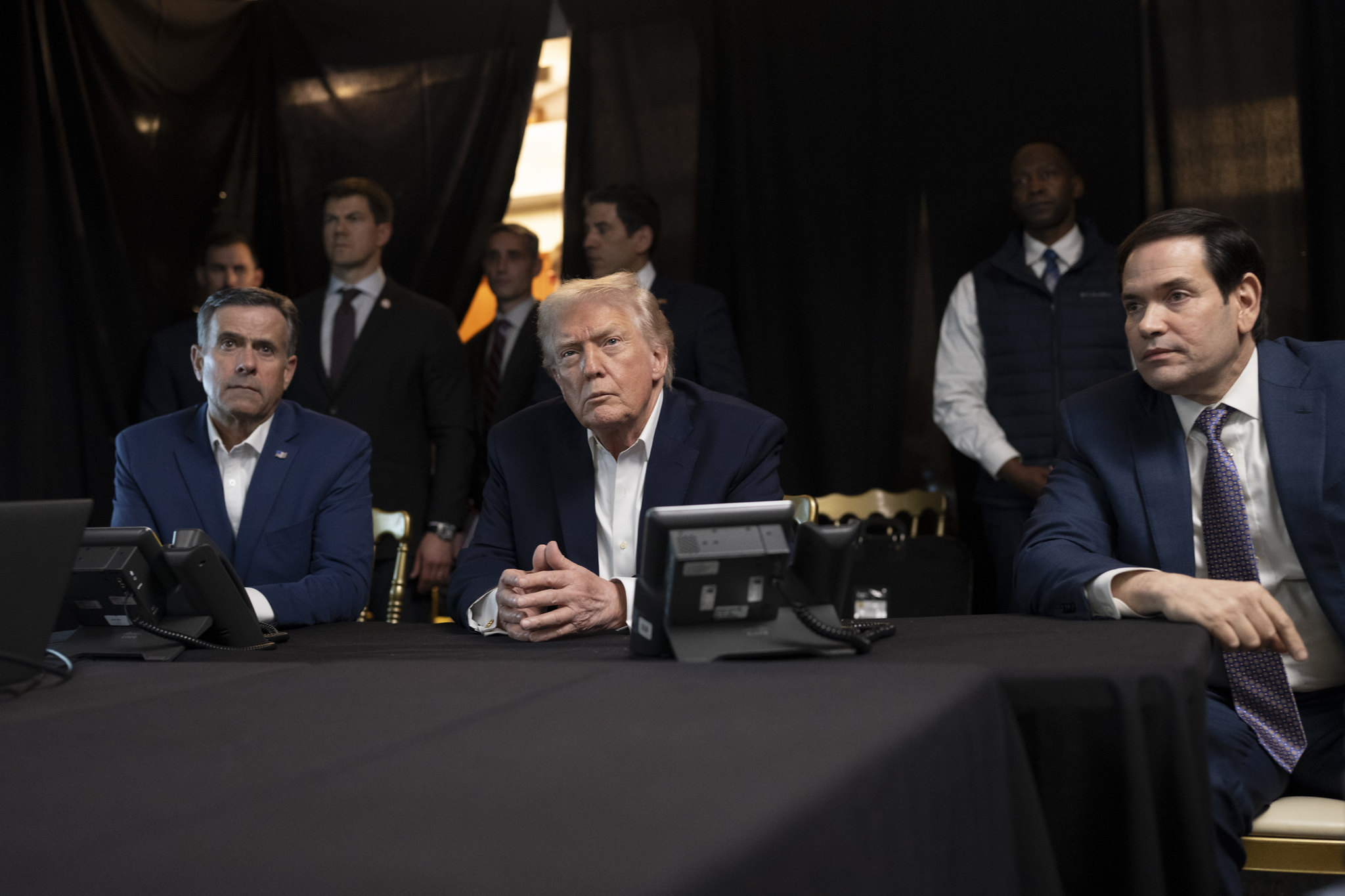
While it doesn’t explicitly mention Taiwan, the NDS does mention that the U.S. would “erect a strong denial defense along the first island chain,” a term that traditionally refers to Japan, Taiwan and the Philippines. The other good news for Taipei is that the United States is still willing and able to sell it weapons for the self-defense, as required by U.S. law under the 1979 Taiwan Relations Act and subsequent legislation. Picture source: The White House, December 17, 2025, flickr, https://www.flickr.com/photos/whitehouse/54993041062/in/album-72177720331009817.
Prospects & Perspectives No. 11
The Indo-Pacific and the U.S. National Defense Strategy: From Rebalancing to Retrenchment
By Igor Khrestin
The United States committed to playing a larger role in Asia in 2011, after President Barack Obama delivered a speech to the Australian parliament in which he said the United States had “made a deliberate and strategic decision." As a Pacific nation, Obama said, “the United States will play a larger and long-term role in shaping this region and its future, by upholding core principles and in close partnership with our allies and friends.” Policymakers called this the “Asian pivot” or “Asian rebalance” — later amended to the “Indo-Pacific pivot,” after the late Japanese Prime Minister Shinzo Abe coined the regional term.
Nearly 15 years later, the “Indo-Pacific pivot” has come full circle. The second Trump administration is instead “rebalancing” to the Western Hemisphere, where it just deposed a dictator by force in Venezuela. As of the time of writing, the United States looks to be preparing for more military action in the Middle East. In Europe, Russia’s war against Ukraine shows no sign of abating. In the meantime, the United States is pushing a long-term ally Denmark to cede control of Greenland, an autonomous territory that the Danes have controlled for over 300 years.
The newly-released 2026 National Defense Strategy (NDS) reflects these changed priorities. Whereas “letting sleeping dogs lie” may be wise in this era of uncertainty, U.S. allies in the Indo-Pacific have ample reason to worry that the United States is retrenching from a region where American influence and leadership are arguably now needed most. Significantly, the NDS does not mention Taiwan at all, which might be cause for concern in Taipei.
A new era of self-reliance
Allied self-reliance, first driven by President Trump’s rhetoric and demands for “fairness,” is now a key theme of U.S. foreign policy and is enshrined in key U.S. strategic documents.
U.S. Under Secretary of War for Policy Elbridge Colby put it bluntly in a Jan. 26 speech in Seoul: “A favorable balance of power requires capable allies with real military strength, real industrial capacity, and real political resolve.” Such worthy allies, according to Colby, should spend no less than 3.5% of their GDP on national defense and an additional 1.5% of GDP on “defense-related spending.”
Conveniently, the Republic of Korea (ROK) President Lee Jae Myung had pledged to achieve those same goals in his meeting with President Donald Trump at the White House several months earlier. In return, Colby praised Seoul in his speech as a “model ally.” Japan has also approved a record defense spending budget in 2025, with an increase of 9.4% from the previous year, in hopes to achieve a much more modest goal of spending 2% of annual GDP on defense by next year. President Trump has so far refrained from criticizing Tokyo for the shortcoming.
The NDS, like the National Security Strategy (NSS) released in November, puts the onus squarely on U.S. allies to provide more for their own defense: “In Europe and other theaters, allies will take the lead against threats that are less severe for us but more so for them, with critical but more limited support from the United States,” the NDS says.
Left unclear in the NDS is what type of “critical, but limited support” the United States plans to provide to its allies in an event of armed conflict. Japan, the ROK, and the Philippines are all party to binding mutual defense treaties with Washington. As such, Tokyo, Seoul, and Manila expect that if they are attacked, the United States would fully aid in their defense. In this new era of U.S. foreign policy transactionalism, it is unclear that Washington in fact would still do so.
The Beijing rebalance
U.S. allies in the Indo-Pacific should also take note of the significantly changed U.S. tone toward China. The 2026 NDS significantly deemphasizes the threat from Beijing.
In the 2018 NDS, the first Trump Administration called China a “revisionist power” and said that China and Russia are “the principal priorities” for the United States “because of the magnitude of threats they pose to U.S. security and prosperity today.” In the 2022 NDS, the Biden Administration said China is the “most comprehensive and serious challenge to U.S. national security.”
But the 2026 NDS states that the United States will “deter Beijing through strength, not confrontation.” It also highlights that President Trump “seeks fair peace, stable trade, and respectful relations with China.” As such, the NDS proposes to expand military-to-military communications with the People’s Liberation Army (PLA) with the goal of “strategic stability” and “deconfliction and de-escalation more generally.”
What the NDS omits is that the United States has for many years tried to establish reliable “military hotlines” with the PLA, and these efforts have consistently failed because Beijing views them as a political tool, not a deescalation mechanism. As Chinese scholar Tang Zhao noted: For Beijing “not to respond to the other side’s request to communicate at a time of crisis is a useful tool to impose pressure on the other side, to express one’s displeasure, and to compel the other side to change its own behavior.” It is hard to see this PLA standard operating procedure changing any time soon, no matter how much the White House wants to wish it into existence.
What this all means for U.S. allies in the Indo-Pacific is that (1) U.S. relations with Beijing will remain unpredictable, and (2) the changes in that relationship will be driven by presidential diplomacy. The next test of these intersecting corollaries will be the presidential summit between Trump and Xi Jinping in Beijing in April.
Taiwan in limbo
Where does this leave Taiwan? Given its explicit omission from the NDS, Taipei should pay close attention to the following three areas: (1) Taiwan’s seeming demotion from a strategic pillar of U.S. defense planning in Asia to primarily an economic concern; (2) the softening of the NDS’s language toward China; and (3) the occasional rhetoric from the U.S. commander-in-chief that suggests a possible “grand bargain” with Beijing that could significantly impact Taiwan’s democratic future.
While it doesn’t explicitly mention Taiwan, the NDS does mention that the U.S. would “erect a strong denial defense along the first island chain,” a term that traditionally refers to Japan, Taiwan and the Philippines. The other good news for Taipei is that the United States is still willing and able to sell it weapons for the island’s self-defense, as required by U.S. law under the 1979 Taiwan Relations Act and subsequent legislation. Last December, the U.S. announced an US$11 billion arms sale package to Taipei, the largest ever assembled. What is less clear is how Taipei plans to pay for this massive package, given Taiwan’s fractious politics and spending bottlenecks. This has already raised ire on Capitol Hill and remains an issue Taiwan needs to remedy quickly if it wants to retain strong bipartisan support in the United States.
On the economic side, Taipei has wisely seen the writing on the wall and announced massive new investments into the United States. Earlier this month, Taiwan signed a reciprocal trade agreement with the United States, becoming only the seventh U.S. partner to sign these bilateral deals with the Trump Administration.
At least in theory, these developments should provide some much-needed stability for Taipei when it comes to dealing with a more unpredictable Washington. But in April, we should also not be surprised if a major change in U.S. policy toward Taipei will be in the offing, with serious implications for the entire Indo-Pacific region and global security.
(Igor Khrestin serves as senior advisor for global policy at the George W. Bush Institute and as visiting fellow at the National Security Institute at George Mason University.)
Related Content
After Two Trump-Xi Summits: Competing Within Limits
Re-Establishing Deterrence in Taiwan’s Maritime Periphery Following the China-Indonesia Naval Exercise
In a Year of Global Upheaval, ASEAN Scrapes by, Divided but Resilient
The G7 Leaders’ Summit in France: An Unexpected Success
Maritime Security in Southeast Asia: Still Business as Usual?
Trump-Xi Summit and the Security Situation in the Taiwan Strait
The Trump-Xi Summit: What It Was Not is More Important than What It Was
What Does the U.S. War Against Iran Mean for the Indo-Pacific?
Japan’s High-Stakes Snap Election and Japan’s Role in the Indo-Pacific

The “Justice Mission 2025” PLA Exercise and Japan’s National Security
Trump’s National Security Strategy and the Future of the World Order
Old Partners and New Friends: Despite Steady Growth, Taiwan-Europe Relations Need ‘Futureproofing’
 Facebook
  Youtube
  Twitter