

The Pacific Islands Forum’s Leaders Meeting in Palau: Steering a Course Between Charybdis and Scylla?


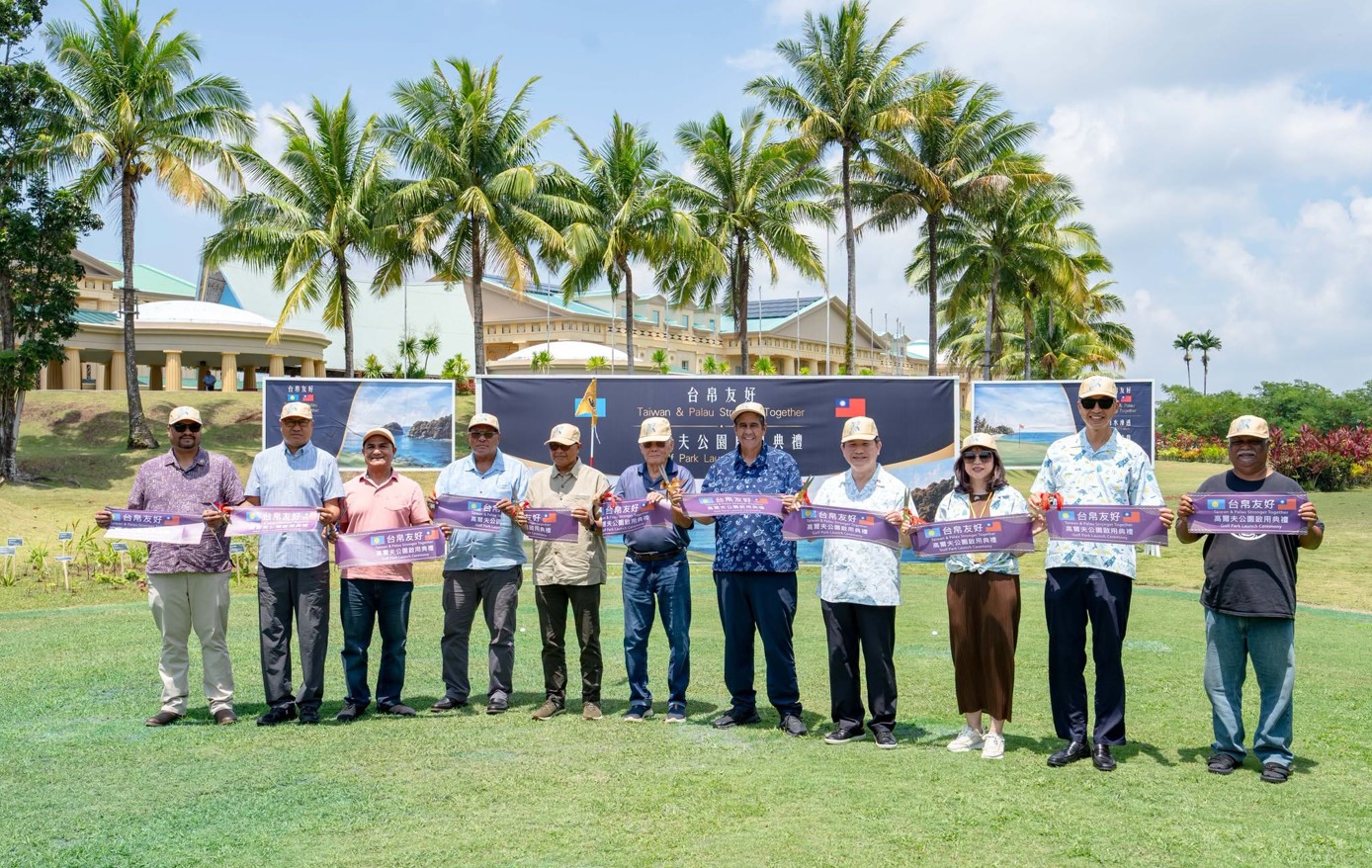
Taiwan’s relationship with the PIF Leaders’ Meetings has been both active and nuanced since 1992 when Taipei was invited to participate in the Post-Forum Dialogue process as a “development partner.” Despite diplomatic recognition from nearly half the Forum membership, the one-China issue prevented it from attaining full Dialogue Partner status that the People’s Republic of China gained two years earlier. Picture source: 林佳龍, August 30, 2026, Facebook, https://www.facebook.com/photo?fbid=1624648342360630&set=pcb.1624648432360621&locale=zh_TW.
Prospects & Perspectives No. 47
The Pacific Islands Forum’s Leaders Meeting in Palau: Steering a Course Between Charybdis and Scylla?
By Richard Herr
Palau lies geographically and strategically at an important intersection of the Indo-Pacific and the South Pacific regions. From August 30 to September 4, the capital, Koror, will play host to a critical meeting of the Pacific Islands Forum (PIF) where the tensions along this geopolitical fault line will be an unwelcome but inescapable presence.
When Palau’s President Surangel Whipps Jr. welcomes 17 Heads of State and Government to Koror for the 55th Pacific Islands Forum Leaders Meeting, the Pacific Islands’ apex political organization will not find relations with the Indo-Pacific bloc or other parts of the globe on the agenda.
Formally, intraregional issues dominate under the agreed theme “B.E.L.A.U – Building Economies: Life. Action. Unity.” The principal issues for resolution include strengthening economic resilience, coordinating the region’s climate change posture, and finalizing ongoing institutional reform.
However, global instability guarantees that extra-regional concerns will intrude into virtually every item the Leaders will address in the open sessions and, perhaps more importantly, during their private retreat which excludes officials. Finding a safe course for the region between competing interests will be a special challenge in 2026.
Security front, center and in the background
Security will be woven throughout the entire agenda of the Koror Forum in various ways, but most explicitly central in an item to approve the draft Regional Peace and Security Action Plan 2026–2030 forwarded from the August Foreign Ministers meeting.
The plan, if approved, will practically integrate and implement multiple measures to address traditional and non-traditional security threats as identified by PIF members, by linking national priorities and resources to appropriate responses.
The Security Action Plan is itself embedded in the background of the region’s broad claim to stewardship over the ocean and environment through the PIF’s 2050 Strategy for the Blue Pacific Continent. The 2050 Strategy has been the region’s key organizing vehicle to protect and enhance every aspect of the region’s physical and human security since 2022.
One issue that may make security contentiously central to the Leaders’ deliberations is President Whipps’ plan to pursue a resolution denouncing the July 2026 Chinese missile test whose missile landed in the waters between Nauru, Solomon Islands and Tuvalu as a violation of the 2050 Strategy’s security aims.
The missile test provoked broad condemnation across the Pacific but the PIF foreign ministers preparatory meeting in August failed to reach a consensus when several small states feared retribution from Beijing.
The Pacific Resilience Facility
Formalizing the operation of, and funding for, the Pacific Resilience Facility is one of the key benchmarks for success on the Koror agenda. The speed between the Facility’s treaty signature at the 2025 Forum and entry into force in May 2026 demonstrates the importance placed on this initiative working.
It is regarded as foundational to securing regional agency in dealing with climate change and natural disasters. Being Pacific owned and operated, the new international financial institution will provide small-scale grants for community-level climate adaptation and disaster preparedness by giving local people ownership of their response.
The Leaders Meeting will test the willingness of an international community increasingly less generous by seeking pledges to reach an operational capitalization of US$500 million by the end of the year.
Although membership is limited to PIF members, Taiwan has staked a claim to involvement in the new regional organization through an early US$3 million contribution. This contrasts with the slower response of larger powers for this initiative and may have some relevance for Taiwan in the Regional Architecture Review assessments.
Taiwan’s development partnership at stake in Koror
Given that Palau is an official diplomatic ally and the change in the Solomon Islands’ leadership, Taipei will be hoping that the controversies in the two preceding Leaders Meetings regarding its involvement in the region will be very much in the rearview mirror at the Koror Forum.
Taiwan’s relationship with the PIF Leaders’ Meetings has been both active and nuanced since 1992 when Taipei was invited to participate in the Post-Forum Dialogue process as a “development partner.” Despite diplomatic recognition from nearly half the Forum membership, the one-China issue prevented it from attaining full Dialogue Partner status that the People’s Republic of China (PRC) gained two years earlier.
In 2024, Beijing used its close relationship with host Tonga to frustrate the normal Taiwanese access to the Leaders’ Meeting. China even interfered with the final communiqué in an attempt to remove references to Taipei.
Solomon Islands, a Taiwan ally until late 2019, hosted the 2025 Leaders Meeting. Its attempt to deny visas to the Taiwan delegation provoked outrage from Taipei’s three allies – Marshall Islands, Palau and Tuvalu – as well as criticism from other members. Prime Minister Jeremiah Manele cut the diplomatic Gordian Knot by denying access to all recognized external dialogue and development partners to the meeting.
The fate of Taiwan’s relationship with the PIF will be on the block in the agenda item considering a report on the multi-year, wide-ranging Review of the Regional Architecture. A compromise at the end of the 2025 Forum suggests Taiwan will have a continuing role but not necessarily at the same level or with the same frequency as in the past.
Instability regional and global challenge the way forward
Beyond its importance for Taiwan, the Review of the Regional Architecture has critical implications for the region as a whole. In seeking to improve the capacity of all the regional organizations to coordinate their efforts to implement the 2050 Strategy, the review is tackling an issue that has bedeviled Pacific regionalism for a half century.
Inter-agency coordination is essential both to make the best use of resources internally as well as projecting shared interests externally. Previous efforts began with the ideal of combining all organizations into a single regional body. Although unobtainable, the concept refuses to die in some quarters.
The problem with various temporizing mechanisms such as the current Council of Regional Organizations in the Pacific (CROP) is that each of the member regional bodies retains its obligations to their governing bodies and separate procedures for decision making.
Moreover, virtually all the CROP members have promoted sub regionalism in recent decades by establishing branch headquarters in Melanesia, Micronesia and Polynesia. Subregional rivalries came close to destroying the PIF in 2021 when five Micronesian states left the PIF temporarily.
Thus, the effort to consolidate and strengthen regional coherence through the Regional Architecture Review is likely to prove as much a source of stress as it is the solution to the coordination needed to meet the expansive objectives of the 2050 Strategy.
As a region on the periphery of both Indo-Pacific and global affairs, the South Pacific has been dependent a rules-based international order to protect it from the abuses of asymmetrical power. Indeed, arguably, the post-WWII international order created the foundations for the decolonization of the region’s micro-states.
While the Trump administration has gloried in disrupting the rules-based international order, its actions have been important as a permission slip to other countries to move away from agreements important to the South Pacific region’s 2050 Blue Pacific Strategy. At risk are such areas as the Paris Climate Change Accord commitments, regulation of deep seabed mining and environmental zones for fisheries protection.
In addition, declining support for international humanitarianism, budgetary redirection towards global rearmament and the acceptance of the use of power in pursuit of state interests have created a less sympathetic international environment for the region.
The most critical challenge for the Leaders in Koror may be how to steer between fragilities at the regional level and unpredictability internationally. The practicalities of plans made in Honiara in 2025 will have to be assessed against what may seem likely when they next meet in New Zealand in 2027.
(Dr. Richard Herr is an Adjunct Senior Lecturer in the Faculty of Law at the University of Tasmania, Australia.)
Related Content
Re-Establishing Deterrence in Taiwan’s Maritime Periphery Following the China-Indonesia Naval Exercise
In a Year of Global Upheaval, ASEAN Scrapes by, Divided but Resilient
Washington Reassures (and Worries) Taiwan

President Trump’s National Security Strategy and Tensions Across the Taiwan Strait
The Honduran Presidential Election: Impact on Ties with Taiwan

Boycotts, Power Politics, and the Future of the G20
The ASEAN Malaysia Summit: The Calm Before the Storm?

The Rare Earth Pause: A Strategic Assessment

The Impact of the Israel-Hamas Ceasefire on Taiwan

Strategic Shift from PM Abe to PM Ishiba: Will Japan’s Strategy Change?
China’s Naval Projection Sends Important Signals Across the Indo Pacific
The Specter of a Broader Regional Maritime Conundrum Over Taiwan
 Facebook
  Youtube
  Twitter