



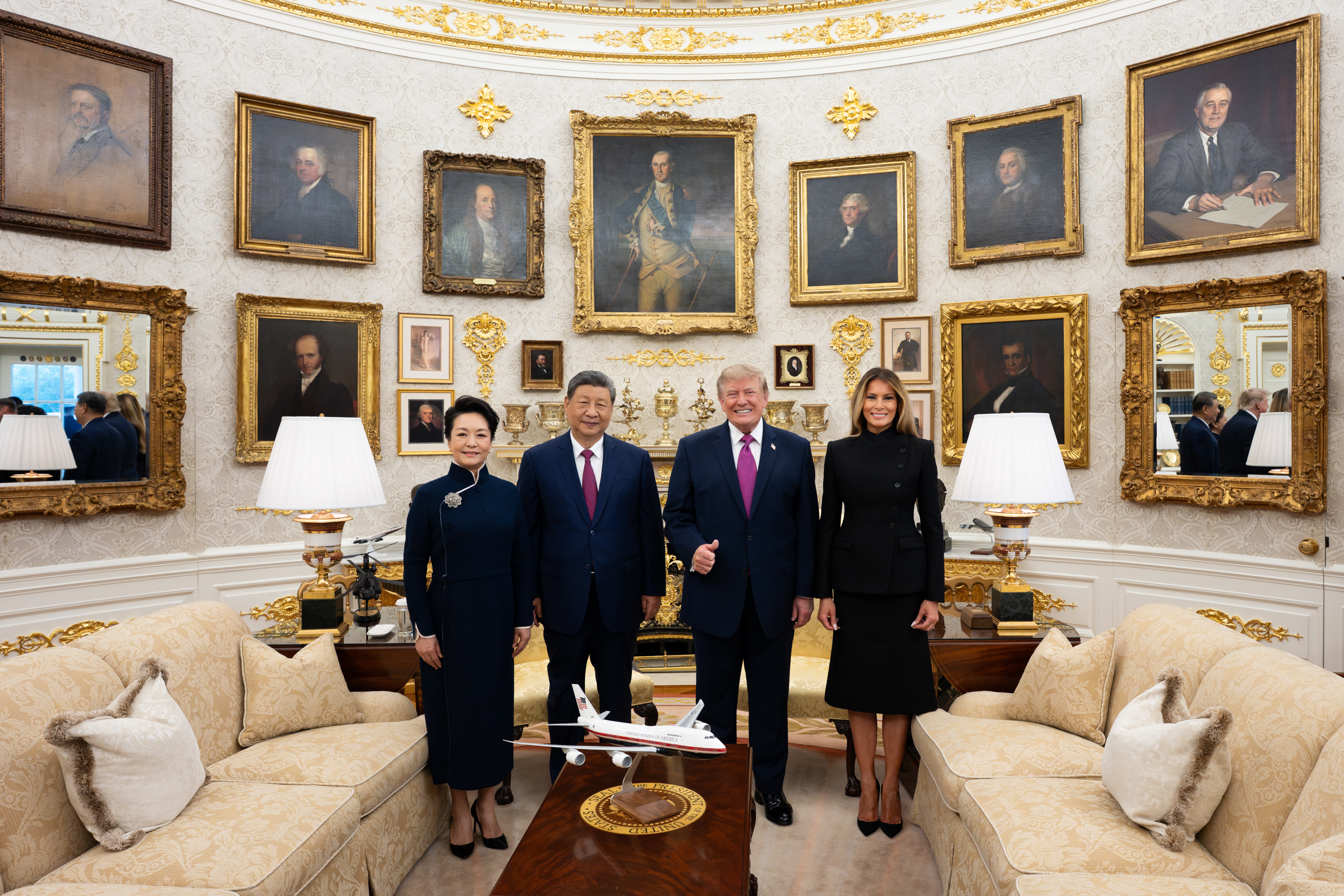
We should expect U.S.-China relations over the next two years to maintain a certain degree of stability at the leadership level. This stability, however, is likely to remain fragile. The structural differences between the two countries are difficult to resolve, while domestic political pressures on both sides will continue to generate new sources of friction. Picture source: The White House, September 25, 2026, The White House, .
Prospects & Perspectives No. 55
After Two Trump-Xi Summits: Competing Within Limits
By Hung-jen Wang
The two meetings between U.S. President Donald Trump and Chinese leader Xi Jinping so far in 2026 present an unusual development in U.S.-China relations. The two leaders have met more frequently, spoken more positively about each other, and begun to restore some channels of communication that had been suspended or weakened in previous years since former U.S. House Speaker Nancy Pelosi’s visit to Taiwan in 2022. However, these developments do not mean that the structural sources of U.S.-China competition have disappeared. The relationship, in fact, is more dynamic and complicated than we thought. Washington and Beijing are trying to stabilize their competition at the leadership level, while disagreements in other areas continue and may even become more serious.
The two summits can therefore hardly be described as representing a new détente or a durable strategic stability between the United States and China. What we are seeing is closer to a form of “bounded strategic rivalry,” instead of what the Chinese government is trying to propose as a “constructive strategic stability.” The major differences between the two countries remain, but both governments temporarily recognize the need to establish certain mechanisms to prevent these differences from developing into a serious crisis.
Military communication
One recent development from the September summit concerns military communication. The two militaries agreed to work toward a memorandum on crisis communication and prevention. This is important because American and Chinese aircraft and naval vessels operate in close proximity in the South China Sea, the East China Sea, and the waters surrounding Taiwan. Keeping military communication open is therefore more than a symbolic gesture. It may help prevent an unexpected accident from developing into a political or even military crisis.
However, there is a paradox here. The apparent stability between the American and Chinese leaders does not necessarily mean greater stability across the Indo-Pacific. Regional actors, including the Philippines, Japan, South Korea, and North Korea, have their own interests, security concerns, and threat perceptions. Their policies will not simply follow an understanding reached between Washington and Beijing.
The Philippines, for example, will continue to defend its maritime claims and interests in the South China Sea. Japan is preparing to revise its three major security documents by the end of this year, against the background of its growing concerns about China, North Korea, and Russia. North Korea, meanwhile, has little reason to subordinate its nuclear and missile policies to an understanding between the United States and China. In other words, even if Washington and Beijing can establish better guardrails between them, tensions involving China and other regional actors will continue. The problem is that China's continued use of gray-zone pressure against Taiwan, Japan, or the Philippines could create a regional crisis in which the United States, because of its security commitments and interests, becomes increasingly involved.
Technology and AI
Technology presents another difficult problem this time for the future development of U.S.-China relations. Artificial intelligence received unusual attention during Xi's visit. The two governments agreed to establish a dialogue on AI — or “super intelligence,” as it was described in the White House documents — as well as a bilateral channel for communication concerning AI-related incidents. These mechanisms may be useful for risk management. However, cooperation over AI safety should not be confused with a convergence of American and Chinese strategies toward AI development.
In the case of China, Beijing is increasingly interested in developing a technological ecosystem that is less dependent on American technology and therefore less vulnerable to U.S. export controls. Beijing has promoted Chinese AI models, open-source technologies, and digital infrastructure while strengthening its relations with countries in the Global South. Xi's AI diplomacy this year should be understood in this context. China is not simply trying to catch up with the United States in individual technologies. More importantly, Beijing would like more countries to use technological ecosystems in which Chinese firms, platforms, standards, and eventually Chinese rules play an important role.
The United States views this competition from a different perspective. Washington continues to believe that it possesses important advantages in advanced semiconductors, computing power, and frontier models. It therefore has little incentive to relax technological controls that are designed to preserve these advantages. We are consequently witnessing two developments at the same time: limited U.S.-China cooperation on serious AI risks and incident management, alongside increasingly intensive competition over chips, computing power, models, standards, and international markets. In my view, this competition may eventually become more consequential than the tariff dispute itself. Tariffs can be negotiated, but different technological ecosystems are much more difficult to reverse.
The Taiwan ‘issue’
Taiwan should also be understood in this broader context. Since Beijing continues to regard Taiwan as one of its most important red lines, it clearly hopes to connect its idea of “constructive strategic stability” with constraints on U.S. arms sales and high-level official interactions with Taiwan. Yet the two Trump-Xi summits have so far produced little evidence that Washington has accepted such a linkage. The White House fact sheet following the September summit did not announce any change in U.S. policy toward Taiwan.
This does not mean that Taiwan has become less important in U.S.-China relations. Rather, we should emphasize how Washington and Beijing understand the relationship between Taiwan and “stability.” Beijing has sought to persuade Washington that reducing its support for Taiwan is necessary for maintaining stable U.S.-China relations. Washington, at least for now, appears to understand stability differently. While Beijing seeks to incorporate Taiwan into the framework of U.S.-China strategic stability, Washington does not appear to accept that stability in its relationship with Beijing should necessarily place constraints on its separate relationship with Taiwan. Their disagreement over Taiwan will continue, but neither side, at least for now, appears to want these tensions to escalate into a military conflict.
There will soon be further opportunities to test this arrangement. Trump and Xi are supposed to meet again around the APEC Economic Leaders' Meeting in Shenzhen in November and the G20 summit in the United States in December. However, we should not expect these two possible meetings to be more consequential than Xi's September state visit. Both will take place in multilateral settings, where there will be less time and political space for major bilateral bargaining.
The APEC meeting could nevertheless be important for another reason. A Trump visit to Shenzhen could become part of a broader Asian trip involving Japan and South Korea. Russia has also publicly raised the possibility of a Trump-Xi-Putin meeting at APEC, although such a trilateral meeting has not been confirmed. If this were to happen, the discussion would certainly go beyond U.S.-China bilateral relations and involve questions related to Russia, Ukraine, and the wider international order. Taiwan, under such circumstances, will not necessarily become the central issue.
American domestic politics will add another source of uncertainty. The midterm elections may change the balance of power in Washington, and some may therefore expect Trump to become a “lame-duck” president if the Republicans suffer electoral losses. We should be cautious about such an assumption. Trump has personalized foreign policy to a considerable degree. The more others regard him as politically weakened after the midterms, the stronger his incentive may be to demonstrate that he is still capable of shaping major international events.
The question after the two Trump-Xi summits is not whether U.S.-China competition is coming to an end. It clearly is not. The more important question is whether Washington and Beijing can establish enough mechanisms to prevent long-term strategic competition from developing into a major political or military crisis. So far, the answer remains mixed. Communication between the two leaders has improved, some military and AI risk-management mechanisms are being restored or built, and economic confrontation has been temporarily contained. At the same time, we are witnessing continued competition over technology, regional influence, and the future distribution of global power.
We should therefore expect U.S.-China relations over the next two years to maintain a certain degree of stability at the leadership level. This stability, however, is likely to remain fragile. The structural differences between the two countries are difficult to resolve, while domestic political pressures on both sides will continue to generate new sources of friction. Both Trump and Xi have reasons to avoid a major confrontation, but neither side is prepared to give up its long-term strategic objectives. What we are likely to see, therefore, is a prolonged period of bounded strategic rivalry in which Washington and Beijing continue to compete, pressure, and test each other, but at the same time trying to keep these tensions within certain limits.
(Hung-jen Wang is Professor in the Department of Political Science at National Cheng Kung University and Executive Director of the Institute for National Policy Research.)
Related Content
The New U.S.-China Paradigm Will Constrain but Not Collapse the U.S.-Taiwan Relationship
Trump-Xi Summit and the Security Situation in the Taiwan Strait
The Trump-Xi Summit: What It Was Not is More Important than What It Was
Four Major PLA Exercises Around Taiwan Since 2022: Significance and Possible Future Trends
Blinken’s Hard-Won Trip Amid U.S.-China Competitive Coexistence
Strengthened Yet Threatened Relations: Taiwan’s Diplomatic Ties with Latin American Countries
Beijing’s Intensifying Pressure on Taiwan’s Passport and Consular Affairs
Strategizing the New Southbound Policy: A Fruitful Journey of a Decade
What If the Quarantine of Taiwan Has Already Begun?

臺灣高度經濟成長率的背後
The Indo-Pacific and the U.S. National Defense Strategy: From Rebalancing to Retrenchment
PM Carney’s Bold New Vision: The Good and the Bad
 Facebook
  Youtube
  Twitter