



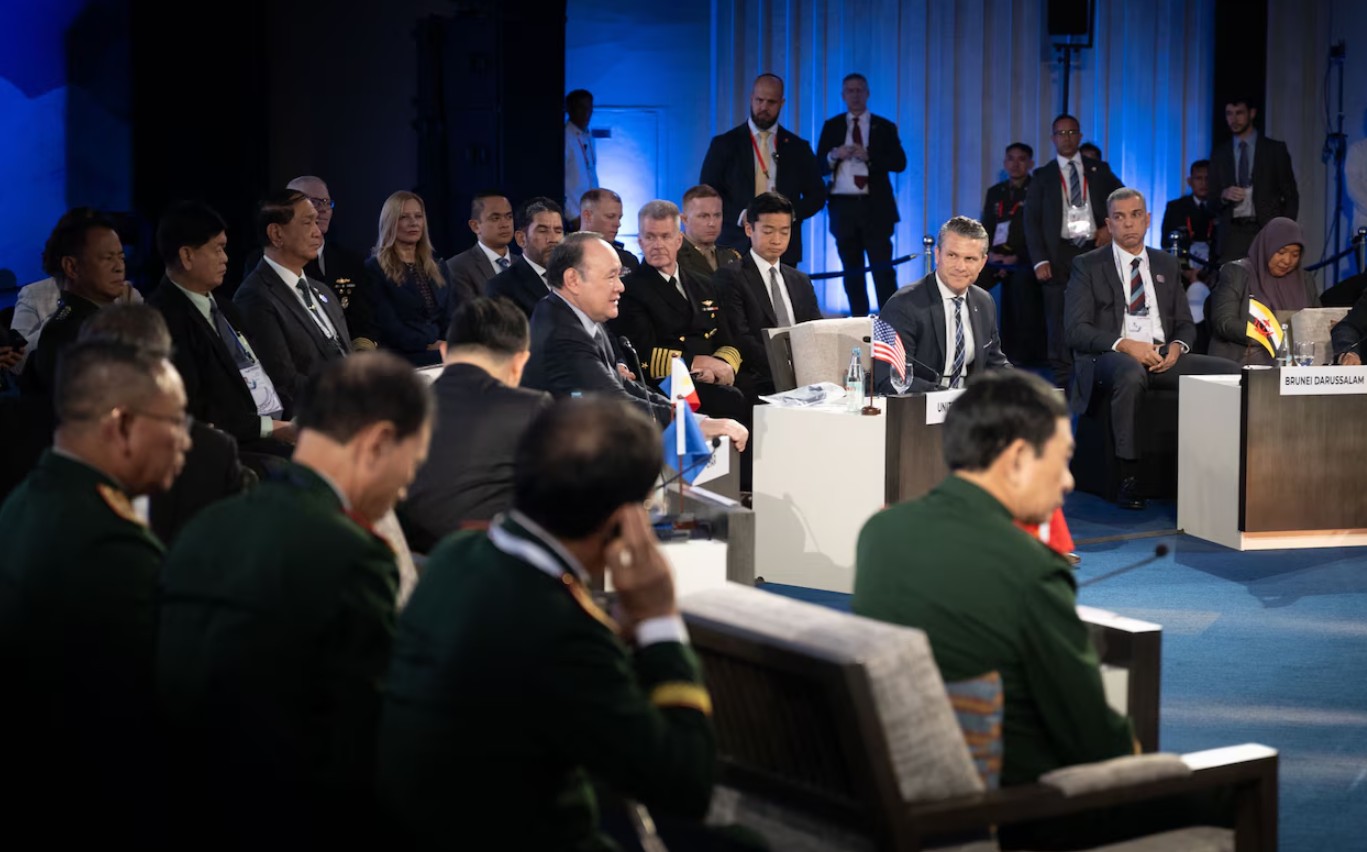
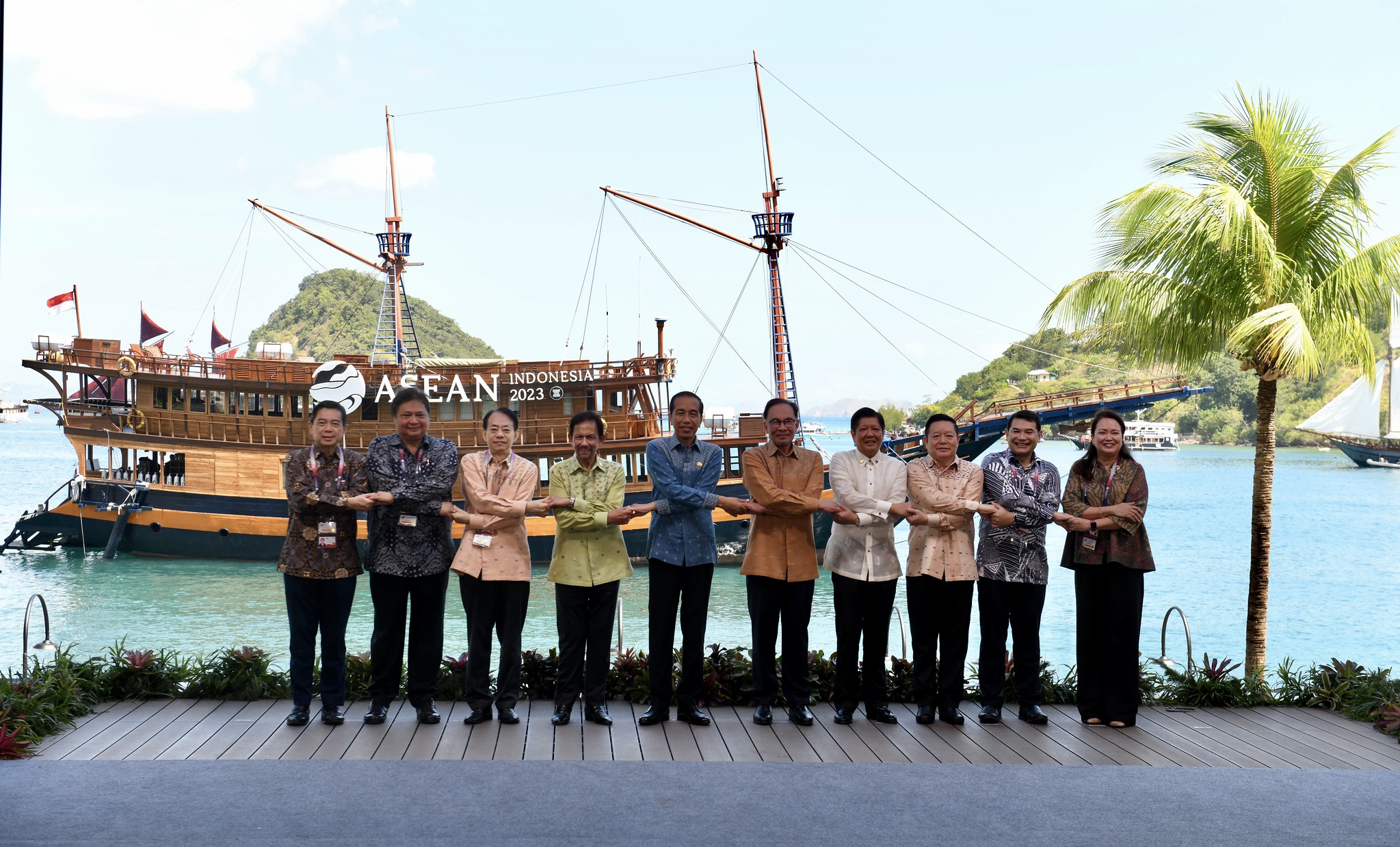
ASEAN has valued dialogue and has acted where cooperation could be achieved. A defense framework that depends on clear shared interests asks for something that might be difficult to provide, and the most it is likely to produce is a modest initiative. Picture source: U.S. Department of War, October 28, 2026, U.S. Department of War, https://www.war.gov/News/News-Stories/Article/Article/4635722/hegseth-outlines-cooperative-agenda-for-regional-stability-in-asia/.
Prospects & Perspectives No. 65
A Cooperative Agenda for Asian Regional Stability?
By Sue Thompson
When U.S. Secretary of War Pete Hegseth travelled to the Philippines in late October, he outlined a defense cooperation agenda at the Association of Southeast Asian Nations (ASEAN) Defense Ministers Meeting-Plus (ADMM-Plus) that, according to the U.S. Department of War, would focus on “strengthening maritime domain awareness” and that the U.S. aimed to “be more ambitious in securing a defense cooperation framework.” He also stressed the need to support practical cooperation "where shared interests are overlapping and clear.”
While Hegseth stressed the benefits of cooperation, his statement was light on detail. It also did not address the issue of what the shared security interests were between ASEAN nations and where the divisions lay within the organization.
A shared strategic outlook
ASEAN’s inaugural declaration in 1967 stated that the countries in Southeast Asia would cooperate on economic, social and cultural development in the region. The founding countries also declared their commitment to stabilizing and securing the region from external interference, adding that all foreign bases were temporary and that the countries in the region shared the main responsibility for strengthening the region’s economic and social stability. Of the five founding members, Indonesia was the only country that did not have Western forces inside its territory, and Jakarta insisted that the declaration should stress the temporary nature of those foreign bases that were in the region at the time. At first, the Philippines opposed the passage but backed down after the inaugural meeting began. However, the final statement was a compromise. Indonesia initially wanted a passage saying there would be no foreign bases but accepted the word “temporary”; and Malaysia accepted the inclusion of these references to foreign bases as a condition of Indonesian membership. Indonesia’s position was that the declaration must refer to the foreign bases and stipulate that the region was responsible for its own defence, although the founding members did not see ASEAN as a security organization and each of them continued their external bilateral security ties.
Yet, in a crucial sense, ASEAN was concerned with the security of the region as economic growth was intended to stabilize Southeast Asia. Some observers at the time believed that the biggest threat to the region would come from internal insurrection rather than external invasion. Therefore, economic development was essential.
ASEAN had been formed against the backdrop of the Cold War, and the five founding members were all non-communist nations. Yet, these five nations had not always lived together harmoniously. ASEAN evolved from the tail end of conflict between Malaysia and Indonesia over the formation of the Federation of Malaysia in 1963, and it was during the talks to end this conflict that discussions turned to the formation of a regional group. Indeed, the Malaysia-Indonesian confrontation highlighted the need for stable relations in the region that were underpinned by economic growth and development and a desire to avoid being drawn into the superpower rivalry between the United States and the Soviet Union that was part of the political landscape in Asia at that time.
Therefore, while the main motivations behind the establishment of ASEAN were economic, social and cultural, in the early decades of the organisation, security and stability came from perceived shared strategic interests of the founding members. Defense and security cooperation developed away from the formal ASEAN structure and usually on a bilateral basis. When Vietnam invaded Cambodia in 1978, ASEAN foreign ministers deplored the armed intervention in Cambodia and called for an immediate withdrawal of foreign troops from its soil. This was despite ASEAN nations having underlying differences of opinion on where the threat to Southeast Asian stability lay.
Changes to the strategic environment
Since the end of the Cold War perceptions of a shared strategic outlook have started to wane and ushered in more changes to ASEAN and to the region. The association expanded. Brunei had joined in 1984 and then Vietnam, Myanmar, Laos and Cambodia joined in the 1990s. Diplomatic relations in the region were altered with the demise of the Soviet Union that saw changes to the Soviet Union-Vietnam alliance as well as improved relations between the United States and China. However, there were clashes between China, Vietnam and the Philippines over claims in the South China Sea.
In this new strategic environment ASEAN sought further regional security through the creation of the ASEAN Regional Forum (ARF) in 1994. And while this 27-member forum is generally considered as a useful diplomatic platform for security dialogue, it has also been criticized for being too broad with limited functions. However, for an organization that had evolved without a defined security structure, the establishment of the ARF was a significant step for ASEAN.
As security uncertainties have increased in the 21st century, so have ASEAN’s efforts to consult and cooperate on defense issues. The annual ASEAN Defence Ministers’ Meeting (ADMM) was inaugurated in 2006 to provide a platform for defence dialogue and cooperation. While well short of forming a security pact, the ADMM was another significant step for ASEAN as it provided a platform for some defence cooperation among the 10 member nations — now 11 with the admission of Timor-Leste. The ADMM+, launched in 2010, added Australia, China, India, Japan, New Zealand, Russia, South Korea and the United States. It has provided a practical forum for military exercises and training. However, ADMM+ is not without its criticisms. These have been for inaction due to its consensus-based structure and its inability to address regional security issues such as the ongoing civil war in Myanmar and maritime disputes in the South China Sea.
Indeed, earlier this month, ASEAN and China could not come to an agreement on a code of conduct for the South China Sea, something that the Philippines had aspired to achieve this year while ASEAN chair. For more than 20 years negotiations on an ASEAN-China code of conduct for the South China Sea have been ongoing and agreement has been elusive. The Philippine Foreign Minister attributed the delay to disagreements among the ASEAN members involved in the talks and China.
If ASEAN were to be judged as a security organization, criticisms about inaction on regional security issues could be justified. But ASEAN’s founders had intended that stability would come primarily from areas of cooperation that included economic development, while defence would be left to bilateral arrangements. Whether ASEAN can be viewed within security terms today is open to question.
Vague commitments, modest outcomes
Hegseth’s agenda calls for action on “where shared interests are overlapping and clear.” However, without a clear indication on where these shared interests now lie, this comment maintains a vague commitment without much detail.
During the Cold War, the shared strategic interests for ASEAN’s five non-communist members were to primarily maintain internal Southeast Asian stability and keep foreign power rivalry out of their region. They also agreed that ASEAN would not be a security organization and their own defence needs lay in existing bilateral relations. Since the end of the Cold War, ASEAN has created more forums for security dialogue yet differences over how to resolve regional security issues have persisted, as the failure to agree on a code of conduct for the South China Sea after more than 20 years of negotiations shows. ASEAN has valued dialogue and has acted where cooperation could be achieved. A defense framework that depends on clear shared interests asks for something that might be difficult to provide, and the most it is likely to produce is a modest initiative.
(Sue Thompson is an Associate Professor at the National Security College, Australian National University.)
Related Content
In a Year of Global Upheaval, ASEAN Scrapes by, Divided but Resilient
The BRICS Summit 2026: Cracks and Momentum Amid Global Instability
Re-Establishing Deterrence in Taiwan’s Maritime Periphery Following the China-Indonesia Naval Exercise
The Pacific Islands Forum’s Leaders Meeting in Palau: Steering a Course Between Charybdis and Scylla?

The Impact of the Israel-Hamas Ceasefire on Taiwan

China’s Naval Projection Sends Important Signals Across the Indo Pacific
The Specter of a Broader Regional Maritime Conundrum Over Taiwan
Yoon’s Martial Law Damaged South Korean Democracy — and Regional Security

Unpacking the Recent High-Level Meetings on the Korean Peninsula
Elections in India and Indonesia: Implications for the Indo-Pacific
The Limits of Declaratory Summitry: Another Year, Another ASEAN Meeting
South Korea’s Indo-Pacific Strategy Report and Its Regional Implications
 Facebook
 Youtube
 Twitter