



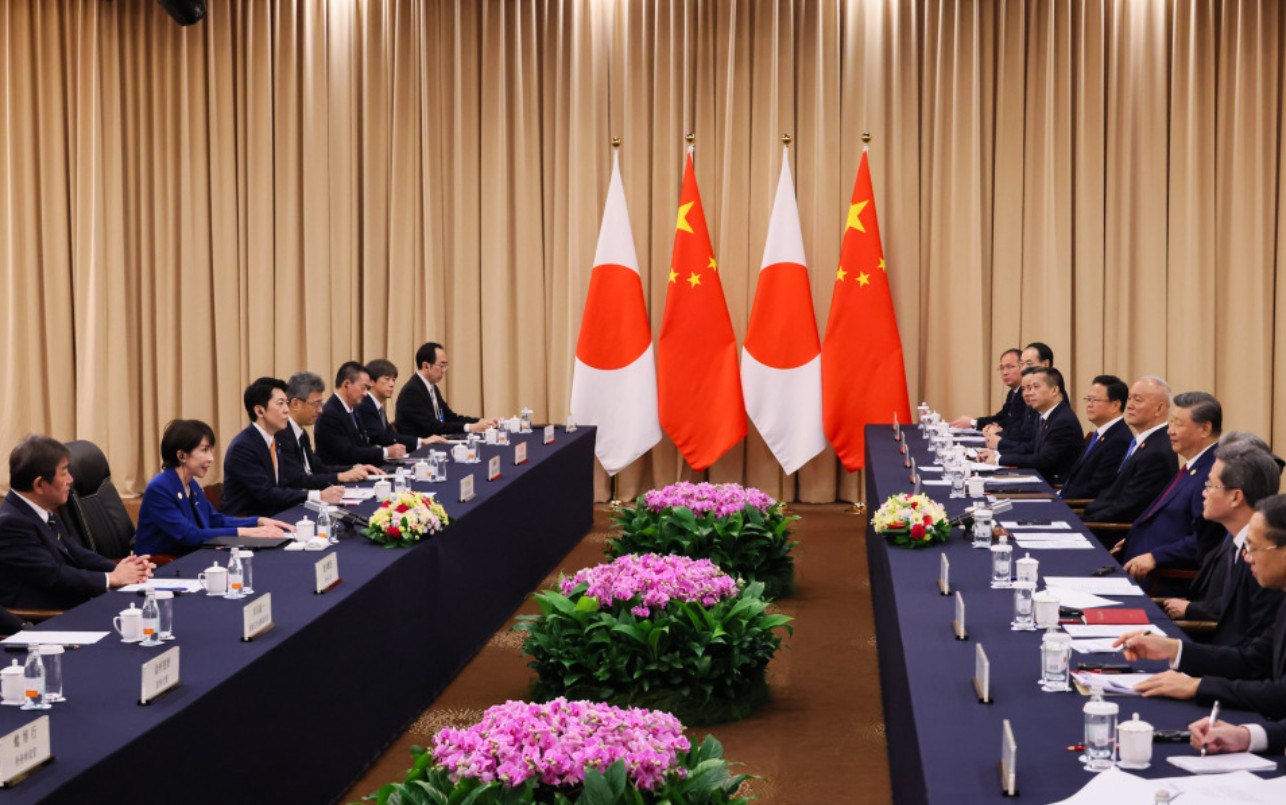
China’s assertiveness around Taiwan as well as in the vicinity of Japan will only make the Japanese more alert and strengthen Japan’s resolve to enhance its national security capabilities and to assume larger roles for regional security to maintain the rules-based international order together with its international partners. Picture source: 高市早苗, October 31, 2025, X, https://x.com/takaichi_sanae/status/1984238688868700630/photo/2.
Prospects & Perspectives No. 5
The “Justice Mission 2025” PLA Exercise and Japan’s National Security
By Hideshi Tokuchi
We live in a world of a higher degree of economic interdependence. The world is more connected than ever before. The Indo-Pacific region, particularly East Asia, is thriving, fully taking advantage of the progress of interdependence. Taiwan’s semiconductor industry is a linchpin of the global electronics ecosystem, providing the most sophisticated chips to the world. Disruption of Taiwan’s semiconductors would seriously damage the global prosperity.
On the other hand, today’s world is under the stress of intensifying rivalry of the U.S. and China. The world’s biggest and second biggest military powers face each other in East Asia. The maritime power confronts the continental power in the huge seascape of East Asia due to the rapid maritime expansion of the land power. Taiwan is a focus of the rivalry. The U.S. National Security Strategy of the Trump administration refers to Taiwan as the strategic point which “provides direct access to the Second Island Chain and splits Northeast and Southeast Asia into two distinct theaters.” As Japan is one of the few U.S. allies that can continue to provide a dependable stationing and operating environment for the U.S. forces to contribute to the regional stability, the U.S. view on the importance of Taiwan for its security affects Japan’s national security mindset.
Importance of Taiwan for Japan
The distance between Japan and Taiwan is only 111km. In fact, several ballistic missiles impacted on the Japanese exclusive economic zone (EEZ) when the People’s Liberation Army (PLA) conducted a military drill around Taiwan in August 2022. Fire on Taiwan would easily spread to Japan. Defense of Okinawa and the First Island Chain would be extremely difficult in Taiwan contingencies.
Also, Japan is a maritime nation, much dependent on maritime transit for its survival and prosperity. Bashi Channel just south of Taiwan lies along key maritime transit routes connecting the Middle East and East Asia including Japan.
For Japan, Taiwan is an extremely important partner and a valuable friend, with which it shares fundamental values and principles and enjoys close economic relations and people-to-people exchanges. According to a recent public opinion poll conducted in Japan, the Japanese public regards Taiwan as Japan’s best friend in Asia.
A Japanese opinion poll conducted one month after the start of the Russian invasion of Ukraine, 77% of the respondents were concerned about the possibility that the Russian invasion of Ukraine would affect the situation involving Taiwan. Japan’s National Security Strategy released 10 months after the Russian aggression states: “The possibility cannot be precluded that a similar serious situation may arise in the future in the Indo-Pacific region, especially in East Asia.” It was the time when the expression “A Taiwan contingency is a Japan contingency” became widely known in Japan.
Although Japanese Prime Minister Sanae Takaichi’s statement on the Taiwan contingency issues in the National Diet last November is causing strong backlash from China, a recent Japanese poll shows that the majority of the Japanese public think that the statement was appropriate. According to another poll, a large majority of the Japanese think that the prime minister does not have to withdraw the statement. Japan does not give in to China’s assertiveness.
Objectives of the Joint Mission 2025 PLA exercise and its impact on Japan
The PLA’s Joint Mission 2025 exercise held in late December 2025 is part of China’s efforts to build capabilities and skills to invade Taiwan. As part of political warfare, the exercise embodies China’s strong signal to Taiwan against its independence and strong warning to deter interference by foreign countries, particularly the U.S. and its regional allies, in China’s ambition on Taiwan. Joint Mission 2025 added just another example of operations to serve these military and political objectives.
Parts of all five exercise zones were within Taiwan’s territorial waters. Those zones were closer to Taiwan’s main island than those of previous exercises. They were close to Taiwanese sea ports and set in positions to cut off Taiwan’s maritime shipping routes. Taiwan is becoming increasingly suffocated.
Experts point out even the possibility of coordinated actions by Russia and North Korea. Russia notified Japan that it would conduct live-fire exercises on Japan’s Northern Territories, illegally occupied by Russia, starting on January 1, and North Korea launched ballistic missiles toward the direction of Japan on January 4. The impact of actions by the Axis of Autocracies on Taiwan should not be underestimated because both Russia and North Korea support China’s “One China” principle.
Japan’s national security strategy and policy looking toward the future
Japan’s response to the Chinese military exercise was consistent with its long-standing policy on Taiwan. The Press Secretary of the Ministry of Foreign Affairs stated that the exercises “increase tensions across the Taiwan Strait.” Japan expects that “the issues surrounding Taiwan will be resolved peacefully through dialogue.” It also states, “Peace and stability across the Taiwan Strait are important for the international community as a whole.”
Japan’s “One China” policy and China’s “One China” principle are completely different. China has known the difference since the diplomatic normalization between the two countries in 1972. Both countries agreed to disagree on their policies toward Taiwan. It seems that China is trying to pressure Japan to change its position on Taiwan, but it will not succeed. Japan and G7 countries continue to encourage peaceful resolution of issues related to the Taiwan Strait through dialogue and oppose any attempts to try to unilaterally change the status quo by force or coercion.
China’s assertiveness around Taiwan as well as in the vicinity of Japan will only make the Japanese more alert and strengthen Japan’s resolve to enhance its national security capabilities and to assume larger roles for regional security to maintain the rules-based international order together with its international partners. It will be articulated in the new National Security Strategy expected to be released in December. Even if China repeats hybrid and gray zone warfare, the Japanese will not be “boiled frogs.” Japan will remain vigilant and be more prepared.
(Hideshi Tokuchi is President, Research Institute for Peace and Security.)
相關文章
Japan’s High-Stakes Snap Election and Japan’s Role in the Indo-Pacific

Japan-Taiwan Relations After the Japanese House of Representatives Election

Re-Establishing Deterrence in Taiwan’s Maritime Periphery Following the China-Indonesia Naval Exercise
In a Year of Global Upheaval, ASEAN Scrapes by, Divided but Resilient
The Pacific Islands Forum’s Leaders Meeting in Palau: Steering a Course Between Charybdis and Scylla?

The G7 Leaders’ Summit in France: An Unexpected Success

Maritime Security in Southeast Asia: Still Business as Usual?
What Does the U.S. War Against Iran Mean for the Indo-Pacific?
The Indo-Pacific and the U.S. National Defense Strategy: From Rebalancing to Retrenchment

Trump’s National Security Strategy and the Future of the World Order

Old Partners and New Friends: Despite Steady Growth, Taiwan-Europe Relations Need ‘Futureproofing
President Trump’s National Security Strategy and Tensions Across the Taiwan Strait

 Facebook
  Youtube
  Twitter
  Podcast