

Old Partners and New Friends: Despite Steady Growth, Taiwan-Europe Relations Need ‘Futureproofing


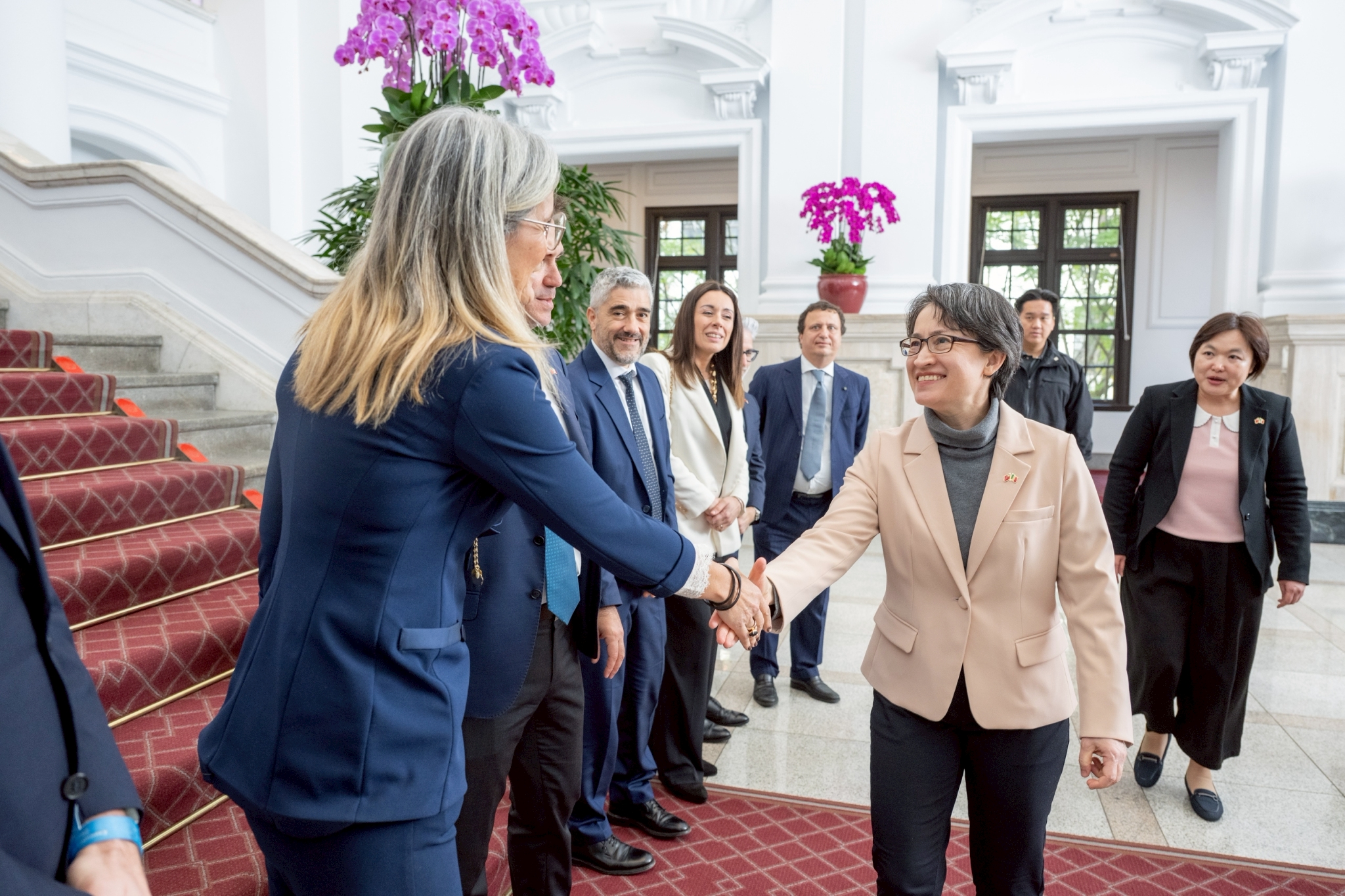
Taiwan’s relations with Europe have gone through steady development over the past five years. Catalyzed by a series of global disruptions, Europe’s relations with Taiwan have moved from the margins toward a broader recognition that strengthening ties with Taiwan contributes to Europe’s strategic autonomy and resilience. Picture source: Bi-khim Hsiao, January 8, 2026, Facebook, https://www.facebook.com/photo/?fbid=1454750269346751&set=pcb.1454750562680055&locale=zh_TW.
Prospects & Perspectives No. 3
Old Partners and New Friends: Despite Steady Growth, Taiwan-Europe Relations Need ‘Futureproofing’
By Matej Šimalčík
Taiwan’s relations with Europe have gone through steady development over the past five years. Catalyzed by a series of global disruptions—the COVID-19 pandemic, Russia’s invasion of Ukraine, China’s growing assertiveness, Europe’s growing expectations fatigue towards China, and the U.S. shift toward a more mercantilist and transactional foreign policy—Europe’s relations with Taiwan have moved from the margins toward a broader recognition that strengthening ties with Taiwan contributes to Europe’s strategic autonomy and resilience.
This shift is evident both from a quantitative as well as qualitative perspective. Data collected by the EU-Taiwan Tracker, a database maintained by the Central European Institute of Asian Studies, show that the volume of mutual engagements has grown more than fivefold since the beginning of this decade.
While in 2019 the database recorded only 58 engagements between Europe and Taiwan across political, economic, security, and subnational domains, in 2024 the volume rose to more than 300. A similar pattern can be observed also in mutual visits and delegations, a pinnacle of symbolic engagement with Taiwan. The volume of mutual visits has increased more than sixfold in the same period.

The normalization of mutual visits included not just an increase in engagement volume, but also a shift from covertness to the public spotlight, from unofficial interactions to formal meetings. This is well exemplified by the Vice President Hsiao Bi-khim’s address to the Inter-Parliamentary Alliance on China (IPAC) summit on the floor of the European Parliament in November 2025, or a chain of visits by the Foreign Minister Lin Chia-lung to several European countries through autumn 2025.
From political to security cooperation
However, Europe-Taiwan ties can’t be examined only through the lens of visits by senior officials. European legislatures increasingly voice their concerns about PRC assertiveness in the Taiwan Strait and push back against lawfare by the Chinese Communist Party (CCP). Several European states have concluded international agreements with Taiwan, focused on facilitating business and people-to-people connections, but also moving into much more sensitive and sovereignty implying field of judicial and legal cooperation.
Even security is no longer such a strict taboo, as three new dynamics help to unlock cooperation. First, in recent years, there has been an emergence of increasingly viable dialogue on matters of soft security. Countering Chinese and Russian foreign information manipulation and interference (FIMI), protection of critical infrastructure (such as undersea cables), economic security, and promotion of resilient supply chains are areas where the two sides have overlapping interests, as well as a corpus of learning experiences to share.
Second, defense-adjacent economic cooperation is also sensitizing Europeans to the idea of security, and even military, cooperation with Taiwan. This can be exemplified by new partnerships and joint ventures on drone production with Poland, Czechia, and the Baltic States, or Danish and French companies interests to alleviate Taiwan’s energy security risks.
Third, as Europe becomes increasingly aware of the intertwined nature of the European and Indo-Pacific security theaters, we also see a growing openness among major European naval powers to conduct freedom-of-navigation operations. In 2024, Dutch, German and French ships transited the Taiwan Strait, much to Beijing’s dismay. A year later, in September 2025, the UK traversed the Strait.
Four approaches to Taiwan across Europe
While most European states are increasingly open to engaging with Taiwan, they do so at differing speeds and with divergent risk appetites. Thus, while on the aggregate the ties between Europe and Taiwan have significantly improved, the picture looks slightly different when we disaggregate the ties to individual European states.
Based on criteria revolving around openness to political dialogue, maturity of economic ties, and the longitudinal trend of the relationship, CEIAS has categorized 30 European countries (EU27, Norway, Switzerland, UK) into four categories:
- Old Partners: Countries of Western Europe that have fairly broad and long-term relations with Taiwan, often dating back to the period of their diplomatic recognition of the Republic of China. These countries maintain robust economic ties with Taiwan and often engage with Taiwanese counterparts at the political level as well.
- New Friends: Countries of the Central and Eastern Europe region that, after a period of dormancy, (re-)discovered engagement with Taiwan at the beginning of the 2020s. They are often among the most politically active European states vis-à-vis Taiwan.
- Pragmatists: Countries that are quite wary (for a variety of reasons) of pursuing political relations with Taiwan, yet enjoy beneficial economic ties, sometimes even surpassing some of the more politically active states.
- Laggards: States with comparatively underdeveloped relations with Taiwan in both political and economic domains, and which would require wide-ranging changes in their approach to Taiwan to engender more robust (political or economic) ties with Taiwan. None of these countries currently maintains a representative office in Taiwan.

What can Taiwan do to ‘futureproof’ ties with Europe?
Still, this classification cannot be treated as static. The case of Slovakia illustrates this. Between 2020 and 2023 Bratislava was among the friendliest European capitals. In 2022 Slovakia even recorded the second highest volume of interactions (after Lithuania) among the EU member states. However, after the 2023 elections, the new populist government decided to favor ties with Beijing, leaving Taipei largely forgotten.
As we see populism rising across Europe, this experience should serve as a lesson that domestic political developments, changing foreign policy priorities, as well as exogenous factors can impact how individual European states treat Taiwan.
Hence, progressive development of ties with Taiwan is not a given. Taiwan must invest into “futureproofing” the relations by adopting measures ranging from low-hanging fruit to complex strategy adjustments across four pillars—economic resilience, political signaling, trust-building, and public diplomacy:
- Deliver on economic promises to avoid expectation fatigue in key partner states, where unmet pledges can contribute to erosion of Taiwan’s goodwill.
- Broaden economic cooperation beyond semiconductors by identifying overlapping interests and complementarities in high-tech sectors, such as aerospace and UAVs, clean energy, biotech, advanced machinery, photonics, artificial intelligence (AI) and data centers.
- Remove remaining trade barriers, especially non-tariff barriers, and push for a broad EU-Taiwan commercial agreement. If blocked, pursue an EU version of the UK-Taiwan Enhanced Trade Partnership.
- Leverage symbolic diplomacy strategically, as high-profile political gestures continue to normalize Taiwan’s presence and enable substantive follow-up cooperation. However, Taiwan should also offer low-risk engagement formats for reluctant states, signaling that high-level symbolism is not a precondition for mutually beneficial ties.
- Build ties across the political spectrum, including deeper party-to-party contacts and staff-level engagement to insulate relations from electoral volatility. Efficient dialogue requires that Taiwan prioritize rising, credible political interlocutors in major European parties rather than relying on former officials who often have limited influence after leaving office.
- Expand 1.5-track diplomacy and paradiplomacy by institutionalizing regular closed-door exchanges and scaling up city-to-city cooperation, both on a bilateral basis as well as via multilateral platforms like the Pact of Free Cities.
- Invest in public diplomacy as a core pillar, expanding scholarships, media cooperation, cultural programming, and tourism promotion to capitalize on increasingly favorable public opinion by turning passive goodwill into active support for Taiwan. This should include reframing Taiwan as a “solution provider,” emphasizing economic reliability, crisis resilience, and democratic governance rather than leading with threat-centric narratives.
- Improve external communications, ensuring unified messaging, better access to data about cooperation, and stronger internationally facing Taiwanese media.
This article is based on the introductory chapter of the report Partners in need, partners indeed? Tracking Europe-Taiwan relations amidst global disruption published by the Central European Institute of Asian Studies (CEIAS), of which the author was the lead editor.
(Matej Šimalčík is the Executive Director of the Central European Institute of Asian Studies.)
相關文章
Re-Establishing Deterrence in Taiwan’s Maritime Periphery Following the China-Indonesia Naval Exercise
In a Year of Global Upheaval, ASEAN Scrapes by, Divided but Resilient
The Pacific Islands Forum’s Leaders Meeting in Palau: Steering a Course Between Charybdis and Scylla?
The G7 Leaders’ Summit in France: An Unexpected Success
Maritime Security in Southeast Asia: Still Business as Usual?
What Does the U.S. War Against Iran Mean for the Indo-Pacific?
Japan’s High-Stakes Snap Election and Japan’s Role in the Indo-Pacific
The Indo-Pacific and the U.S. National Defense Strategy: From Rebalancing to Retrenchment
The “Justice Mission 2025” PLA Exercise and Japan’s National Security
Trump’s National Security Strategy and the Future of the World Order
President Trump’s National Security Strategy and Tensions Across the Taiwan Strait
Implications of the U.S.-Australia Summit’s Enhanced Bilateral Cooperation for the Indo-Pacific
 Facebook
  Youtube
  Twitter
  Podcast