



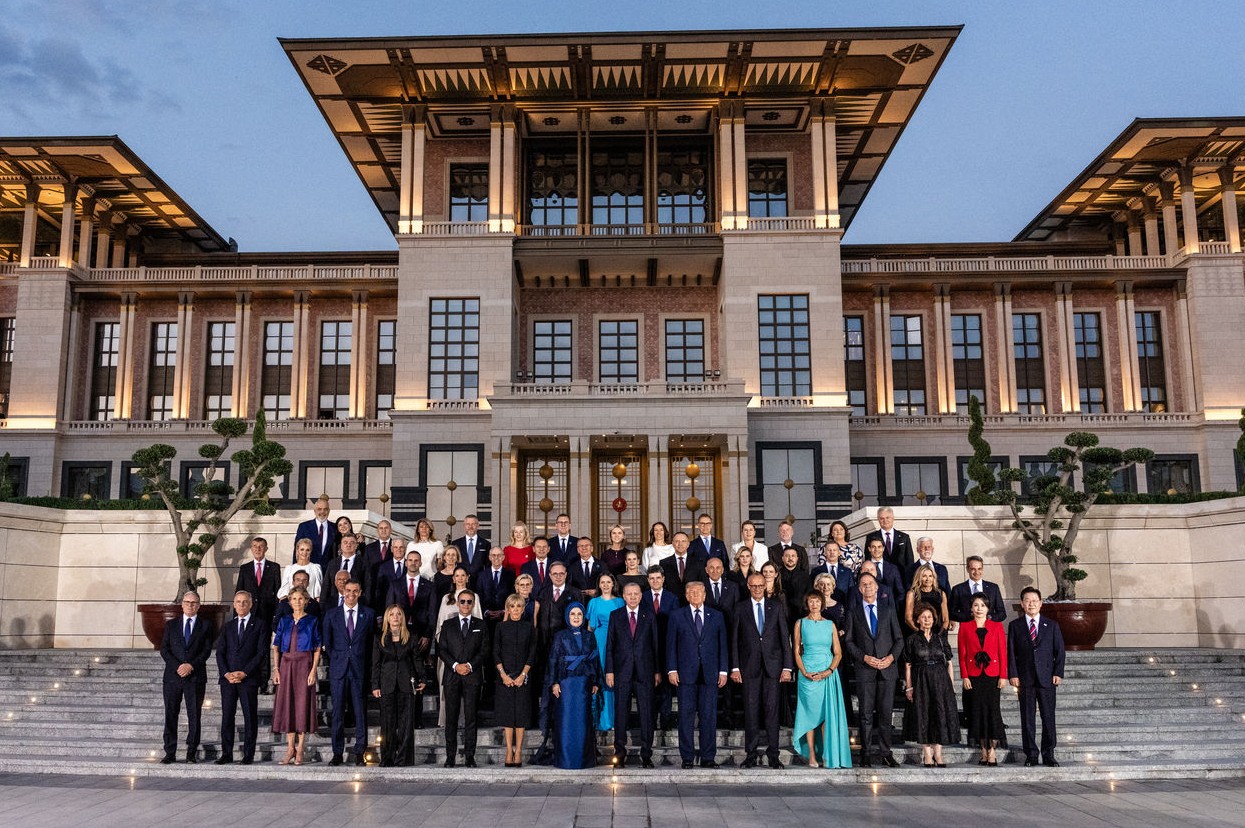
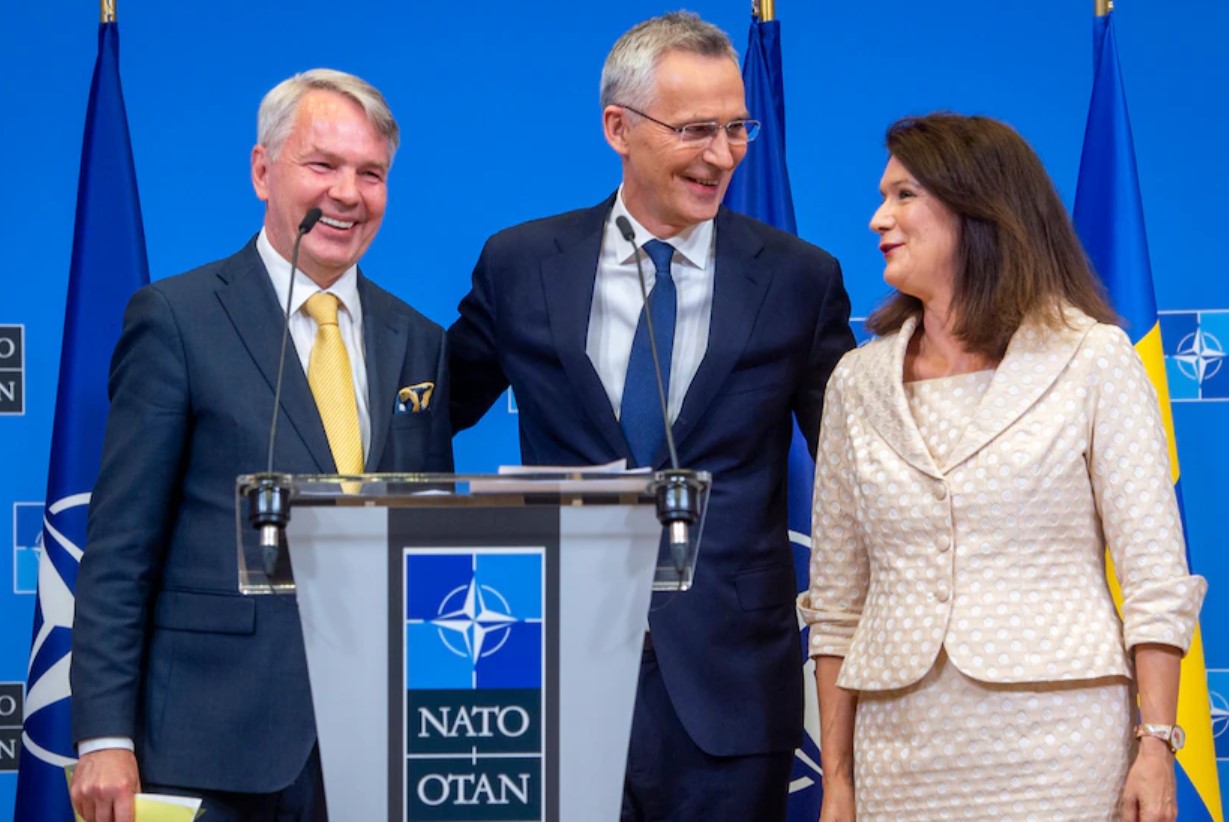
Faced with the current tensions in the transatlantic alliance, there is a growing consensus that the answer lies in the non-U.S. NATO members increasing their defense budgets. The obvious problem with this “spend more money” response is that it fails to get to grips with a more deep-seated structural problem. Picture source: NATO, July 8, 2026, NATO, https://www.nato.int/en/news-and-events/articles/news/2026/07/08/secretary-general-on-the-ankara-summit-nato-delivers.
Prospects & Perspectives No. 40
NATO, Transatlantic Security, and ‘Flexible Realism’
By Glyn Morgan
“NATO survives!”
That was the gist of the headlines following the annual NATO summit in Ankara in July 2026. Proponents of the transatlantic alliance breathed a sigh of relief that U.S. President Trump had not, as he had done on earlier occasions, threatened to pull out of NATO, thereby drawing the curtain on an alliance that had endured for nearly 80 years.
The relief did not, however, last long, because few can forget Trump’s repeated call for the U.S. to take control of Greenland. Moreover, Trump used the occasion of the Ankara summit to reiterate his familiar criticisms of his NATO allies: they were not spending enough on their own defense; they had failed to assist the United States in its Iran War; and they were taking advantage of the United States on trade.
Faced with the current tensions in the transatlantic alliance, there is a growing consensus that the answer lies in the non-U.S. NATO members increasing their defense budgets. If European states spend more money, especially if that money goes to U.S. arms manufacturers, the hope is that the U.S. administration will commit to the defense of Europe for another 80 years.
Structural problems
The obvious problem with this “spend more money” response is that it fails to get to grips with a more deep-seated structural problem. The United States no longer seems committed to the postwar international order that it constructed in the 1940s. The “American Europe” that resulted from United Nations, NATO, the IMF, GATT, and even the postwar project of European integration is largely a creation of the Roosevelt and Truman administrations. None would have existed without the diplomatic foresight and financial resources of the United States. European political leaders have been slow to recognize that the current Trump administration wants to dismantle “American Europe.” For the Trump administration, the effort to “Make America Great Again” entails remaking Europe in the image of a new “Civilizational America.” Neither NATO nor the project of European integration is wholly compatible with this Civilizational endeavor.
Why has the United States turned against its own European creation? There are three main reasons for this transformation. The first is the threat posed by China as a geopolitical competitor. The second is the threat posed by China’s manufacturing industry and control over key natural resources. And the third is the worry—forcefully expressed by Vice President J.D. Vance in his speech at the 2025 Munich Security Conference—that Europe and the United States no longer share a common set of values.
‘Middle-range’ powers
For a United States that is primarily concerned with China, the task left for Europe is to buy more weapons from the United States, while making itself less reliant on the U.S. for the defense of its own territory. Shortly after the Ankara Summit, Elbridge Colby, the Under-Secretary of War for Policy, reiterated, forcefully if controversially, precisely this position. Colby took pointed aim at any pretense of Europeans (and other “middle-range powers” like Australia and Canada) to pursue security autonomy. For Colby, the Trump administration are “flexible realists” who view the world “through the prism of interest, geography, economics, military power,” not through shared values. European states and other middle powers “don’t have a coherent basis for alignment” and would do better to accept their place, purchase those U.S. weapons systems that they are allowed, rather than waste "time, money, and political capital” pursuing autonomy.
“Middle-range powers” could not but be alarmed at Colby’s instruction to subjugate themselves to the United States. This diktat requires them to ignore the wide range of harmful actions and expressions of contempt directed towards them by the Trump administration. Examples here include: refusing to rule out military force against Denmark to grab Greenland; a trade war that pushed Canada’s tariffs to 50 percent; constant criticisms of the EU that it was formed “to screw the United States”; and the recent news that Trump wants to work with China and Russia to destroy the International Criminal Court.
Furthermore, Colby’s insistence that its NATO allies rely on the United States, assumes that allies should ignore reasonable, if officially denied, concerns that U.S. weapons systems—like the F-35 Fifth Generation jet, which Canada and Portugal have both considered abandoning in favor of Sweden's Gripen—come with a de facto “kill-switch,” leaving allies dependent on U.S.-controlled spare parts, software updates, and maintenance to keep their aircraft aloft.
In short, recent U.S. administrations have done much to destroy the generational trust that they established in the postwar era. In fact, a recent Pew survey of 36 countries found the United States is viewed more favorably than China in just six of them — mostly countries in Asia. Confidence in Xi Jinping outpaces confidence in Trump by double digits in Germany, Italy, Spain, Sweden, and the UK, while Canadians, who favored the US over China by 43 points in 2023, now favor China.
If the United States can no longer be trusted, what are the European members of NATO to do? One answer lies in a European appropriation of Colby’s concept of “flexible realism.” There is a certain grim logic to this. Colby reminds us that the Trump administration operates on the basis of “interest, geography, economics, and military power.” Europeans might well operate on the same basis. Fortunately, they have several theoretical options here, some bolder and more ambitious than others.
Strategies for the future
One option would be for European states, possibly in conjunction with Canada and other middle-range powers—the very coalition Colby pooh-poohed as lacking "a coherent basis for alignment” — to establish a new political entity that brings together the trade and security functions currently performed, respectively, by the EU and NATO. This new entity—call it EUTO—would mark a radical break with the postwar order and would establish Europe as a non-American Western pole in a multipolar international system. This EUTO option would, however, be enormously expensive and would require Europe to tackle its energy and technology dependencies. Not surprisingly, no major political party in any European country has EUTO on its agenda.
A second option—conceding that Colby is right that the “middle-range powers” lack “a coherent basis for alignment”—is for these powers each to go their own way. In Europe, this would give rise to a “Europe of nation-states,” a goal of many nationalist-populist parties. The drawback of this option is that it is far from obvious that all these nation-states would remain members of any Western pole, whether American or European. Some might, for example, choose to ally themselves with Russia; others might choose China. Viktor Orban’s Hungary provided a glimpse of what form a Europe of nation states might assume.
A third option, less radical than the previous two, would be for the Europeans to seek to sustain NATO through flattery and funds. This is the option exemplified by the current NATO Secretary-General Mark Rutte, who routinely praises the U.S. president as “the leader of the free world.” Rutte has helped Trump elicit more funds from European states and has persuaded NATO members to spend 5 percent of GDP by 2035. The hope of this Rutte strategy is that future U.S. administrations will prove more accommodating.
A fourth option—which has yet to be fully tried but is fully compatible with “flexible realism”—is to pursue a more Machiavellian version of the Rutte strategy. This would involve pretending to flatter and going through the motions of increasing funding, while in practice working to undermine hostile U.S. administrations. The aim here would be to retain the U.S. as a financial benefactor, while gaining more scope for independent action. In practice, this might involve Europe seeking closer ties with African states and others in the Global South. The obvious problem with this Machiavellian strategy is that it requires a level of diplomatic sophistication that Europe’s current leaders lack.
NATO summits are not the occasion for discussing the structural challenges facing Europe. Viewed in the light of the four options mentioned here, it looks like the Europeans are happy to pursue option three and so far, that option seems to be working, at least in the narrow sense of keeping the Trump administration nominally engaged, even if it does nothing to close the trust deficit noted above. But lurking in the background is the looming fear that a Europe that pins its security on a China-focused United States, doesn’t have much security at all.
(Glyn Morgan is Director of the Moynihan Center of European Studies at Syracuse University.)
Related Content
The Harder They Fall: Strategies for Countering Russia and China

From Crisis to Capacity: Europe’s Defense Evolution Amidst Transatlantic Strains
Sino-Russian Military Cooperation: Scenes from the Arctic
The Ukraine War Enters its Third Year

Ukraine’s Accession to the EU: There’s Still a Long Way to Go
Fueling War: China’s Military Assistance to Russia
After Vilnius: Key Take-Aways from the NATO Summit
Taiwan Foreign Minister Wu’s Visit to Prague, Taipei’s International Relevance Is on the Rise
The Foreign Relations Implications of Erdoğan’s Electoral Victory
Finland’s NATO Membership Sparks Binary Responses
Unwelcome Presidential Remarks, but a Clear and Unchanged French Position on the Taiwan Strait
The EU and Taiwan in the Indo-Pacific: Partners in Enhancing Multilateral Cooperation
 Facebook
  Youtube
  Twitter