



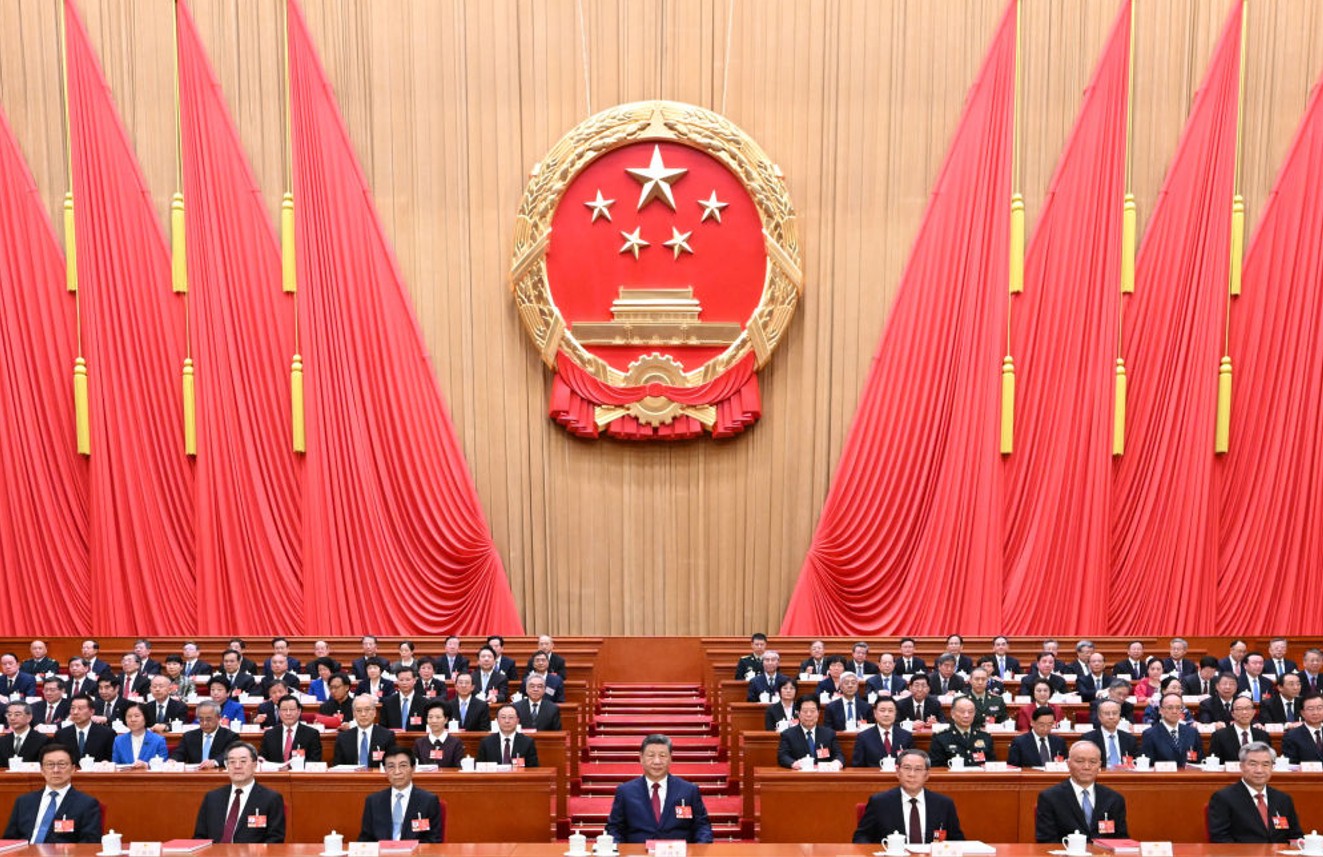
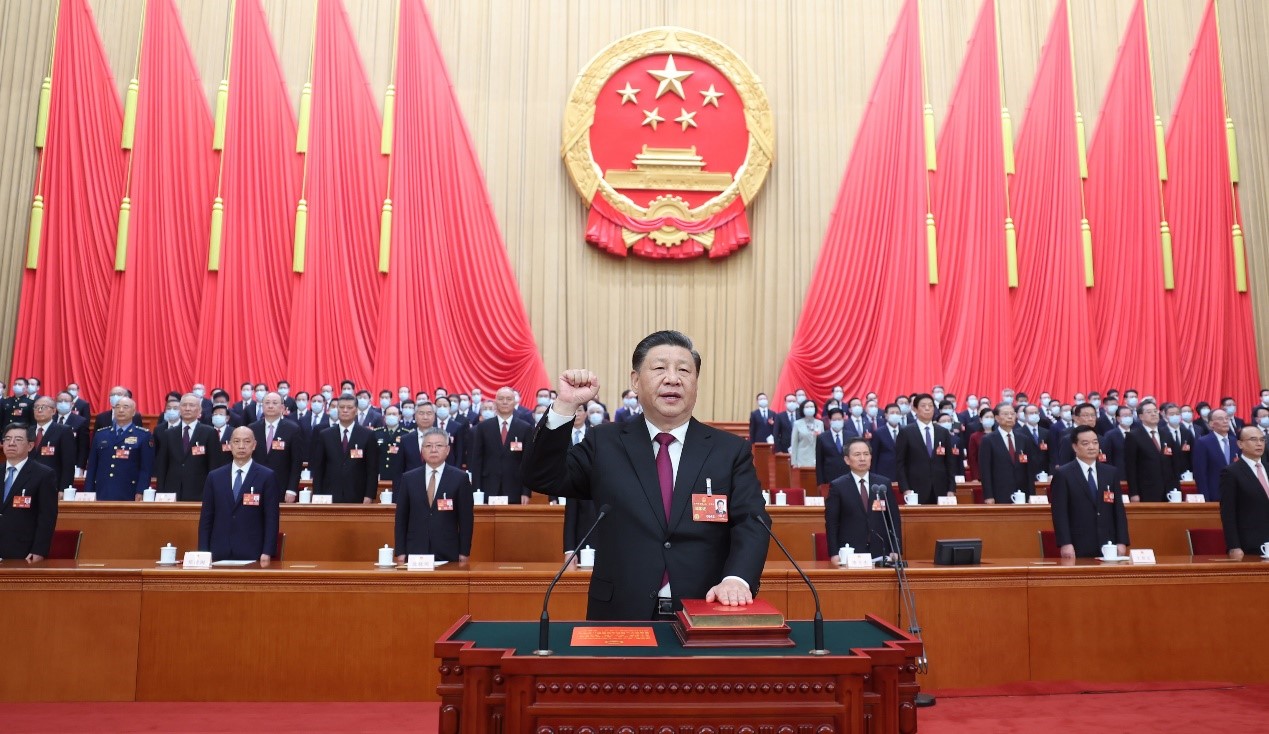
The policy signals delivered during the Two Sessions are economically and politically significant, as the National People’s Congress (NPC) reviewed and approved the 15th Five-Year Plan, which sets the direction for China’s economic development over the next five years. For the top leader Xi Jinping, the events provide instruments to shape the environment for securing another term as general secretary at next year’s Party Congress. Picture source: Ministry of Justice, PRC, March 12, 2026, Ministry of Justice, PRC, https://www.moj.gov.cn/pub/sfbgw/zwgkztzl/2026nianzhuanti/2026qglh0206/gdtp20260206/202603/t20260312_532682.html.
Prospects & Perspectives No. 19
Key Highlights of China’s Two Sessions
By Wei-Feng Tzeng
China’s Two Sessions held in March 2026 attracted close attention among China watchers. The meetings carried substantial economic weight, as the National People’s Congress (NPC) reviewed and approved the 15th Five-Year Plan, which sets the direction for China’s economic development over the next five years. They are politically important as well. For the top leader Xi Jinping, the events provide instruments to shape the environment for securing another term as general secretary at next year’s Party Congress. Therefore, the policy signals delivered during the Two Sessions are economically and politically significant. This paper briefly evaluates these signals across political, economic, and external relations dimensions, based on the documents and reports issued by the Chinese government during the Two Sessions.
Political signals: signs of Xi’s fourth term
When it comes to elite politics, the Two Sessions generally involve fewer overt political affairs than Politburo meetings led by senior Party leadership. That being said, the emphasis on loyalty and the wording used in the Government Work Report by Premier Li Qiang this year revealed certain messages regarding a potential fourth term for Xi.
One of the signals lies in the linkage between the completion of the 15th Five-Year Plan and Xi’s leadership. The Government Work Report at the start of a Five-Year Plan period typically outlines the Plan and expresses confidence in achieving its goals. In his briefing, Li states that “under the strong leadership of the Party Central Committee with Comrade Xi Jinping at its core, … [China] will surely be able to turn the grand blueprint of the 15th Five-Year Plan into reality.” What is notable is that this expression differs from that of the 2021 Two Sessions, when then-Premier Li Keqiang, referring to the 14th Five-Year Plan, stated that “we have the confidence and the capability to overcome the difficulties and obstacles on the path ahead and to accomplish the goals and tasks of the 14th Five-Year Plan.” The comparison shows that this year’s Government Work Report implies approval of Xi’s fourth term by explicitly linking “Xi’s leadership” with “turning the 15th Five-Year Plan into reality,” given that the completion of the Plan extends beyond 2027.
Moreover, Xi attended a People’s Liberation Army (PLA) delegation meeting during the Two Sessions, where he reiterated the principle of “politically building the military” (政治建軍) and warned that there must be no personnel with divided loyalties or involvement in corruption (軍中不得有二心之人、腐敗之人). This emphasis on loyalty suggests that Xi remains attentive to the consolidation of control over the military, an institution central to securing the conditions for a potential fourth term.
Economic dimensions: A lower growth target and shift in strategic industries
The Government Work Report this year lowered the annual GDP growth target for 2026 to 4.5%–5%, compared with 5% in 2025. Some commentators argue that this indicates the Chinese economy is facing serious challenges. While this interpretation is not unfounded, the lower target should not be taken as evidence that the Chinese Communist Party (CCP) has accepted economic slowdown as a new normal.
In fact, the target does not diverge from the CCP’s long-term goal of achieving socialist modernization. In 2025, the CCP Central Committee explicitly defined its 2035 long-range objectives as reaching the level of moderately developed countries, which entails doubling GDP per capita from its 2020 level. This would require China’s per capita GDP to exceed US$20,000. A rough calculation suggests that China can achieve this target if it maintains an average annual GDP growth rate of around 4.3% after 2026. As such, the 4.5% growth target remains a signal of the Chinese government’s confidence in realizing its 2035 objectives.
However, any economic slowdown still imposes pressure on the CCP in sustaining growth. The Government Work Report, together with the 15th Five-Year Plan, states that over the next five years the government will focus on two main tasks — building a unified domestic market to boost consumption, and developing new growth drivers through advanced technology industries. These two priorities imply that traditional drivers in economic development such as real estate and external trade will be treated as secondary.
External affairs: Signs of avoiding escalation but continued targeted struggle
As is usually the case, external affairs such as foreign policy and cross-Strait relations occupied only a small portion of the Government Work Report. However, they are still worth noting, as the wording in these limited passages may signal certain directions in this year’s policy.
On foreign policy, Li stated that China will “adhere to the path of peaceful development” (堅持走和平發展道路) and “expand [China’s] global network of partnerships” (拓展全球夥伴關係網絡). While the Report still includes the phrase “resolutely opposing hegemonism and power politics” (堅決反對霸權主義和強權政治), the overall tone remains calm and less aggressive.
Regarding Taiwan, the Report restates its policy principles such as “promoting the peaceful development of cross-Strait relations and advancing national reunification” (推動兩岸關係和平發展、推進祖國統一大業), as well as “deepening cross-Strait exchanges, cooperation, and integrated development” (深化兩岸交流合作和融合發展). These expressions suggest that the CCP seeks to avoid escalation in both foreign affairs and cross-Strait relations. A similar tone can be observed in remarks by Wang Yi at the Foreign Minister’s press conference, as well as by Wang Huning at the Taiwan Work Conference in February. However, Li Qiang also, somewhat unusually, referenced more specific policies such as equal treatment measures (同等待遇政策) in the Work Report. It clearly specifies that China will introduce more policies to attract Taiwanese businesspeople, students, and youth to China.
Nevertheless, we should not expect that the CCP will adopt a benign stance toward its rivals. The Report explicitly opposes hegemonism and power politics, language that is widely understood to target the United States and its global posture. For the cross-Strait section, the Report states that China will “resolutely crack down on ‘Taiwan independence’ separatist forces and oppose external interference” (堅決打擊“台獨”分裂勢力,反對外部勢力干涉), targeting Taiwan’s incumbent Democratic Progressive Party (DPP) and its growing ties with the United States. In other words, in terms of external policy, the signals from this year’s Two Sessions suggest an aversion to escalation alongside continued, and even strengthened, struggle (鬥爭) against targeted rivals.
Conclusion
China’s 2026 Two Sessions marked certain changes in policy directions. Economically, the CCP lowered the target in economic growth but pursues a qualitative shift in industrial drivers and domestic markets. Politically, we also see implicit approval for a fourth Xi term. For external relations, the CCP seems averse to conflict escalation, which might be due to its prioritizing economic development over external issues. However, the Work Report also suggests there is no sign of the CCP’s abandonment of the principle of struggling against targeted rivalries. It should be expected that the CCP will continue to adopt a dual track approach towards the United States and Taiwan.
(Wei-Feng Tzeng is Associate Research Fellow, Institute of International Relations, National Chengchi University.)
Related Content
China’s ‘Two Sessions’ and Their Impact on the Situation in the Taiwan Strait
Analysis of China’s Strategy Toward Taiwan After the Two Sessions
China After General Zhang Youxia’s Purge
The CCP’s 4th Plenum: Is China on the Right Path?
An Old Dog’s New Tricks? China’s United Front Work and Taiwanese Internet Personalities
Ramifications of the Hong Kong Safeguarding National Security Ordinance
China’s Sweeping New ‘Foreign Policy Law’: Scope and Implications

Lessons for Europe from Lu Shaye's Controversial Interview
Canada Grapples with CCP Interference
Gallagher’s Committee on China: What Can We Expect?
Analyzing the CCP’s Strategy on Taiwan from China’s Two Sessions Report
What Can Taiwan and China Expect from the New U.S. Congress?
 Facebook
  Youtube
  Twitter