
Strategizing the New Southbound Policy: A Fruitful Journey of a Decade


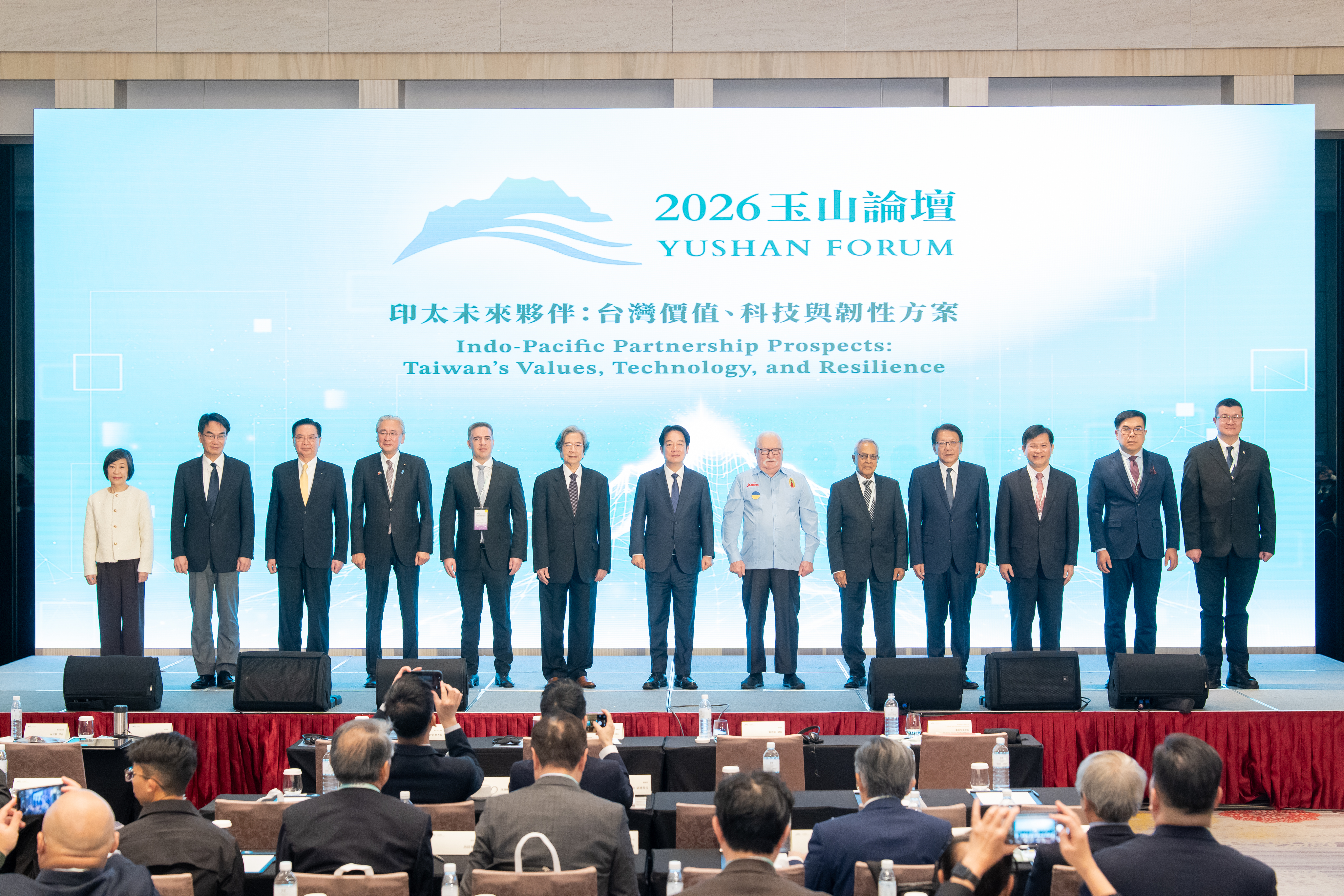
The New Southbound Policy not only accomplished its original aim of diversifying economic risks away from dependence on a single market — that is, China — but the regional partnerships it has built are very vibrant and resilient today. Through people-to-people exchanges and practical measures, the NSP has created multifaceted partnerships between Taiwan and its neighboring countries. Picture source: TAEF, March 16, 2026, Yushan Forum, https://www.yushanforum.org/photos.php?id=1436&ch.
Prospects & Perspectives No. 42
Strategizing the New Southbound Policy: A Fruitful Journey of a Decade
By Alan Hao Yang
The New Southbound Policy (NSP) is a regional strategy for Asia put forward by President Tsai Ing-wen after she took office in 2016. It was carried out during the two terms of the Tsai presidency and has continued into President Lai Ching-te’s first term, with its status raised from “NSP” to “NSP+.” This marks the first and most concrete Asian strategy in the long history of the Republic of China (Taiwan), and it is also, without question, Taiwan’s most effective diplomatic initiative.
The NSP not only accomplished its original aim of diversifying economic risks away from dependence on a single market — that is, China — but the regional partnerships it has built are still active today. Through people-to-people exchanges and practical measures, the NSP has created multifaceted partnerships between Taiwan and its neighboring countries. This year marks the 10th anniversary of the NSP, making it timely to look back at its achievements, underline its current significance, and its important value for Taiwan’s diplomacy and international presence. This also helps us think about the next steps for President Lai’s foreign policy of values-based diplomacy. For these reasons, this article will summarize the three most important achievements as well as their strategic meanings, and outline the three main challenges ahead for the NSP/NSP+.
Strategic achievement I: Establishment of a flagship international forum annually hosted by the Taiwan-Asia Exchange Foundation (TAEF) and the Ministry of Foreign Affairs
The Yushan Forum, initiated by Taiwan and supported by international partners, was launched in 2017 with the mission of encouraging regular visits to Taiwan by high-level officials and leaders from around the world. Since Taiwan’s international space is heavily constrained due to interference by the People’s Republic of China (PRC), the creative use of Host Diplomacy is essential for Taiwan to better connect internationally. Since 2017, Taiwan has held the inaugural Yushan Forum, now in its ninth year, while in 2027 the 10th edition of the Forum will continue to underscore Taiwan’s international contributions and global partnerships.
International dignitaries who have participated include former prime ministers or presidents from Australia, Poland, Fiji, Denmark, Canada, Slovakia, Sweden; former deputy prime ministers or vice presidents from the Philippines, Thailand, Indonesia and New Zealand; former or incumbent ministers from Thailand, the Philippines, Korea, New Zealand, Canada, Poland, Paraguay, Lithuania, New Zealand, Bulgaria, Czech Republic; various speakers of parliament, and important parliament leaders from NSP partner countries such as Singapore, Malaysia, Indonesia, as well as incumbent and former members of parliament from Japan, the United States, Korea, Malaysia, and Singapore. These participants have not only shown their supports for the rule-based and value-based international Order that include Taiwan, but have also shared ideas for cooperation with Taiwan through talks and exchanges with Taiwanese leaders via Yushan Forum.
Strategic achievement II: Enabling think tank diplomacy in line with the NSP has encouraged dialogue and cooperation between Taiwan and partner countries, boosting Taiwan’s multi-faceted engagement and influence across the NSP region
Established in 2018, TAEF has taken on the role of a national think tank for the NSP. Through ongoing operations in key action areas like think tank cooperation, civil society and NGOs connectivity, youth leadership, regional resilience, and arts and cultural exchanges, TAEF was recognized as one of the global best new think tanks and started a new chapter in enriching people-to-people engagement within the NSP by facilitating think tank diplomacy. This includes launching the strategically important Taiwan-India Dialogue (starting in 2022) and the Taiwan-Philippines Dialogue (to start in 2027), as well as promoting President Lai’s NSP+ vision through think tanks, NGOs, and youth corridors including the launch of the Think Tank Summit (2025), the Youth Assembly (2026), and the NGO Congress (2026). All have become new channels and mechanisms in addition to the annual Yushan Forum.
Strategic achievement III: the NSP has succeeded in diversifying Taiwan’s over-dependence on a single market and de-risking Taiwan’s economic risks, while also building multifaceted partnerships with its neighbors and like-minded countries
The vivid proof of this achievement is that the share of Taiwanese investment in China out of total outbound investment dropped from a high of 83.8% in 2010 to about 3.75%-3.8% in 2025 — a record low — and is expected to keep falling in 2026. In addition, key government efforts in NSP flagship programs shouldered by various ministries have facilitated trade and economic supply chain connectivity, education and talent cultivation, medical and healthcare cooperation, and regional agriculture. These have helped Taiwan establish and consolidate partnerships with its neighbors. These efforts include setting up agricultural demonstration farms, 13 overseas NSP medical centers in various countries, talent development programs, and training programs for disaster prevention and firefighting personnel. Such initiatives not only help de-risk the over-reliance on a single market, but also make Taiwan an indispensable and even more reliable, partner for its neighbors.
Alongside these important achievements, many private sector efforts are also taking root in Taiwan and the region. Still, as the world changes quickly, Taiwan’s NSP/NSP+ continues to face several challenges ahead, the most pressing of which are the following three:
- The pressing structural impacts and reshaping forces of great power politics on the international system
China is using ASEAN’s post-pandemic economic recovery and reconstruction efforts to extend its influence over related cooperation agendas. Nonetheless, the reciprocal tariffs and “America First” policies pursued by the United States during Donald Trump’s second term have also affected neighboring NSP countries, which in turn influences Taiwan’s strategic position.
- Emerging strategic interests and engagement in the Indo-Pacific region by global major powers
So far, at least 16 countries and international organizations worldwide have announced concrete actions to support their Indo-Pacific strategies and policies, with a large overlap between their target countries and those of Taiwan’s NSP/NSP+. This shows there is a shared global understanding of the importance of the Indo-Pacific strategy and means Taiwan needs to quickly clarify its own specific goals and actions for how it will respond, take part, and utilize these strategies to build deeper cooperation with like-minded countries.
- China is increasing its overall pressure against Taiwan, aiming to weaken public trust and support for the presidency and its government, stir up internal confusion and distrust, and thereby undermine and push aside the government’s foreign policy
The NSP’s strategic achievement started with diversifying risks through trade and economic measures, but after years of operation, it has evolved and expanded to multi-faceted connectivity with NSP partners and like-minded countries. What is imperative for Taiwan in this era of uncertainty is to stand firm with the NSP+ by embracing a broader Indo-Pacific vision. Taiwan’s presence and practices via an assertive Indo-Pacific strategy and policy should be built on what the NSP/NSP+ has already achieved. It should aim to strengthen new channels for international cooperation, and connect with the local priorities of the various global Indo-Pacific strategies and policies around the world so that Taiwan can become an even more reliable partner in a world that is going through drastic changes.
(Alan Hao Yang is a professor at National Chengchi University, Taiwan, and Executive Director of the Taiwan-Asia Exchange Foundation, Taiwan.)
相關文章
Time to Break Old Taboos: Pavel’s Call with Tsai as A New Normal
The Summit for Democracy and the Role for Taiwan
After Two Trump-Xi Summits: Competing Within Limits
Strengthened Yet Threatened Relations: Taiwan’s Diplomatic Ties with Latin American Countries
Beijing’s Intensifying Pressure on Taiwan’s Passport and Consular Affairs
What If the Quarantine of Taiwan Has Already Begun?
PM Carney’s Bold New Vision: The Good and the Bad
A Geopolitical Inflection Point: The Deeper Implications of the U.S.-Taiwan Reciprocal Tariff Agreement for Bilateral Relations
Feeding the Porcupine: The U.S. December 2025 Arms Sales to Taiwan
‘Tiger Head with a Snake Tail’: The PLA’s ‘2025 Justice Mission’ Exercise

The CCP’s 4th Plenum: Is China on the Right Path?
U.S. Reciprocal Tariffs and Implications for Taiwan
 Facebook
  Youtube
  Twitter
  Podcast