

Beijing’s Intensifying Pressure on Taiwan’s Passport and Consular Affairs


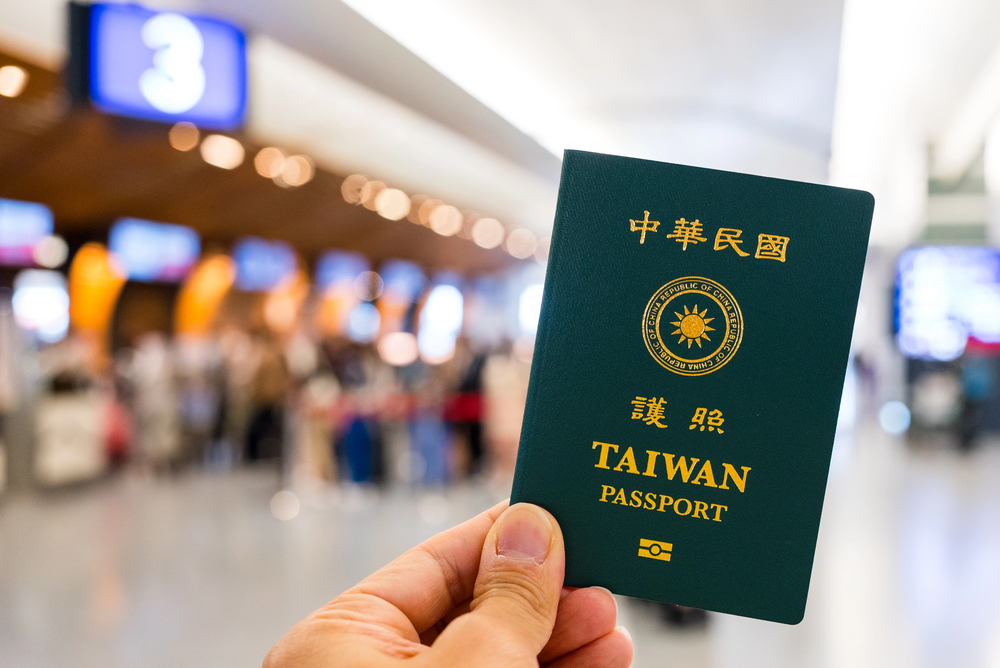
In recent years, Beijing’s pressure on Taiwan has expanded beyond military coercion, gray-zone activities, and diplomatic isolation. It increasingly combines lawfare, diplomatic pressure, gray-zone operations, and transnational repression. Picture source: Depositphotos.
Prospects & Perspectives No. 45
Beijing’s Intensifying Pressure on Taiwan’s Passport and Consular Affairs
By Fang-Yu Chen & Po-You Chen
In recent years, Beijing’s pressure on Taiwan has expanded beyond military coercion, gray-zone activities, and diplomatic isolation. It increasingly combines lawfare, diplomatic pressure, gray-zone operations, and transnational repression. At the core of this strategy is Beijing’s “one China principle,” which it seeks to transform from a diplomatic claim into an administrative norm applied by governments, international organizations, and multinational corporations.
Unlike the past, when Beijing primarily sought to constrain Taiwan by persuading countries to sever official diplomatic relations with the Republic of China (ROC), it now increasingly attempts to incorporate its interpretation of the one China principle into everyday administrative procedures. These include electronic visa systems, immigration databases, official websites, international conference registration, passport procedures, the naming of representative offices, and aviation regulations, among other things. By embedding its political narrative into routine administrative practices, Beijing seeks not merely to make diplomatic statements, but to gradually reshape international perceptions of Taiwan.
The Lowy Institute’s 2025 report, Five One-Chinas: The Contest to Define Taiwan, shows that countries maintain different interpretations of their respective “one China” policies. These policies do not necessarily correspond to Beijing’s “one China principle.” Nevertheless, Beijing has increasingly attempted to export its interpretation internationally and pressure foreign governments and institutions to incorporate it into both diplomatic statements and administrative practices.
Since 2026, this pressure has become particularly visible in relation to the ROC passport, consular affairs, and Taiwan’s overseas representative offices. These developments affect not only the practical rights of Taiwanese citizens but also Taiwan’s international visibility and ability to operate as a distinct political entity.
From individual cases to institutionalized lawfare
This trend has developed over many years. In 2016, Kenya deported Taiwanese nationals involved in telecommunications fraud cases to China rather than Taiwan, limiting Taipei’s ability to provide consular protection. The case demonstrated how Beijing could extend its one China principle into international judicial cooperation and consular affairs.
Beijing’s pressure has also targeted international organizations and multinational corporations. Since 2017, Taiwan has been excluded from the World Health Assembly — the World Health Organization’s decision-making body — and other international organizations. In 2018, China pressured more than 40 international airlines to alter the way Taiwan was identified on their websites and booking systems. Multinational companies such as Marriott and Gap were similarly pressured to modify references to Taiwan after coming under scrutiny from Chinese authorities. These cases demonstrated that Beijing was increasingly willing to use its market power and regulatory authority to extend its political demands beyond governments and into the private sector.
More recently, digital administrative systems have become another arena of pressure. Controversies involving Taiwan’s designation in South Korea’s electronic arrival card system and South Africa’s Electronic Travel Authorization system illustrate how immigration and digital-government platforms can become politically contested spaces. Systems originally designed as neutral administrative tools may therefore reproduce Beijing’s political terminology and directly affect Taiwanese travelers.
In 2026, further cases demonstrated the breadth of this trend. Mauritius, Madagascar, and the Seychelles reportedly revoked overflight permissions for President Lai Ching-te’s aircraft; Kenya restricted the participation of Taiwanese representatives carrying ROC passports at the Our Ocean Conference; and South Africa continued to pressure Taiwan over the location of its representative office. Papua New Guinea abruptly announced the closure of Taiwan’s Trade Office in Port Moresby without prior warning. Together, these cases indicate that Beijing’s pressure increasingly extends from diplomatic recognition to aviation, immigration, consular affairs, and the operation of Taiwan’s overseas institutions.
Lawfare and transnational repression
These developments should not be viewed as isolated incidents. Rather, they reflect a broader effort to transform a political claim into an administrative norm.
First, Beijing is extending its one China principle from diplomatic recognition into administrative governance. Electronic visas, immigration systems, official databases, international conferences, and representative offices can all become instruments through which Beijing’s political position is institutionalized.
Second, this approach is reinforced by China’s domestic legal framework, including the Anti-Foreign Sanctions Law and other legislation and policies related to counter-interference and national unity. Domestic law, foreign policy, and administrative measures increasingly operate as mutually reinforcing components of China’s external influence.
Third, Beijing’s strategy increasingly exhibits characteristics of transnational repression. Its targets are no longer limited to the Taiwanese government. Third-country governments, international organizations, corporations, and civil-society organizations may all become channels through which Beijing’s political demands are implemented.
The controversy surrounding RightsCon 2026 illustrates this broader concern. The international digital-rights conference, organized by the nonprofit Access Now, was reportedly subjected to Chinese pressure because Taiwanese individuals and organizations were expected to participate, ultimately contributing to the cancellation of the event, which that year was to be held in Lusaka, Zambia. Such incidents suggest that Beijing’s influence can extend beyond cross-Strait affairs into international civil society, human-rights advocacy, and democratic governance. We believe the international community must take this matter seriously with due caution, as this is not an issue that concerns Taiwan alone.
Policy recommendations
Taiwan must move beyond case-by-case diplomatic protests and establish a comprehensive response mechanism. Beijing’s strategy is cross-sectoral, transnational, and cumulative; Taiwan’s response must therefore be systematic.
First, the Taiwanese government must establish a dedicated task force to counter such coercion. Because China’s suppression spans a broad scope with increasingly diverse and systematic tools, Taiwan’s response in each case cannot rely on a single ministry alone; it inevitably spans different ministries and jurisdictions. Therefore, a more rapid response mechanism—at least one coordinated across ministries at or above the level of Minister without Portfolio— is necessary.
The top priority for such a response mechanism is to establish a standard operating procedure (SOP) for countermeasures. This will accelerate the government’s response time while also demonstrating policy consistency to other countries. The president and the national security team could designate the Ministry of Foreign Affairs (MOFA) as the coordinating agency to formulate risk assessments and initiate standard operational procedures for countermeasures. At the same time, the national security team or a Minister without Portfolio could take inventory of the policy tools available across various ministries. For instance, across areas such as economic investment, official exchanges, foreign aid programs, and bilateral exchange mechanisms, there should be standardized action plans ready for immediate activation whenever an incident occurs, rather than deliberating on responses only after an event takes place. Establishing such a standardized mechanism will enable all ministries to act synchronously according to their respective jurisdictions and established procedures.
Second, Taiwan should strengthen its engagement with the Global South. Economic cooperation alone does not automatically generate diplomatic support. Taiwan should therefore integrate economic relations with public diplomacy, parliamentary exchanges, local-government cooperation, think-tank partnerships, media exchanges, and youth programs. The goal should be to transform economic ties into broader political and institutional relationships.
Third, Taiwan should actively clarify the distinction between the “one China policy” and Beijing’s “one China principle.” Many democratic governments maintain their own one China policies without recognizing Taiwan as part of the People’s Republic of China or accepting all of Beijing’s legal claims concerning Taiwan. Taiwan should communicate this distinction more systematically through diplomatic, academic, and public-diplomacy channels, particularly in the Global South.
Last but not least, Taiwan should strengthen cooperation with like-minded countries and international organizations on international law, public diplomacy, and countering transnational repression. It should systematically document cases in which Beijing uses administrative procedures, digital systems, international organizations, or private corporations to constrain Taiwan’s international space. Increasing the international political costs of such practices can help deter further normalization.
In conclusion, the challenge facing Taiwan is increasingly a contest over the rules and practices through which international governance operates. Taiwan must be well-prepared to raise the costs for China when it employs these coercive tools.
(Dr. Fang-Yu Chen is Associate Professor of Political Science at Soochow University in Taiwan. Po-You Chen is a student in political science at Soochow University in Taiwan.)
相關文章
What If the Quarantine of Taiwan Has Already Begun?
PM Carney’s Bold New Vision: The Good and the Bad
An Old Dog’s New Tricks? China’s United Front Work and Taiwanese Internet Personalities

Beyond a Rhetorical Defense of Taiwan
The U.S.’ Security Package: Implications for Taiwan and the Indo-Pacific
Taiwan Enters a New Age: Continuity and Change
Taiwan’s Role in the US-Japan-Philippines Alliance
China’s Claim of the Taiwan Strait as ‘Inland Waters’ and the Kinmen Incident

The Impact of China’s Suspension of the ECFA on Cross-Strait Relations
Taiwan’s 2024 Presidential and Legislative Elections: Implications for the Region

The Ukraine War: Lessons in Preparedness for Taiwan

Washington Needs Strategic Clarity and Resolve to Deter Chinese Aggression Against Taiwan

 Facebook
  Youtube
  Twitter
  Podcast