

The Trump-Xi Summit: What It Was Not is More Important than What It Was


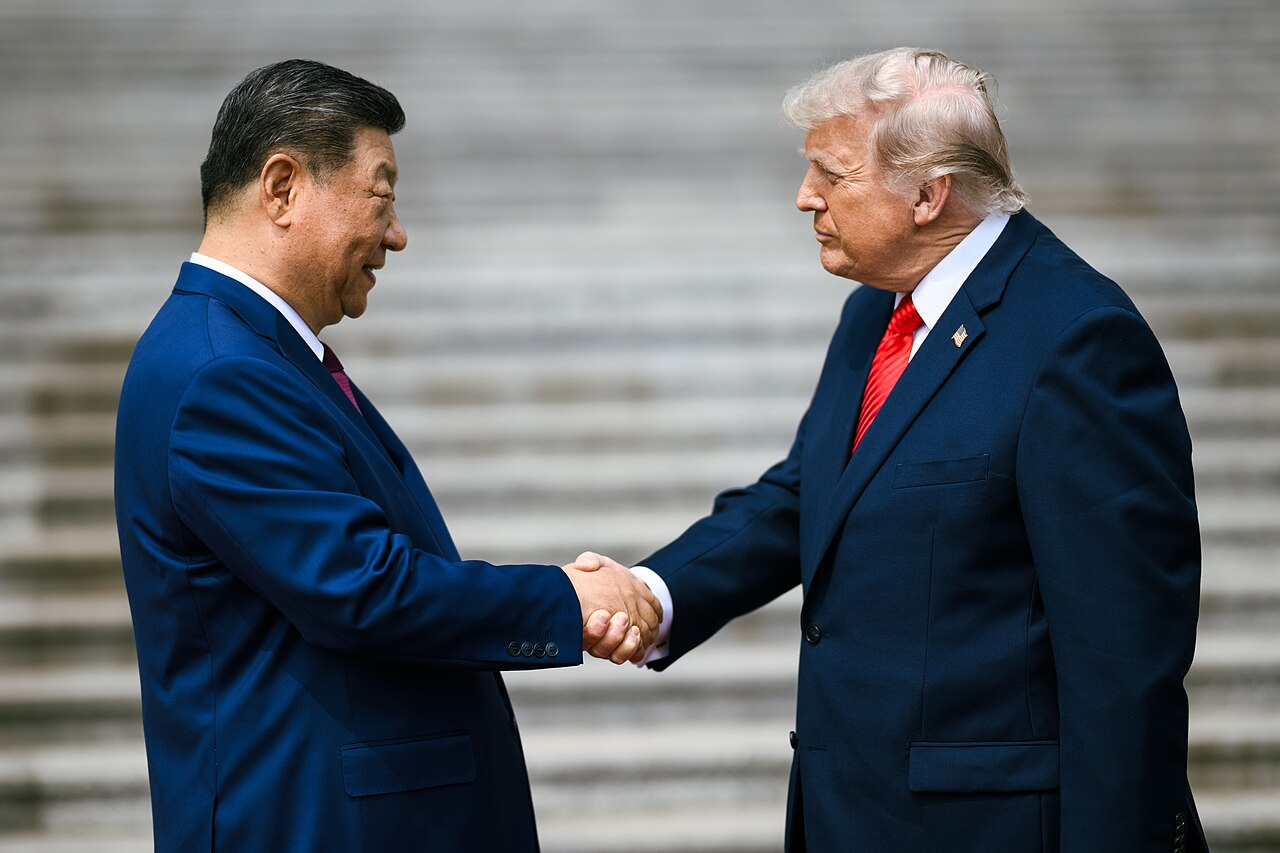
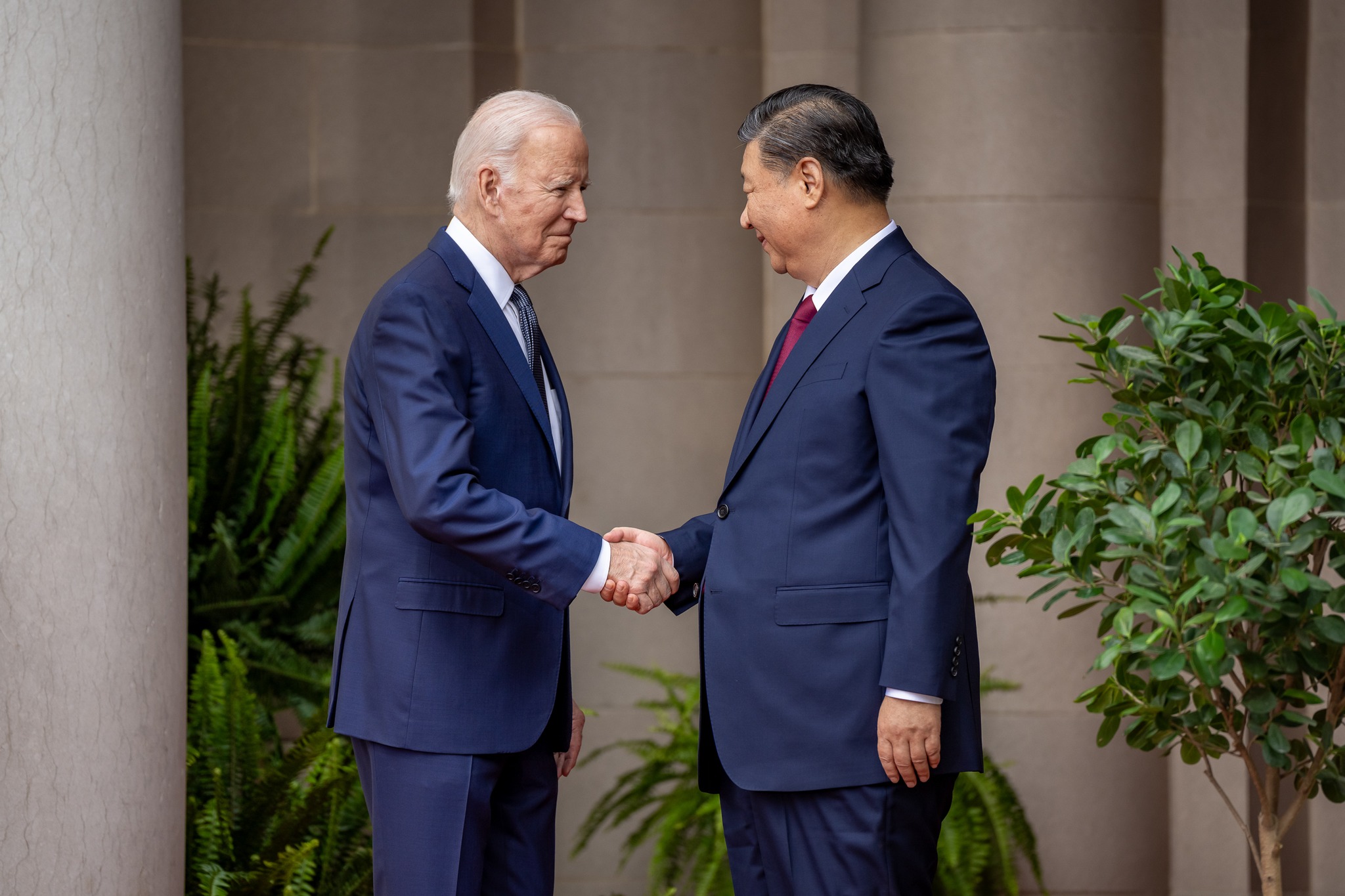
Washington is unlikely to cut a big deal with Beijing at the expense of its friends and allies – much less enter into a “G-2” – for the foreseeable future. The summit is over. Time to return to the work of countering the PRC’s narrative warfare. Picture source: The White House, May 13, 2026, Wikipedia, https://en.wikipedia.org/wiki/2026_state_visit_by_Donald_Trump_to_China#/media/File:Donald_Trump_visit_to_China,_May_2026_P20260514DT-0841.jpg.
Prospects & Perspectives No. 30
The Trump-Xi Summit: What It Was Not is More Important than What It Was
By Markus Garlauskas
The recent summit in Beijing between President Donald Trump and Chairman Xi Jinping received perhaps the most pre-summit global public attention for any meeting since President Trump’s 2018-2019 meetings with North Korean leader Kim Jong Un. Among many of those most concerned about threats posed by the People’s Republic of China (PRC) — in Washington, D.C., among U.S. treaty allies, in other regional countries, and in Taiwan itself — there was palpable unease and no shortage of worried speculation. Similar to some of the public commentary prior to the Trump-Kim meetings, however, most of the fears and hopes for the summit did not come to pass. This outcome should not have been surprising, and it provides us with an opportunity to clear up misconceptions and address concerns.
Thanks to my position leading the Indo-Pacific Security Initiative of the Atlantic Council’s Scowcroft Center in Washington, and having conducted a research trip to Japan, Taiwan, and South Korea in the weeks prior to the summit, I had several opportunities to hear concerned views firsthand. Worried narratives about what could come to pass generally fell into three categories. First, there was the fear in the region that this summit could mark a transition to a “G-2” in which the new paradigm of world order would be that the leaders of the PRC and the U.S. would jointly determine the agenda for the region and the world. Second, there were fears, particularly among those most worried about PRC coercion against Taiwan, that Xi would be able to maneuver Trump into concessions compromising Taiwan’s security. Third, more broadly, there were expectations that a dramatic “bargain” would be struck, perhaps one designed to narrowly benefit only some in the U.S. and the PRC.
All three of these concerned narratives seemed premised on the idea that Xi and the PRC were going into the summit from a strong position relative to Trump and the U.S., itself a problematic assumption. Ironically, though these narratives were in many ways driven by those most aware of the threat posed by the PRC expressing their concerns, these very narratives could be used to advance the PRC’s interests – by eroding the confidence of those looking to U.S. leadership in confronting the PRC, while making Xi and the PRC look stronger than they are.
No ‘G-2’: Asymmetric leaders, different coalitions
The summit was definitely not the “G-2” moment that some were worried it might become. If anything, the coverage and results of the summit highlighted the fundamental asymmetries between the two leaders and what they represent.
President Trump came to the meeting at the pinnacle of executive power in what is still the world’s most powerful country – one still looked to by many others for leadership, still relied upon by many for extended deterrence, and still possessing the world’s largest economy and primary reserve currency. However, he also represents heterogeneous coalitions domestically and internationally, coalitions that have many shared interests alongside deep differences of view on how to balance economically beneficial transactions with the PRC versus countering the various threats that the PRC poses. There are such policy differences within his own party and even his own cabinet. Xi, in contrast, “leads” a very different type of de facto coalition. Russia, North Korea, and even Iran, and perhaps a few other states, have shared interests explicitly aligned with the PRC’s, but are collectively weaker and do not yet look to Beijing’s leadership as U.S.-allied countries still look to Washington’s. Meanwhile, though the Chinese Communist Party (CCP) and the PRC itself are not fully monolithic and include constituencies with differing interests, Xi can compel domestic obedience in ways Trump cannot.
This asymmetry probably did not provide Xi with useful leverage over Trump, while it did clearly limit how much Xi could get out of the summit. Many of the things Xi probably most desires, such as the unfettered continuation of the PRC’s economic leverage internationally and the surrender of Taiwan to CCP rule, were simply not President Trump’s to give unilaterally.
No Taiwan giveaway: Do not feed the CCP propagandists
Fears of a deal that would undermine Taiwan’s security abounded in the run-up to the summit. The most extreme of these were farfetched. The idea that Taiwan could or would be “sold” by Trump to the PRC in some sort of bilateral deal like Czechoslovakia was in the 1938 Munich agreement between British Prime Minister Chamberlain and German Chancellor Adolf Hitler was always implausible. However, some had the more apparently plausible fear that Trump would trade away a meaningful concession on Taiwan, perhaps even a purely rhetorical one, that would help further Beijing’s coercive agenda to intimidate Taiwan into submission.
Ironically, the very public focus of so many critics of Trump on this issue may have done more to advance this agenda, by exaggerating the fragility of U.S. support for Taiwan, than anything that happened at the summit. Official U.S. messaging of the results of the summit showed little sign of concession to Xi on Taiwan, though admittedly the President’s own later comments on U.S. arms sales to Taiwan were mixed. Trump’s apparent willingness to even discuss arms sales to Taiwan with Xi was a break from past policy that could be seen as an unsettling concession to Beijing, but in the same interview he also mentioned he would speak to Taiwan’s leader about it – which would be a U.S.-Taiwan president-to-president communication, breaking from precedent in a way unfavorable to Beijing.
No flashy ‘big bargain’: Focus on the shadowy small struggles instead
Before the summit, many speculated about what sort of high-profile bargain would be struck. In the end, there was no such deal to be had, and it is the absence of such a bargain that should serve as a reminder of how deep the differences are between Beijing and Washington and of how difficult it is for one to dictate terms to the other, making such summits likely to be inconclusive. Those who see the long-term and severe challenges posed by the PRC to their interests, prosperity, and freedom, should recognize that such summits can end up being distractions. The struggle to hold off and roll back Beijing’s agenda – to coerce its neighbors, undermine democratic political systems, and wield economic leverage – will require persistence and focus, while remaining incremental, largely low-profile, and lacking in the public glamor of summitry.
The aftermath of the summit should also be an opportunity to revisit some of the implicit assumptions that led to the exaggerated fears of what might occur, and a reminder that voicing such fears can just empower CCP narratives – like those that paint the PRC as an inevitably rising power and the US as a declining, untrustworthy power. In reality, Xi is not in as strong a position as he is trying to project. Washington is unlikely to cut a big deal with Beijing at the expense of its friends and allies – much less enter into a “G-2” – for the foreseeable future. Washington is similarly unlikely to make such a deal to abandon Taiwan. The summit is over. Time to return to the work of countering the PRC’s narrative warfare.
(Markus Garlauskas is the director of the Indo-Pacific Security Initiative of the Scowcroft Center for Strategy and Security at the Atlantic Council.)
相關文章
Trump-Xi Summit and the Security Situation in the Taiwan Strait
After Two Trump-Xi Summits: Competing Within Limits
President Lai’s Second-Year Address and Prospective Developments in Cross-Strait Relations
The Indo-Pacific and the U.S. National Defense Strategy: From Rebalancing to Retrenchment
Narrative-Building Trumps Island-Building for Beijing in Sandy Cay
The Shadow War: How the Pahalgam Terror Attack Redefined India-China-Pakistan Equation
The Implications of the ‘Reagan National Defense Survey’ for the U.S., China, and Taiwan
Four Major PLA Exercises Around Taiwan Since 2022: Significance and Possible Future Trends
The Blinken-Wang Meeting and the 2024 Munich Security Conference
The Future of U.S.-Taiwan Relations After the January Elections
The Biden-Xi Meeting at Woodside: What Was Said about Taiwan?
The Biden-Xi Meeting and U.S.-China Relations
 Facebook
  Youtube
  Twitter
  Podcast