



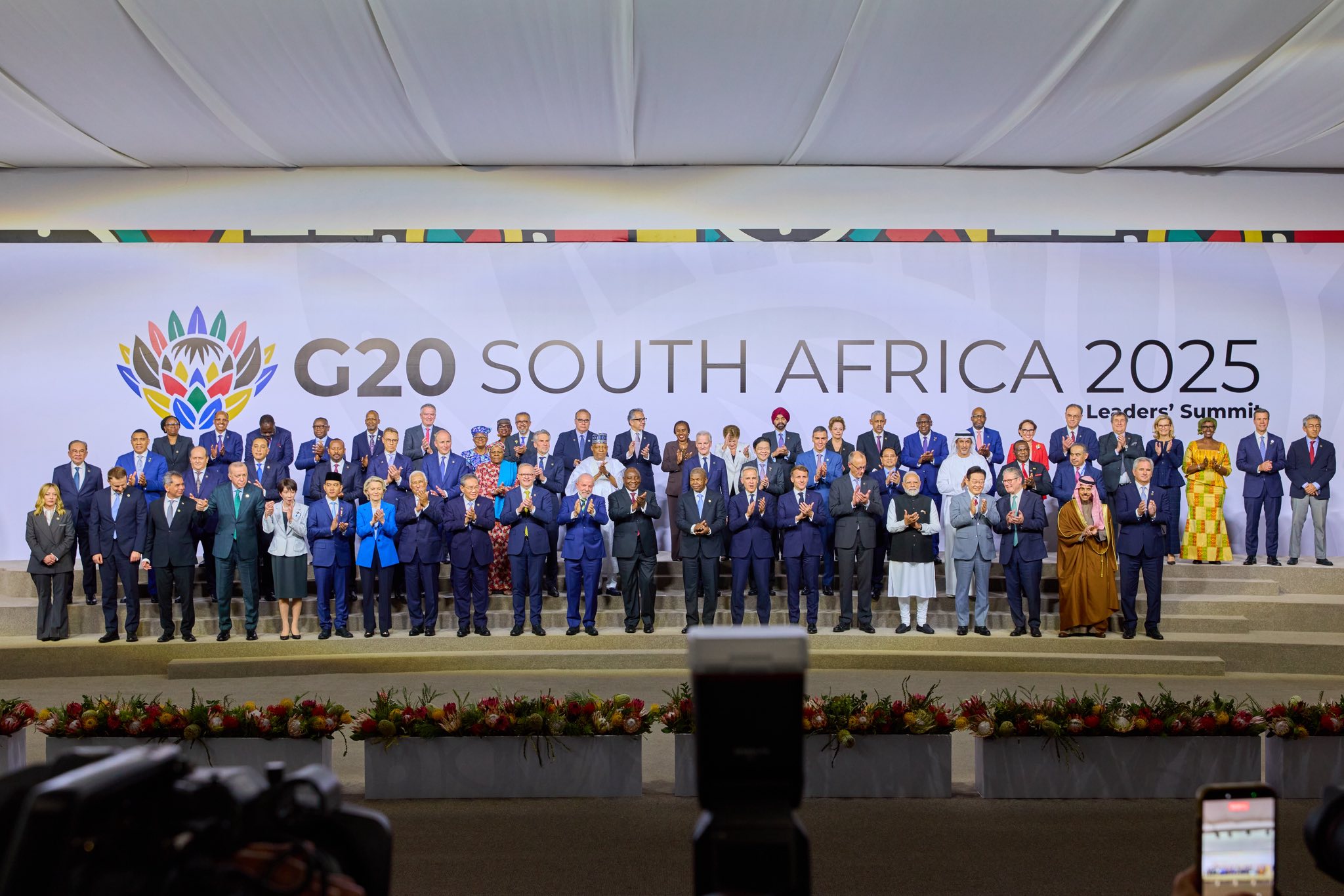
Although the four consecutive Global South presidencies carry diplomatic significance, it did not alter the fundamental reality that influence within the G20 remains uneven. Experts believe that despite the symbolism of four Global South countries having held the G20 presidency, they continue to have merely a “seat at the table,” which is realistically more ceremonial than substantive when major powers choose not to engage. Picture source: 이재명, November 24, 2025, Facebook, https://www.facebook.com/photo/?fbid=32546830671598684&set=pcb.32546914644923620.
Prospects & Perspectives No. 71
Boycotts, Power Politics, and the Future of the G20
By Isel Ras
The G20 Leaders’ Summit took place in Johannesburg, South Africa, on November 22-23. This event was symbolic for two reasons: it was the first Summit to take place on the African continent, and South Africa served as the fourth consecutive Global South presidency following Indonesia, India, and Brazil.
Although the four consecutive Global South presidencies carry diplomatic significance, it did not alter the fundamental reality that influence within the G20 remains uneven. Experts believe that despite the symbolism of four Global South countries having held the G20 presidency, they continue to have merely a “seat at the table,” which is realistically more ceremonial than substantive when major powers choose not to engage. The structural constraints facing small and medium states become more evident when geopolitical tensions escalate, as we have seen with the lead-up to this year’s Summit.
Symbolism, ambition, and political reality
South Africa entered its presidency with an ambitious agenda grounded in the priorities of most developing countries, including debt relief, climate finance, development, and reform of international financial institutions. These priorities not only echoed issues facing developing countries, but also the continent’s biggest regional body, the African Union. These priorities emerged from longstanding structural challenges, including Africa’s high borrowing costs, limited fiscal space, and the disproportionate climate burdens carried by developing economies.
Thus, South Africa’s presidency offered an opportunity to show that the Global South could capitalize on its momentum to advance a more inclusive and equitable global agenda. Yet as the Summit approached, it became increasingly clear that symbolism and ambition would collide with geopolitical reality. The precarious backdrop, marked by strained relations between President Cyril Ramaphosa and U.S. President Donald Trump, heightened the power dynamics and domestic political pressures in the U.S., casting a long shadow over the presidency. What unfolded in Johannesburg was less a celebration of African leadership than a sober test of the multilateral system itself, and of whether the G20 can function when its most powerful members decide to boycott the group’s most important gathering.
Trump’s absence and the unraveling consensus
The lead-up to the Leaders’ Summit was dominated not by South Africa’s priorities, but by the question of whether President Trump would attend. His engagement with the G20 had been oscillating for months. Initially, he declared he would boycott the Summit, weaponizing discredited claims of “white genocide” in South Africa and calling for the country to be expelled from the G20 — a move that injected inflammatory rhetoric into an already polarized environment. After a meeting with President Ramaphosa in May, President Trump suggested he might attend, but in early November, he confirmed once again that he would not be attending the Summit.
The uncertainty surrounding the U.S.’ absence was only one part of a broader pattern of disengagement from major powers. Chinese leader Xi Jinping sent Premier Li Qiang; Argentinian President Javier Milei sent his foreign minister; and Russian President Vladimir Putin remained absent due to the outstanding arrest warrant by the International Criminal Court. These absences underscored a deeper fragility in the G20’s foundations. Earlier analyses noted that the G20’s effectiveness and potential depend on participation from the world’s major economies, whose political weight has historically been key to achieving consensus and shaping outcomes. When the U.S., China, Russia, and Argentina stepped back, the group’s ability to function as a meaningful platform became limited, and concerns were raised about the future of multilateral cooperation in an increasingly polarized world.
President Trump’s absence was particularly consequential. The U.S.’ disengagement was troubling precisely because of its substantial influence on the global stage and its ability to shape international economic governance, as we have seen this year with all the tariffs. It has also been the second consecutive year in which U.S. engagement in substantive G20 discussions has been lackluster. Under the Biden administration, U.S. officials were reluctant to commit to long-term initiatives, knowing they might be overturned under a future Trump presidency. Trump’s decision to boycott the Summit carried immediate procedural implications. Days before the event was due to take place, he also insisted that he would not accept anything beyond a Chair’s Statement, making this the first G20 Summit, since its inception, where leaders failed to reach a full Leaders’ Declaration. The Leaders’ Declaration has historically served as the G20’s core output, articulating shared commitment and outlining a coordinated approach to global challenges. A Chair’s Statement, issued solely at the host country’s discretion, signals weakened consensus and a reduced appetite for collective action.
President Ramaphosa maintained publicly that the absence of the United States would not derail discussions, yet the inability to secure a Leaders’ Declaration revealed the limits of that statement. Despite South Africa standing its ground, realistically, a consensus-based model cannot function if major powers are absent. More importantly, President Trump’s absence points to the fact that the priorities advanced over the past four Global South presidencies are unlikely to survive into the next year. President Trump’s stance on climate finance, development aid, and multilateral cooperation suggests that these issues are at risk of being deprioritized in favor of a narrower, more transactional U.S. agenda.
What the U.S. G20 Presidency means for Asia
With the U.S. assuming the G20 presidency in 2026, the implications extend far beyond Africa. The past several years of Global South leadership provided space for emerging economies to shape the global agenda, emphasizing financial reform, inclusive growth, and long-term development planning. A U.S. G20 presidency is likely to emphasize strategic rivalry with China, securing supply chains, and prioritizing issues that align with the U.S.’ domestic political agenda. This shift will inevitably influence the positions of Asian states, especially those navigating between Chinese economic engagement and U.S. security partnerships.
Tensions between Trump and several Asian governments continue to escalate, with President Trump reinstating tariffs across key Asian export sectors and maintaining the ban on Chinese-manufactured electric vehicles. These measures have disrupted supply chains and intensified uncertainty for economies such as Japan, South Korea, Vietnam and Malaysia. Under Trump, the G20 is likely to become even more polarized, with Asian countries navigating both economic pressure and sharpening geopolitical divides.
South Africa’s recent fallout with the United States illustrates the risks of escalating tensions and diplomatic retaliation. The expulsion of South Africa’s ambassador from Washington followed growing frustration over South Africa’s alignment with China and its decision in 2024 to downgrade Taiwan’s diplomatic presence by relocating and renaming its liaison office. This move, intended to appease China, jeopardized US$2 billion in annual trade and 40,000 South African jobs that are linked to Taiwan, while undermining South Africa’s democratic credentials.
Taiwan remains strategically vital due to its position along core global shipping routes and its dominance in advanced semiconductor production, making its status a central fault line in U.S.-Asia relations. As the U.S. assumes the G20 presidency, these tensions will increasingly shape the group’s agenda.
(Isel Ras is a Coordinator, Addressing Violent Extremism and Radicalisation to Terrorism (AVERT) Research Network, Alfred Deakin Institute (ADI), Deakin University.)
相關文章
Washington Reassures (and Worries) Taiwan
President Trump’s National Security Strategy and Tensions Across the Taiwan Strait
The Honduran Presidential Election: Impact on Ties with Taiwan
Trump and the Axis of Disorder
Second Thomas Shoal Redux and Beijing’s Strategic Limitations
Reading Korea’s Early Autumn Winds: Trump Abruptly Scales Down a Major Joint Exercise
The G7 Leaders’ Summit in France: An Unexpected Success
What Does the U.S. War Against Iran Mean for the Indo-Pacific?
Implications of the U.S. Tariff Policy on Global Economics and Taiwan’s Response
Trump’s National Security Strategy and the Future of the World Order
The ASEAN Malaysia Summit: The Calm Before the Storm?

The Rare Earth Pause: A Strategic Assessment

 Facebook
  Youtube
  Twitter
  Podcast