


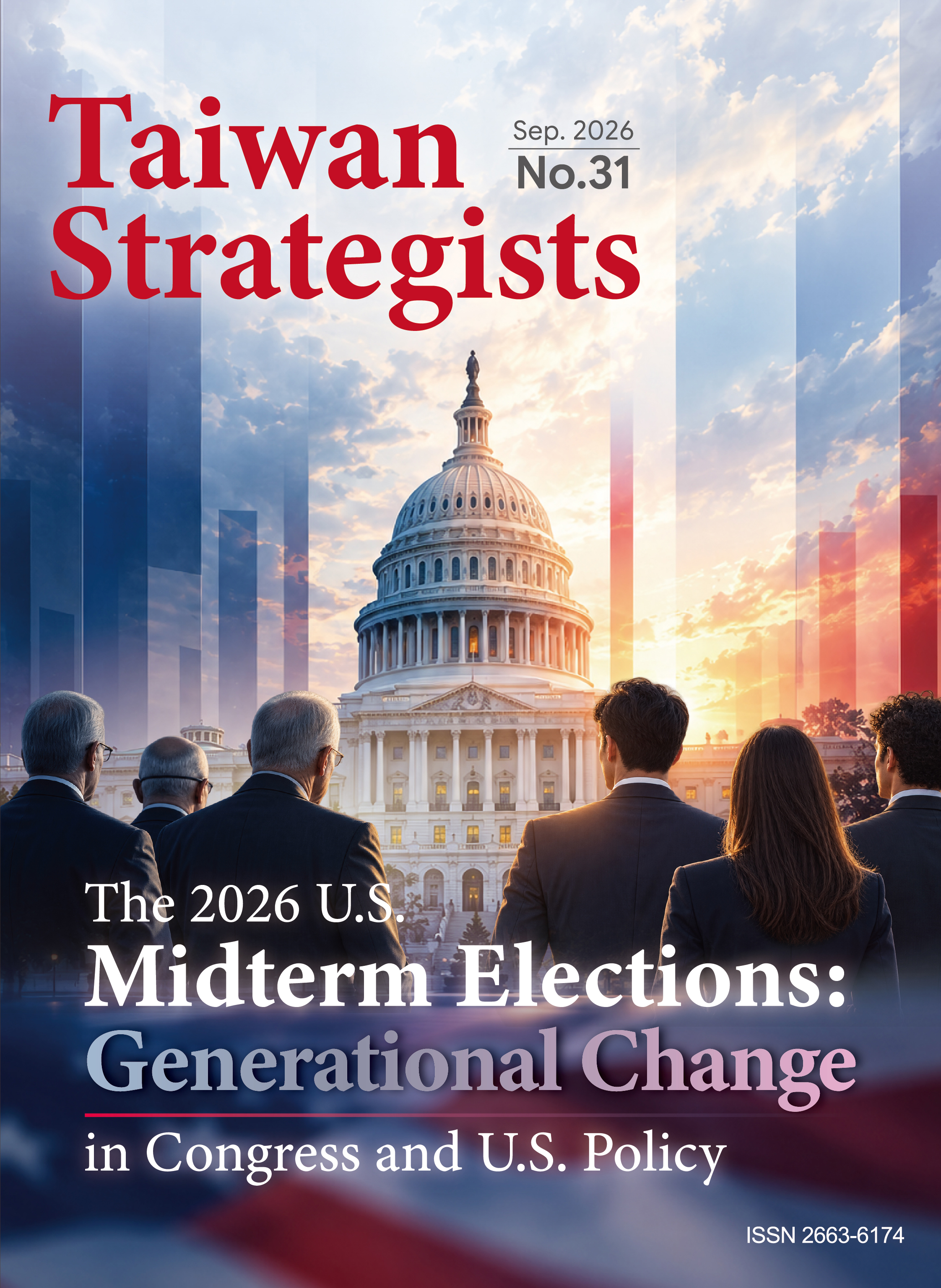
Taiwan Strategists No. 31


- PDF1. Beyond the Midterms Why American Strategy Outlasts American Elections
- PDF2. Generational Change in the Democratic Party and the Rise and Challenges of Progressives and Democratic Socialists
- PDF3. The Rise of a New Generation in U.S. Congress and Its Implications for the Future of Taiwan-U.S. Relations
Beyond the Midterms: Why American Strategy Outlasts American Elections
Yao-Yuan Yeh
Professor and Endowed Chair in International Studies, University of St. Thomas, Houston
Abstract
Every American election invites renewed speculation about the future of U.S. foreign policy, and the 2026 midterm elections are no exception. In Taiwan, much of the discussion has focused on whether Republican leadership changes and shifts in congressional politics will alter Washington’s approach toward China and Taiwan. Such expectations, however, overstate the strategic consequences of electoral politics. Elections redistribute political authority, but they rarely redefine American grand strategy. Over the past decade, strategic competition with China has become increasingly embedded in the U.S. Congress, the national security bureaucracy, and bipartisan policy networks, making it less dependent on any single political leader or administration. This institutional perspective also helps explain why American strategy has remained broadly consistent despite partisan competition and leadership turnover. For Taiwan, the more important challenge is not predicting electoral outcomes in Washington but understandi
Keywords: U.S. Foreign Policy, Republican Party, Political Authority, Strategic Continuity, Taiwan
Generational Change in the Democratic Party and the Rise and Challenges of Progressives and Democratic Socialists
Albert Shihyi Chiu
Professor, Department of Political Science, Tunghai University
Abstract
This paper examines generational change within the Democratic Party and the parallel rise of progressives and democratic socialists in contemporary American politics. Focusing particularly on developments surrounding the 2026 midterm elections, it argues that generational turnover should not be equated automatically with an ideological shift to the left. Rather, Democratic politics currently reflects three overlapping but distinct forces: generational insurgency against long-serving incumbents, progressive demands for stronger economic and social reforms, and democratic socialist efforts to restructure economic and political power. The paper traces the historical development of American democratic socialism from Eugene V. Debs and the New Deal era through Michael Harrington, the Democratic Socialists of America, Bernie Sanders, Alexandria Ocasio-Cortez, and the resurgence of socialist politics since 2016. It further assesses whether progressive and democratic socialist candidates can expand beyond safe Democ
Keywords: Democratic Party, Generational Change, Progressivism, Democratic Socialism, U.S. Foreign Policy
The Rise of a New Generation in U.S. Congress and Its Implications for the Future of Taiwan-U.S. Relations
Ketty W. Chen
Adjunct Associate Professor, School of Business and Finance, National Sun Yat-sen University
Abstract
The 119th Congress is undergoing the largest generational turnover since systematic tracking began in 1930, with more than 70 members retiring or seeking another office. This paper examines how the incoming generation’s foreign-policy orientation is diverging along ideological rather than purely partisan lines, and what this structural shift means for the future of Taiwan-U.S. relations. It finds that bipartisan pro-Taiwan legislation and congressional diplomacy continue to be carried forward by newer members, but that a segment of newer Republicans is markedly more cautious about open-ended overseas commitments than the previous, more hawkish generation it is replacing, introducing a certain level of uncertainty that Taiwan’s congressional engagement strategy has yet to fully absorb. As a result, Taiwan should treat congressional goodwill as a dynamic relationship requiring sustained, cross-generational cultivation rather than a static, self-sustaining asset.
Keywords: Midterm Election, U.S. Congress, Republican Party, Democratic Party, Taiwan-U.S. Relations
 Facebook
  Youtube
  Twitter