




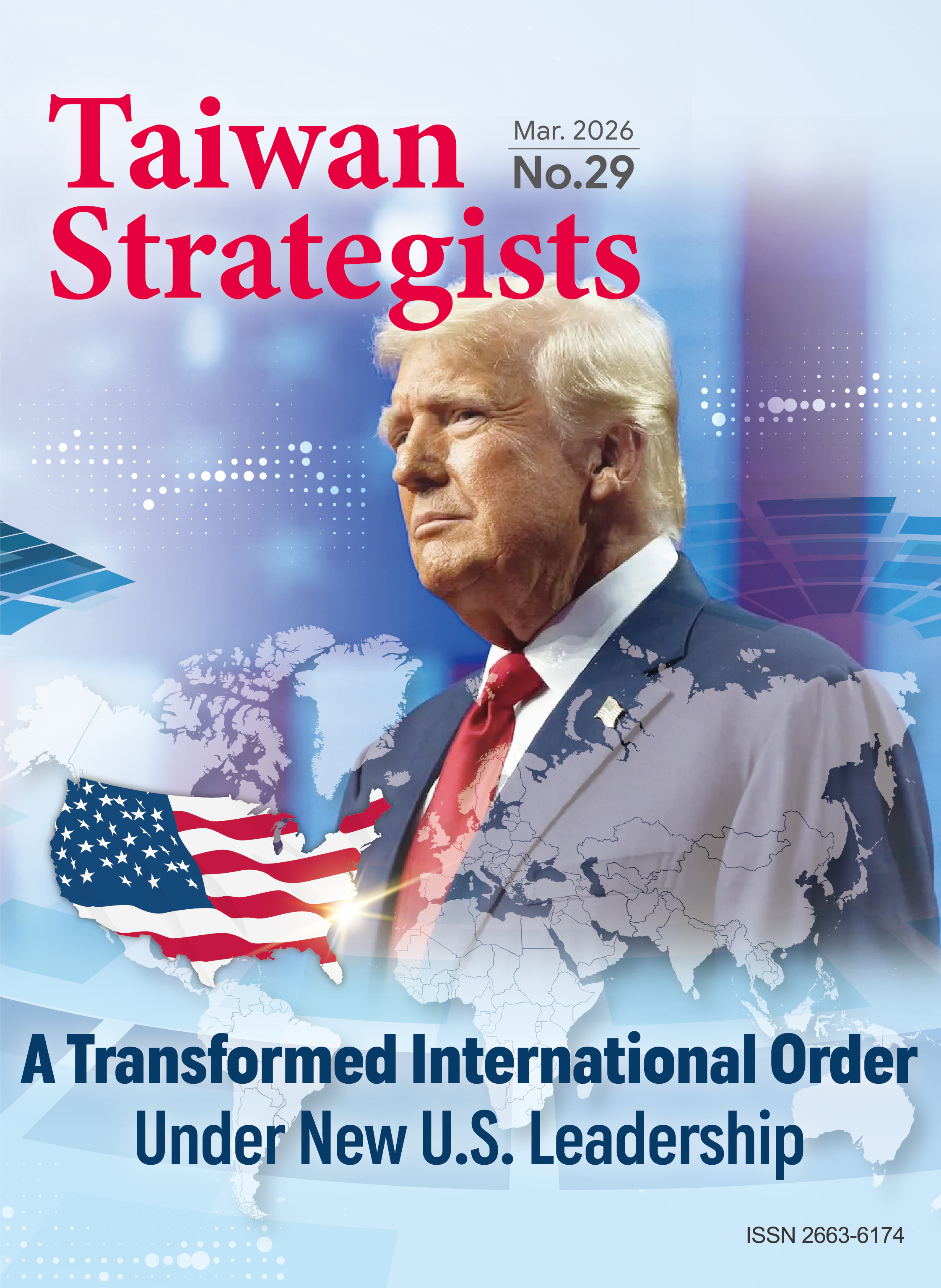
Taiwan Strategists No. 29


Trump’s National Security Strategy and Its
Implications for Taiwan
Jason Po-Nien Chen
Visiting Scholar, Sigur Center for Asian Studies,
The Elliott School of International Affairs, George Washington University
Wen-Cheng Lin
Professor, Institute of China and Asia-Pacific Studies,
National Sun Yat-sen University
Abstract
The United States has been a cornerstone in maintaining peace and stability in the Indo-Pacific region since the end of WWII. In recent years, Washington has undertaken what may be its most consequential national security pivot in more than three decades, driven by China’s assertive expansion and its growing challenge to U.S. global leadership. While the Western Hemisphere remains of primary strategic importance to U.S. interests, Washington is increasingly shifting its center of gravity toward the Indo- Pacific — the most critical battleground for great power competition. All of the Indo- Pacific countries, especially Taiwan, are affected by the U.S.-China strategic competition and the changing U.S. national security strategy. The U.S. government released its National Security Strategy Report (2025 NSS) on December 4, 2025. This paper analyzes Trump’s new national security strategy and is divided into four parts. The first addresses Trump’s strategic thinking, ideas, principles, and goals. The second focuses on the challenges Taiwan faces from Trump’s new national security strategy. The third analyzes the opportunities created by Trump’s 2025 NSS. In conclusion, this paper argues that Trump’s national security strategy created more challenges than opportunities for Taiwan. It points out that the urgent task for Taiwan is to increase defense spending to meet Trump’s expectations.
Keywords: Donald Trump, National Security Strategy, Taiwan, U.S.-China Strategic Competition, Indo-Pacific
Impact of the ‘Board of Peace’ on the
Multilateral International Order
Kuo-Cheng Chang
Professor, Center for General Education, Taipei Medical University
Abstract
Established in early 2026 by U.S. President Donald Trump, the Board of Peace (BoP) represents a radical departure from traditional multilateralism. While its charter mimics the formal language of post-World War II international organizations, its substantive design is highly personalized and centralized, prioritizing transactional efficiency over sovereign equality. The BoP emerged from a governance vacuum following the Gaza war and growing dissatisfaction with the United Nations’ perceived paralysis. A defining feature of the BoP is its “corporatization” of international governance. It effectively transforms international participation into “club goods” through a US$1 billion membership fee, which allows wealthy nations to waive term limits and institutionalize their influence. This design challenges the UN principle of sovereign equality, potentially marginalizing smaller nations. Furthermore, the power structure is heavily weighted toward the Chairman, who holds final discretion over resolutions, vetoes, and charter interpretations. The organization faces significant legal and structural hurdles. Despite its broad mission to secure global peace, the BoP currently lacks a mandate outside of Gaza, as authorized by UN Resolution 2803. Domestically, its status as an “executive agreement” rather than a treaty means it lacks congressional funding and long-term legal stability in the U.S. Additionally, its military model — relying on regional allies for ground troops while the U.S. retains command — creates a dangerous “responsibility and risk asymmetry.” While pragmatically supported by some Middle Eastern countries for its ability to achieve speedy results, the BoP is viewed with skepticism by European powers and used by China as a foil to champion the original UN Charter. Ultimately, the BoP is a “quasi-international governance experiment” whose survival depends more on Trump’s personal political capital than on established international law.
Keywords: Donald Trump, Gaza, Board of Peace, United Nations, Peacekeeping
The Strategic Implications of the ‘Donroe
Doctrine’: From Honduras to Venezuela
Yen-Pin Su
Distinguished Professor and Chair, Department of Political Science,
National Chengchi University
Abstract
This paper examines the emergence and strategic implications of the “Donroe Doctrine.” It is a contemporary reinterpretation of the Monroe Doctrine that combines U.S. nineteenth-century hemispheric power logic with the transactional foreign policy associated with Donald Trump’s second presidential term. Linked to the 2025 National Security Strategy, the doctrine aims to reassert U.S. primacy in the Western Hemisphere and to prevent extra-regional competitors from gaining control over strategically important assets. Using two case studies, this paper shows how the doctrine operates across a range of instruments, from coercive diplomacy to direct military action. The 2025 Honduran general election illustrates how electoral dynamics can be influenced through economic leverage and targeted sanctions from the U.S. Operation Absolute Resolve, the January 2026 capture of Venezuelan President Nicolás Maduro, shows how a law-enforcement framing can be used to justify military intervention. This paper then argues that the doctrine’s deterrent signal reaches beyond Latin America. This is reflected in China’s limited ability to protect its partners in Venezuela and Iran after the U.S.-Israeli strikes in February 2026. For Taiwan, the doctrine offers a cautionary lesson: U.S. support can be consequential, but it remains transactional. Taiwan therefore needs stronger self-defense resilience and deeper military cooperation with Washington.
Keywords: Donald Trump, Donroe Doctrine, Honduras, Venezuela, Taiwan
 Facebook
  Youtube
  Twitter