




Prospect Quarterly 27-2


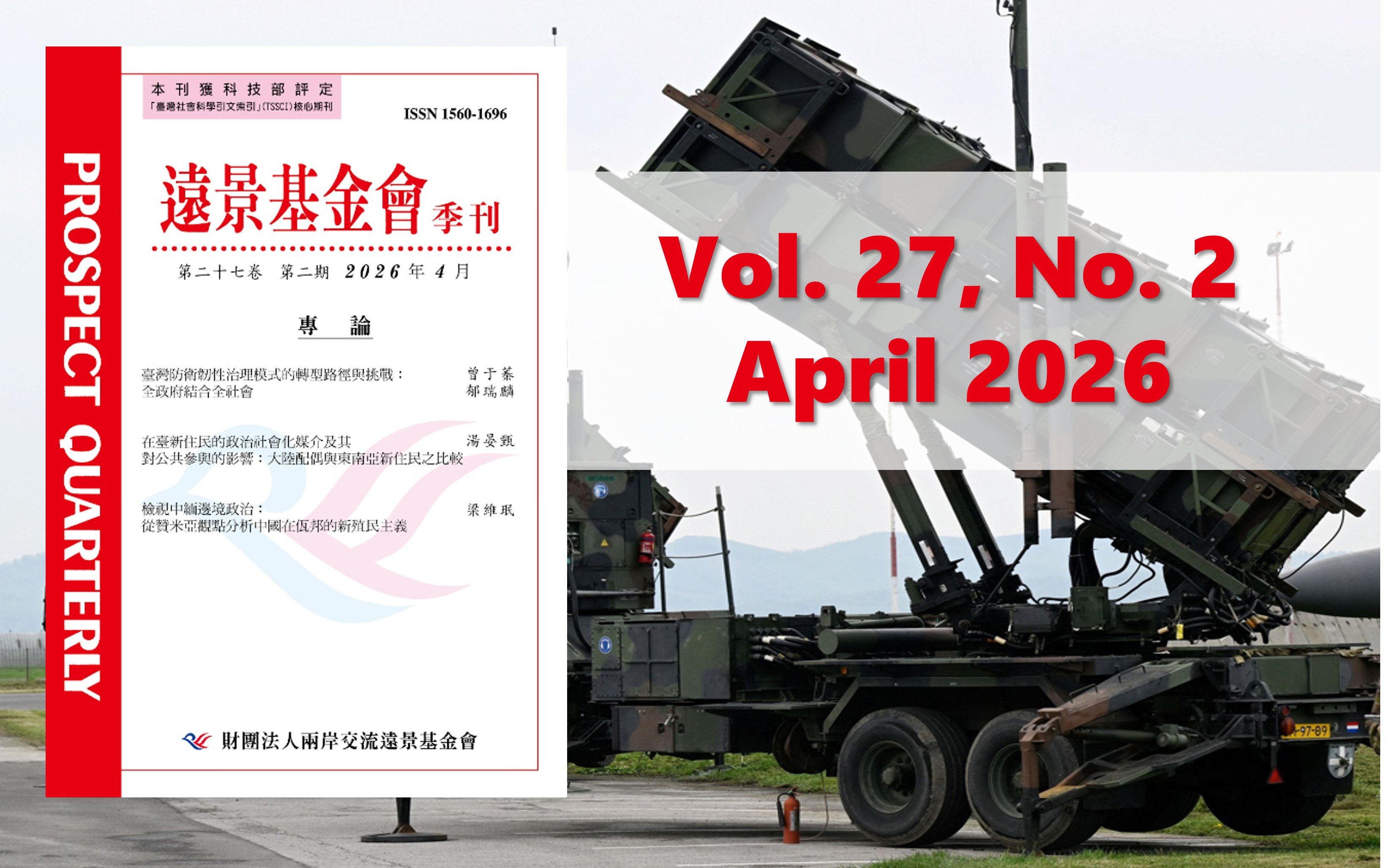
Transformation Pathways and Challenges of Taiwan’s Defense Resilience Governance
Model: A Whole-of-Government and Whole-of-Society Approach
Jean Yu-chen Tseng
(Associate Professor, Graduate Institute of Strategic Studies,
National Defense University)
Ruei-lin Yu
(Associate Professor, Graduate Institute of Strategic Studies,
National Defense University)
Abstract
This paper employs the Whole-of-Government (WoG) and Whole-of-Society (WoS) approaches as an analytical framework to examine the institutional characteristics and evolutionary logic of defense resilience under varying governance models. By analyzing the practical experiences of Nordic and Baltic countries, this study distills differences in actor configurations and policy integration mechanisms to serve as a benchmark for evaluating the current status in Taiwan. Research findings reveal that the construction of defense resilience in Taiwan is currently still characterized by an administratively led WoG model, with institutionalized participation at the societal level remaining in its nascent stages. This paper argues that the key to deepening defense resilience lies not in the expansion of singular policy instruments, but in the stable integration of societal participation into the governance architecture, the accumulation of routine capacitybuilding mechanisms, and the handling of divergences regarding defense issues within a democratic system. It is suggested that the government transition from administrative mobilization toward the establishment of economic incentives and Public-Private Partnerships (PPP), embedding defense responsibilities into daily operations to gradually achieve a transformation in the center of gravity of governance.
Keywords: Whole-of-Society Defense Resilience, Whole-of-Society Mode l , Whol e -of -Gove rnment Mode l , Democ r a t i c Resilience, Governance Transformation
Political Socialization Agents and Their Effects on Public Participation among New Immigrants in Taiwan:
A Comparative Study of Mainland Chinese Spouses and Southeast Asian New Immigrants
Yen-chen Tang
(Project Assistant Professor, Department of Public Administration,
National Dong Hwa University)
Abstract
This paper addresses two key questions: what are the primary agents of political socialization among new immigrants in Taiwan, and how do these agents influence their civic participation? Drawing on theories of political socialization and incorporating Verba, Schlozman, and Brady’s (1995) civic skills framework, this study examines the major channels through which Southeast Asian and Chinese spouses in Taiwan acquire social and political information, and how these sources vary in their effects according to immigrants’ differing levels of Chinese language proficiency. Unlike previous qualitative studies on new immigrants, this study adopts a quantitative approach using a self-designed questionnaire, which yielded 1,570 valid samples for empirical analysis. The findings reveal, first, that the agents of political socialization among new immigrants in Taiwan vary by country of origin. Mainland Chinese spouses primarily rely on mass media for political socialization, while Southeast Asian immigrants are more likely to depend on interpersonal networks. Second, the influence of different socialization agents on civic participation also varies. Family, peer groups, and the internet positively contribute to fostering civic engagement among new immigrants, whereas television media appears to be relatively ineffective in promoting such participation.
Keywords: New Immigrants, Mainland Chinese Spouses, Southeast Asian New Immigrants, Agents of Political Socialization, Public Participation
The Politics of the China-Myanmar Border:
A Zomia-Based Analysis of China’s Neocolonialism in Wa State
Wei-ming Liang
(Ph.D. Candidate, Graduate Institute of Development Studies,
National Chengchi University)
Abstract
The political structures, economic transformations, and military conflicts along the China–Myanmar border have long attracted attention. In recent years, however, the most striking development has been the rise of the telecom fraud industry in the region. This paper adopts the concept of “Zomia,” combined with a neocolonial perspective, to analyze how elites in Wa State deliberately maintain asymmetry with Myanmar’s political system. These elites construct a narrative of legitimate governance through banning opium cultivation and introducing the so-called “China model.” Yet this developmental path essentially functions as a mechanism for elites to consolidate political power and economic resources, while simultaneously fostering grey economies. This paper argues that the case of Wa State reveals the underlying nature of China’s foreign aid policy: despite its proclaimed principle of “non-interference,” China in practice relies on local collaborators to reduce governance costs while reinforcing its geopolitical influence.
Keywords: Zomia, China -Myanmar Border, Wa State, Local Collaborators, Neocolonialism
 Facebook
  Youtube
  Twitter