



Prospect Quarterly 27-1


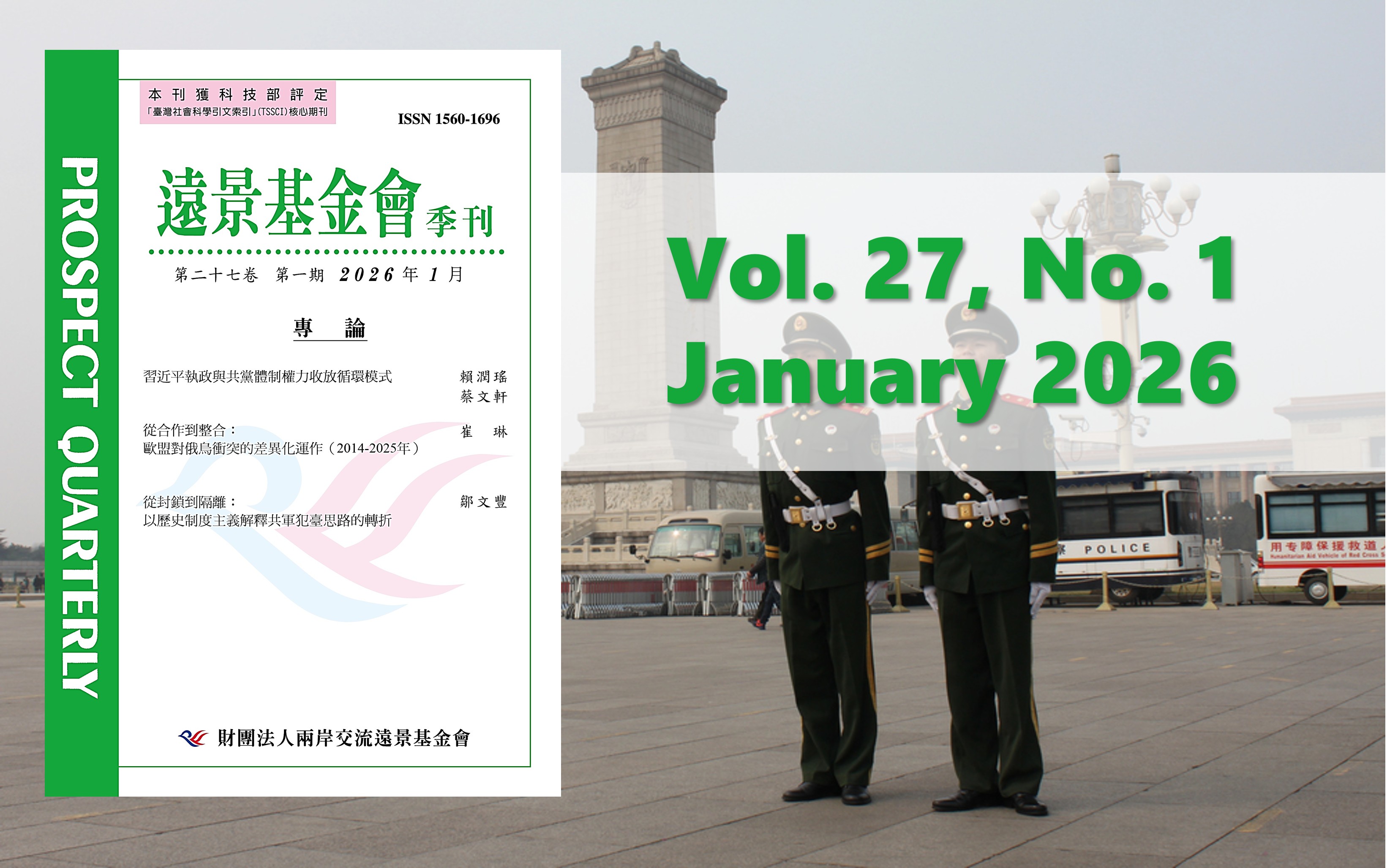
Xi Jinping’s Governance and the Communist
Party System’s Cycle of Power Concentration/Decentralization
Christina J.Y. Lai
(Associate Research Fellow, Institute of Political Science, Academia Sinica)
Wen-hsuan Tsai
(Research Fellow, Institute of Political Science, Academia Sinica)
Abstract
Under Xi’s leadership, why has China taken a confrontational stance toward the West in foreign affairs, while simultaneously adopting socialist economic policies and promoting state-owned enterprises? This article compares the political development of the Chinese Communist Party (CCP) with that of the Soviet Communist Party, and it proposes a cyclical model of political centralization and decentralization within communist regimes. It argues that ideological struggles inherent to communist systems create constant tensions between conservative and reformist factions within the party. When the conservative line prevails, the party tends to pursue a command economy and distance itself from international regimes. To implement such policies, top leaders often consolidate political power. However, when these policies lead to a decline in national capabilities or economic stagnation, political reform becomes necessary. In such phases, leaders tend to adopt decentralization policies and re-engage with international regimes to stimulate more reforms. Xi’s current trajectory resembles that of the Brezhnev era, characterized by a phase of strong political centralization. This work offers a structural explanation grounded in the institutional logic of communist regimes to account for China’s turn toward “re-Maoization” under Xi’s leadership.
Keywords: Comparative Communism, Power Centralization, Command Economy, International Regimes, Authoritarianism
From Cooperation to Integration:
The EU’s Differentiated Practices in the Russia-Ukraine Conflict (2014-2025)
Lin Tsui
(Tamkang University, Department of Diplomacy and International Relations, Associate Professor)
Abstract
This article explores the EU’s response to the Russia-Ukraine conflict since 2014 with the differentiated practices of the EU’s Common Foreign and Security Policy. The author defines the concepts of “differentiated cooperation” and “differentiated integration” from the perspectives of “autonomy,” “behavioral norms,” and “operational logic.” It then explores the EU’s supranational institutions changes, sanctions against Russia, and support for Ukraine during the Crimean crisis in 2014 and the Russian invasion of Ukraine in 2022. It argues that during the Crimean crisis in 2014, the EU’s response was mainly based on differentiated cooperation led by Germany and France; however, Russia’s invasion of Ukraine in 2022 has changed the EU’s perception of Russia and Ukraine: its response was characterized by differentiated integration, greater comprehensiveness and consistency, as well as strengthened autonomy versus Russia.
Keywords: Crimean Crisis, Russian Invasion of Ukraine, Differentiated Integration, Differentiated Cooperation, Common Foreign and Security Policy
The Shift in the PLA’s Approach to a Taiwan Invasion Through Historical Institutionalism
Wen-feng Tzou
(National Defense University, Graduate Institute of Strategic Studies,
Assistant Professor)
Abstract
This study explores, through the lens of Historical Institutionalism, the reasons why China could choose to implement a “coercive quarantine” against Taiwan and how the People’s Liberation Army’s (PLA) approach to invading Taiwan has evolved. The PLA’s strategy against Taiwan has followed a distinct developmental trajectory. “Blockading Taiwan” carries a dual strategic purpose: preparing for an amphibious landing and deterring foreign military intervention. The current primary approach to a Taiwan invasion is through a “regional blockade and triphibious assault.” However, this study argues that, in order to avoid the severe economic repercussions of a military assault on Taiwan, to expand its range of maximum-pressure strategies, to circumvent the uncertainty posed by the United States’ policy of “strategic ambiguity” regarding Taiwan’s defense, and to eliminate the rationale for international intervention in a Taiwan Strait conflict, China may view “coercive quarantine” as the most viable option. This approach would serve to compel Taiwan to accept Beijing’s political conditions without resorting to full-scale warfare. While this study does not suggest that the possibility of a Chinese military invasion of Taiwan will be eliminated, from the perspective of historical institutionalism, it represents yet another shift in China’s strategic approach to military action against Taiwan.
Keywords: Taiwan Strait Security, Armed Invasion of Taiwan, Blockade, Quarantine, Historical Institutionalism
 Facebook
  Youtube
  Twitter