



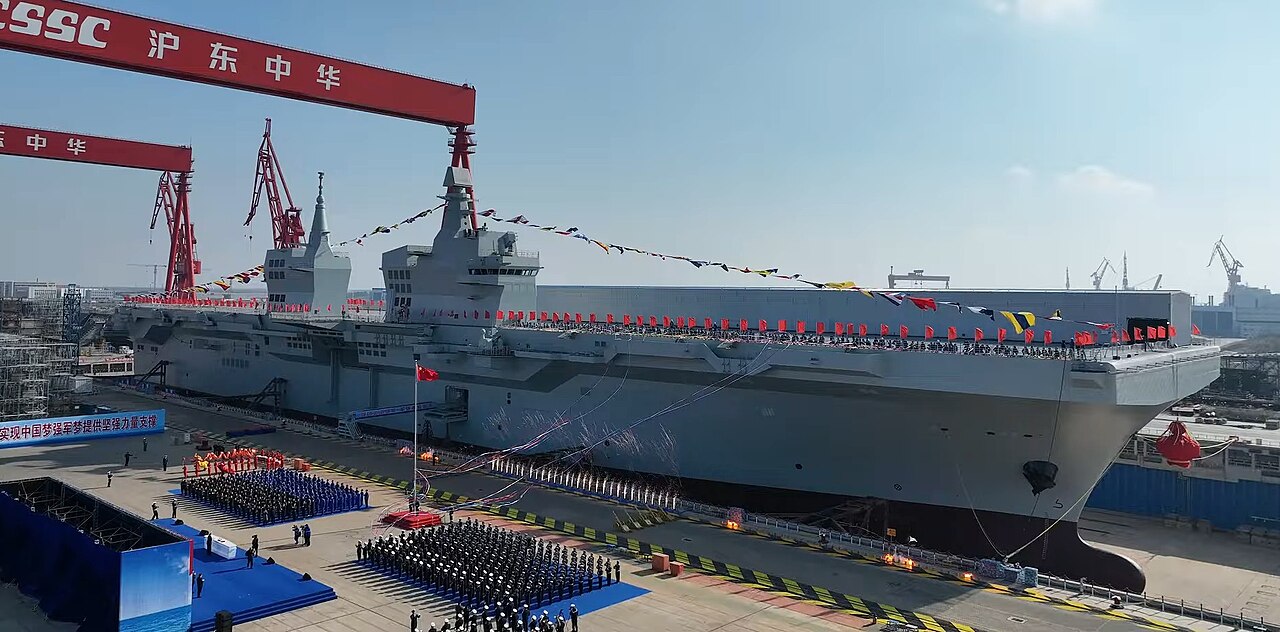
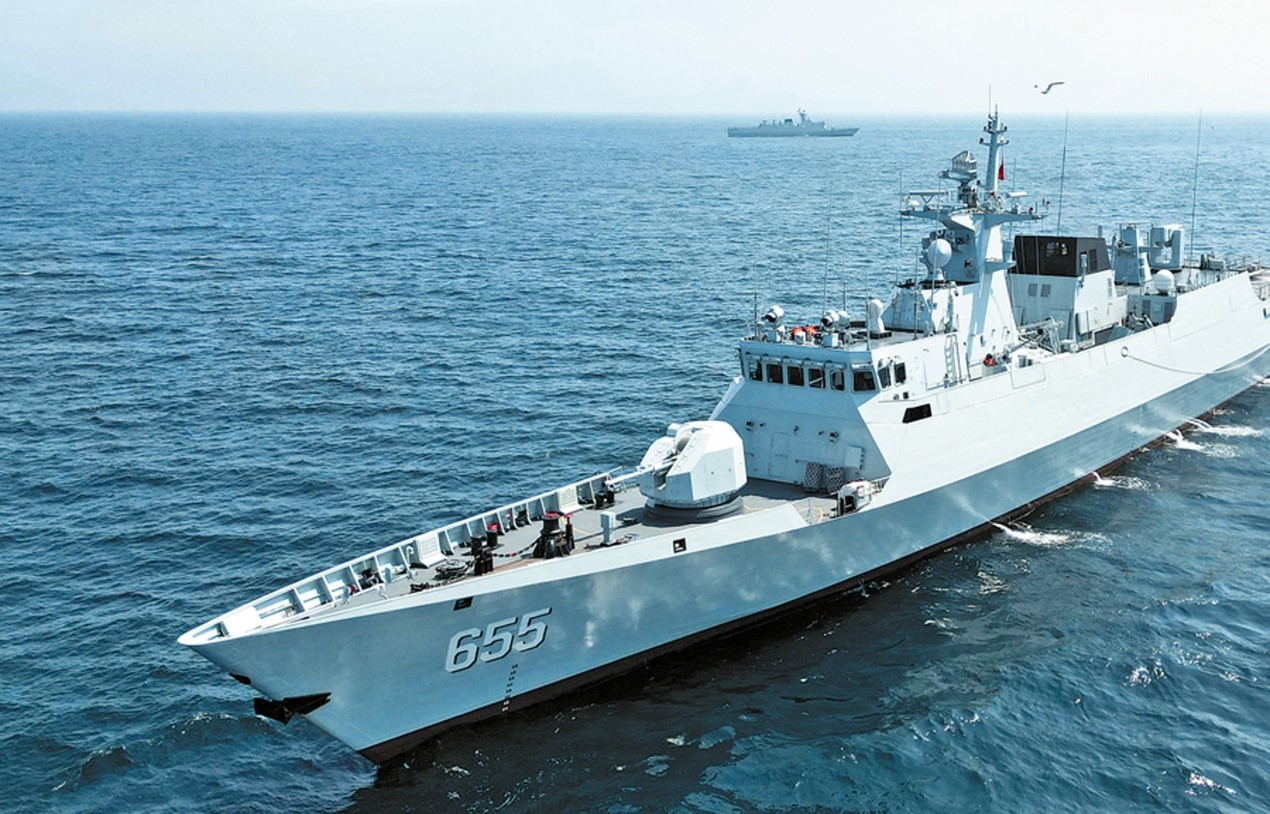
The U.S. IC assessment should not lull either side into complacency on the issue of Beijing’s intentions regarding Taiwan. The unclassified assessment limits its analysis of China’s military capability to carry out an amphibious assault and notes that China prefers “peaceful” means to unify Taiwan. However, Beijing may conclude that while force is not the preferable option, it may be the necessary one. Picture source: 中國新聞社, December 7, 2024, Wikipedia, https://zh.wikipedia.org/zh-tw/%E5%9B%9B%E5%B7%9D%E5%8F%B7%E4%B8%A4%E6%A0%96%E6%94%BB%E5%87%BB%E8%88%B0#/media/File:LHD_Sichuan.jpg.
Prospects & Perspectives No. 22
Washington’s China-Taiwan Annual Threat Assessment: More of the Same
By Ann E. Kowalewski
In March 2026, the U.S. intelligence community's (IC) annual threat assessment made several claims regarding Taiwan. First, the document assessed that China prefers to “achieve unification without the use of force, if possible.” Second, it said that the People’s Liberation Army (PLA) continues to make “steady but uneven progress on capabilities” it would use to seize Taiwan, despite the fact that Chinese leaders “do not currently plan to execute an invasion of Taiwan in 2027” and “recognize that an amphibious invasion of Taiwan would be extremely challenging.”
None of these assessments are particularly surprising. China has long emphasized its preference for “peaceful” unification, and has deployed a sustained pressure campaign with “grey zone” tactics to compel Taiwan into accepting Chinese Communist Party (CCP) rule. Yet the risk is not whether Xi Jinping prefers peace, but whether he can realistically annex Taiwan in a “peaceful” manner. That is, if Xi concludes that he can no longer take the preferable option to achieve his goals with Taiwan, then he may take the only necessary option left: use of force.
Trendlines
On the issue of annexing Taiwan, China may not be able to realistically achieve its goal by “peaceful” means alone. The trendlines are worrying for two reasons. First, Xi has made clear that he is willing to use force if necessary and increasingly the PLA has acquired and developed the capability to use that force successfully. Second, China’s pressure campaign against Taiwan has pushed Taiwan away from political or economic integration with China, and reduced people-to-people ties.
The IC assessment notes questions about PLA readiness and emphasizes that an amphibious invasion of Taiwan would carry “a high risk of failure.” Yet the PLA has made incredible gains in the capabilities needed to eventually conduct an amphibious invasion successfully. Note, for example, China’s ever-growing defense budget (which some models estimate at around US$450 billion in 2024) and investment into amphibious assault capabilities, most notably the Type 076 amphibious assault ship Sichuan that PLA Navy (PLAN) expects to add to its fleet in 2027. This capability, coupled with China’s increasingly sophisticated military exercises around Taiwan, demonstrates Xi’s intention to ensure that the option to use force remains open and possible.
Moreover, the IC assessment limits its unclassified analysis to an invasion scenario, but the PLA can deploy other military campaigns that could achieve unification through the use of force: a joint strike campaign, destabilizing attacks on critical infrastructure, or a naval blockade, just to name a few. Each of these campaigns carries its own risks, but requires less sophisticated military capabilities than an amphibious invasion scenario.
In many of these scenarios, the PLA has already demonstrated that it has the capability to carry out these campaigns via increasingly sophisticated military exercises. During the PLA’s “Strait Thunder-2025A” exercise in April 2025, the PLA simulated blockades and precision strikes, alongside footage depicting specific Taiwanese critical infrastructure as mock targets. While military exercises do not demonstrate PLA decision-making under fire, counter-intervention capability, or logistics durability, they do show that the PLA is serious about acquiring the hardware it needs to seize Taiwan via military operations short of amphibious assault.
Second, there is an open question as to whether China’s continued pressure campaign against Taiwan has worked since Xi came to power. Trendlines seem to indicate that since Xi ramped up its political, legal, informational, and economic pressure against Taiwan in 2016, Taiwan has become even less integrated with China. Taiwanese identity has solidified, with poll after poll showing that the share of those in Taiwan who consider themselves “Taiwanese” has increased while fewer citizens consider themselves “Chinese” or both “Chinese and Taiwanese.”
Meanwhile, Taiwan has reduced its economic dependence on China. Taiwan’s annual outward investment into China dropped from 44% in 2016 to 11% in 2023. Since 2012, financial data from Taiwan’s top 500 business groups also reveal a clear decline in Taiwanese firms’ revenue and profitability in China. And while China has grown more authoritarian over the past decade, Taiwan now ranks 94/100 for freedom, according to the U.S.-based Freedom House. These trendlines have occurred despite China ramping up its political, informational, and economic pressure on Taiwan through tactics such as misinformation, election meddling, and attempted brain drain. These “peaceful” pressure campaigns to compel Taiwan into unification thus appear to be failing. And if these “peaceful” means are not enough to compel unification, then Xi may conclude that the use of force becomes necessary to achieve his goals.
Implications for U.S.-Taiwan relations
The U.S. IC assessment should not lull either side into complacency on the issue of Beijing’s intentions regarding Taiwan. The unclassified assessment limits its analysis of China’s military capability to carry out an amphibious assault and notes that China prefers “peaceful” means to unify Taiwan. However, assuming that Beijing is unwilling to use force against Taiwan in the near future would be a mistake. Beijing may conclude that while force is not the preferable option, it may be the necessary one.
Therefore, it is unlikely that this IC assessment will fundamentally shift the trajectory of U.S.-Taiwan relations. The U.S. will continue its defense relationship with Taiwan, Congressional delegations will continue to visit Taiwan, and U.S. companies will continue to expand their presence and investment in Taiwan.
If anything, this IC assessment is a reminder of the short amount of time left for the PLA to reach its military goals, and the capability that Xi has to conduct a spectrum of military operations against Taiwan. To deter Xi from launching these operations, the U.S. and Taiwan should continue to work together to strengthen deterrence. The two sides should actively work in the information and defense space to inject uncertainty into Xi’s decision making about the success of a military campaign against Taiwan. After all, 2027 — the year by which Xi has ordered the PLA to have the capabilities to use force against Taiwan if called upon by the Chinese leadership — is just a few months away.
(Ann Kowalewski is Senior Non-Resident Fellow with the Global Taiwan Institute.)
Related Content
Re-Establishing Deterrence in Taiwan’s Maritime Periphery Following the China-Indonesia Naval Exercise
What Lessons Can Taiwan Take from the Situation in the Strait of Hormuz?
What Does the U.S. War Against Iran Mean for the Indo-Pacific?
Feeding the Porcupine: The U.S. December 2025 Arms Sales to Taiwan
‘Tiger Head with a Snake Tail’: The PLA’s ‘2025 Justice Mission’ Exercise
No Rain on This Parade: New Directions for China’s Military Thinking?
The Specter of a Broader Regional Maritime Conundrum Over Taiwan
China’s ‘New New Normal’ Military Exercises Against Taiwan and Their Implications
 Facebook
  Youtube
  Twitter