




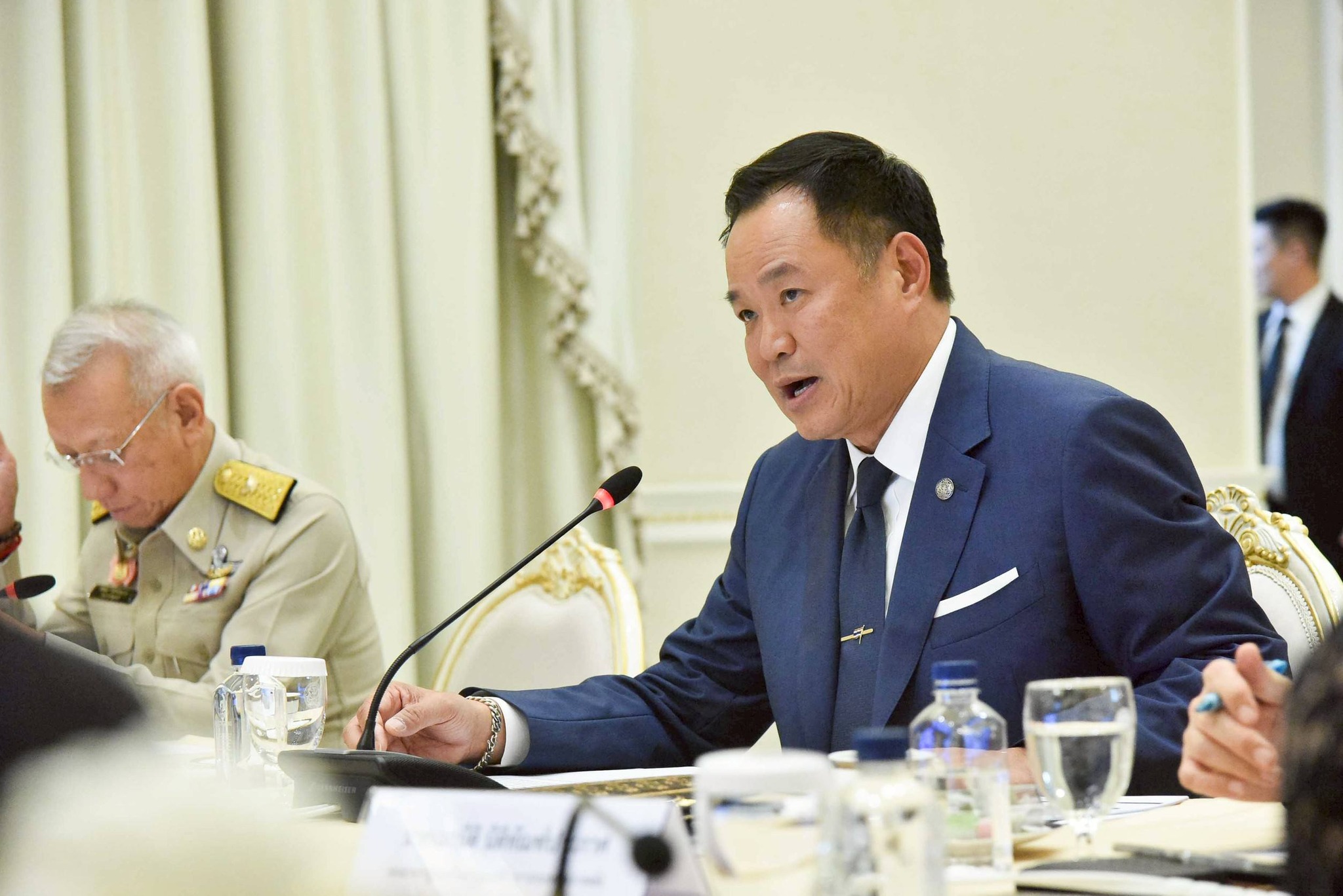
There is an unmistakable sense of Thailand’s 2026 election going “back to the future.” With only a slightly altered supporting cast, Bhumjaithai Party Leader Anutin Charnvirakul’s return as prime minister feels less like a surprise than a reminder of the enduring, transactional nature of Thai elite politics. Picture source: FC Anutin, February, 5, 2026, Facebook, https://www.facebook.com/photo.php?fbid=1465706918253298&set=pb.100044420114254.-2207520000&type=3.
Prospects & Perspectives No. 17
Back to the Future:
Déjà‑Vu Politics in Thailand’s 2026 Election
By Roger Lee Huang
A familiar face in a reconfigured landscape
There is an unmistakable sense of Thailand’s 2026 election going “back to the future.” With only a slightly altered supporting cast, Bhumjaithai Party Leader Anutin Charnvirakul’s return as prime minister feels less like a surprise than a reminder of the enduring, transactional nature of Thai elite politics. The same figures keep returning to the stage, even as the political scripts are revised. What has emerged is not simply the reassertion of an old establishment, but a recalibrated coalition that has absorbed former rivals, sidelined previous partners, and reorganized the hierarchy of power in ways that reveal both continuity and adaptation.
Abhisit Vejjajiva of the Democrats Party’s return to parliament captures this sense of déjà vu. Once a symbol of Bangkok’s middle‑class conservatism and a favorite among royalist constituencies, the former prime minister who rose to power in 2008 with decisive backing from Newin Chidchob’s faction — the group that famously broke from Thaksin Shinawatra and later formed the backbone of Bhumjaithai — now finds himself leading a party reduced to a shadow of its former influence and outside the new governing coalition. In his place, Bhumjaithai’s Anutin stands at the center of a reconstituted conservative‑pragmatic bloc drawing on the same provincial and establishment networks that once supported Abhisit.
This realignment carries its own irony. Pheu Thai, the current incarnation of Thaksin’s once‑dominant political vehicle and formerly a fierce rival to Newin’s Bhumjaithai‑aligned provincial networks, now serves as a junior partner in Anutin’s coalition. The party that once commanded sweeping electoral mandates has seen its influence diminished to the point where it must now accommodate forces it once sought to outmaneuver.
Yet this reconfigured establishment is only one half of the 2026 electoral story. The election has been widely framed as a disappointment for reformist forces, especially when contrasted with the youth‑driven surge of the previous cycle. However, casting the outcome as a simple setback risks flattening a political landscape long shaped by cyclical realignments, elite bargains, and the durability of provincial patronage networks. It also obscures the more complicated dynamics revealed by the results.
Rather than a straightforward reversal, the election reflects a familiar pattern in Thai politics: entrenched power blocs reshuffling their alliances while demographic shifts and evolving voter expectations complicate any linear narrative of reform versus conservatism. Thailand’s mixed electoral system, which gives voters one ballot for a constituency candidate and another for a party list, further amplifies this complexity. The prevalence of split‑ticket voting in 2026 illustrates how voters navigate between local power structures, often dominated by patronage networks, and their broader preferences for national‑level political change.
A movement under pressure, not in retreat
Opposite this reconfigured establishment stands the People’s Party, whose strong party‑list performance and dominance in key urban centers demonstrate that the reformist impulse remains deeply rooted among substantial portions of the voting public. Now in its third iteration of a movement that began with the Future Forward Party and re‑emerged as Move Forward Party, the People’s Party continues to occupy a central place in national politics despite years of legal pressure, party dissolutions, leadership bans, and the constant threat of judicial intervention. These constraints have undeniably weakened its organizational capacity and curtailed its momentum, but they have not extinguished its popular appeal.
The loss of seats in 2026 reflects not only these structural pressures but also a more competitive electoral landscape. Pro‑reform voters are more divided than in 2023, and the remarkable youth‑led surge that powered Move Forward’s rise has been difficult to sustain with the same intensity. The People’s Party’s earlier decision to back Anutin’s first premiership while remaining in opposition likely alienated some progressive voters who viewed the move as a departure from the principled stance associated with its predecessors.
Lower turnout compared with the 2019 and 2023 elections further contributed to the party’s reduced seat count. This decline reflects growing voter fatigue and disillusionment shaped by a long history of authoritarian interventions that have repeatedly overridden electoral outcomes. In such a context, maintaining high levels of reformist mobilization becomes an uphill battle.
Yet despite these challenges, the People’s Party still managed to prevail as the second‑largest party and will lead the parliamentary opposition. Its continued strength in metropolitan areas, most notably Bangkok and Chiang Mai, underscores its enduring appeal among urban, middle‑class, and younger voters. Combined with broad public support for revising the military‑drafted 2017 constitution, as shown by the referendum’s 60 percent approval, the party’s strong party‑list performance underscores the continued demand for meaningful political reform.
Rather than signaling a retreat of the reform movement, the results reflect a political landscape in which conservative power is maintained through transactional alliances and local patronage networks, while the reformist opposition continues to draw support from voters seeking structural change. The movement may be under pressure, but it is far from defeated.
Back to the future: A government of pragmatic networks, not ideological victory
Despite Anutin’s return at the head of a reconfigured coalition that aligns provincial patronage networks with conservative establishment support, the 2026 elections reveal a far more complex political landscape than the familiar conservative–progressive or authoritarian–democratic binaries suggest. The Anutin‑led government reflects not a popular rejection of reform, but a reassertion of Thailand’s traditional political logic, one in which patronage networks, royalists, military, and bureaucratic elites, and pragmatic coalitions continue to negotiate the terms of power.
Taken together, the 2026 results illustrate a political order caught between continuity and change. Conservative forces have once again assembled a governing coalition through familiar mechanisms of patronage, elite bargaining, and institutional advantage. Yet the persistence of a large, mobilized reformist electorate and its ability to translate that support into significant parliamentary representation despite structural obstacles suggests that the demand for a more accountable and participatory political system remains strong.
Challenges for Anutin, openings for reform
Thailand’s immediate future may be shaped by transactional coalition politics, but the broader contest over the country’s direction is far from settled. The tension between entrenched power structures and pressures for political reform continues to define the political landscape.
For Anutin’s coalition, the obstacles are immediate and structural. Holding together a patchwork of provincial powerbrokers, managing friction with Pheu Thai, and responding to public expectations for constitutional change will test the government’s durability. Economic stagnation, rising inflation, and global uncertainty, from geopolitical tensions in the Middle East to slowing regional growth, further constrain its room to maneuver. Patronage networks that once delivered reliable electoral dividends may struggle to satisfy rising material demands amid an increasingly fragile economic environment. The exclusion of conservative-leaning Kla Tham, despite its electoral gains, adds another source of potential instability outside the governing bloc.
For progressive forces, the moment is challenging but far from bleak. The referendum’s 60 percent approval revealed broad national support for revising the military‑drafted 2017 Constitution, extending well beyond youth‑driven activism. The People’s Party retains a strong urban base and a clear mandate to push for structural reform from the opposition benches. Economic pressures and public frustration with stagnant governance may create new openings for reformist politics. The path ahead will be contested, but sustained public engagement and electoral resilience ensure that the push for change remains very much alive.
(Dr. Roger Lee Huang, Senior Lecturer, School of International Studies, Macquarie University.)
Related Content
Electoral Stability and Foreign Policy Direction: Thailand After the 2026 General Election
Israel’s Legislative Elections: A Challenge to Bibi’s Long Tenure?
 Facebook
  Youtube
  Twitter