

Electoral Stability and Foreign Policy Direction: Thailand After the 2026 General Election


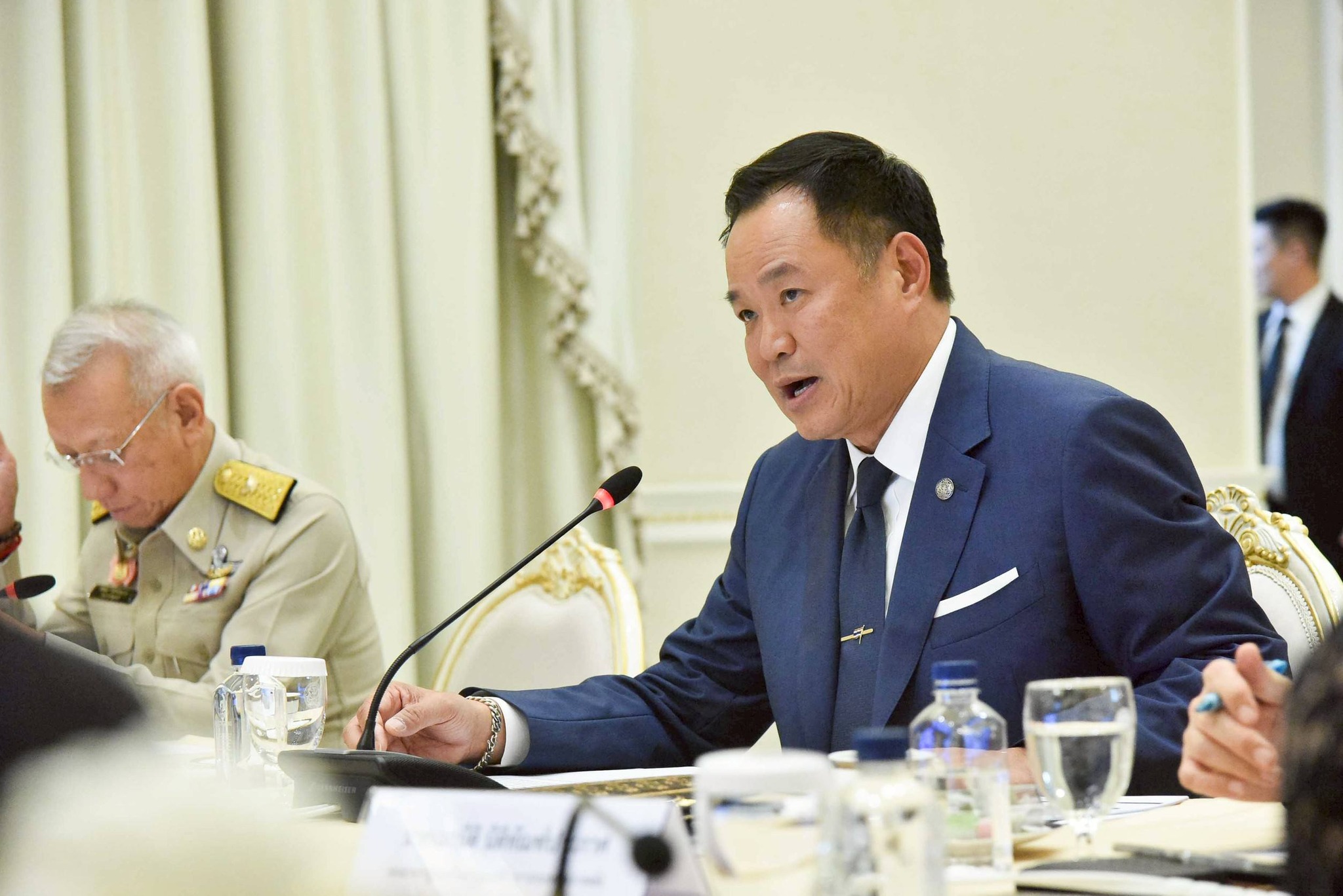
The 2026 general election signals a return to political pragmatism in Thailand after a period of reformist momentum. Rather than producing a major shift in foreign policy, the election outcome is likely to reinforce Thailand’s traditional “bamboo diplomacy” of balancing between major powers. Picture source: FC Anutin, March 2, 2026, Facebook, https://www.facebook.com/photo/?fbid=1486825139474809&set=pcb.1486825746141415.
Prospects & Perspectives No. 14
Electoral Stability and Foreign Policy Direction:
Thailand After the 2026 General Election
By Shangmao Chen
Thailand’s general election held on February 8 concluded amid widespread surprise, producing three major unexpected outcomes.
Three surprises
The first was the relatively low voter turnout. According to the latest data released by the Election Commission, turnout stood at 71.42 percent — the lowest since the 2001 general election. Out of approximately 52.9 million eligible voters, only about 37.8 million cast their ballots. This trend was already discernible two days before the election when this author attended a campaign rally of the People’s Party at the Thai-Japan Youth Center in Din Daeng, Bangkok. The crowd size was significantly smaller compared to the 2023 election, and the event concluded earlier than usual, indicating a noticeable decline in electoral enthusiasm among voters, including young voters.
The second was the landslide victory of the Bhumjaithai Party. In the previous election, the party secured only 68 constituency seats and obtained merely 3 percent of the party-list vote, translating into three additional seats. Yet in this election, it emerged as the largest party, winning 193 out of 500 seats — far exceeding expectations. It surpassed both the highly anticipated People’s Party and the experienced governing party, Pheu Thai Party. The outcome suggests that voters opted for stability over the uncertainties that sweeping reforms might entail.
The third was the strong performance of the Kla Tham Party, a party with deep-rooted local networks and patronage system. Under the leadership of Thamanat Prompow — often characterized as a political cobra who switches sides for political gain — the party skillfully forged alliances and secured 58 seats, becoming the fourth-largest party. It even outperformed the Democrat Party, which had hoped to stage a comeback. The Kla Tham Party performed particularly well in northern Thailand, capturing numerous seats previously held by Pheu Thai and leaving Pheu Thai without a single seat in its Chiang Mai stronghold.
Forming a coalition
Following the announcement of the election results, Anutin Charnvirakul swiftly began coalition negotiations. Responding to voters’ desire for stability, Anutin sought to build a stable majority government. He turned to Pheu Thai, which secured 74 seats and possesses extensive governing experience, while excluding the ideologically reformist People’s Party and the Democrat Party. Although Kla Tham had initially been considered a potential ally, concerns over its controversial image, including alleged connections to gray-area economic activities, led to its exclusion. Anutin instead incorporated sixteen smaller parties (excluding the United Thai Nation Party), contributing a combined 33 seats. The resulting coalition commands 300 seats, a majority expected to ensure effective and stable governance.
As coalition formation nears completion, attention has shifted to the foreign policy direction of the new government amid a turbulent global political and economic environment. A key question concerns how Anutin’s administration will navigate intensifying U.S.–China rivalry, particularly in light of deepening Thailand–China relations.
Impact on foreign policy
Based on post-election observations, Thailand’s core foreign policy orientation is unlikely to undergo dramatic transformation. The traditional “bamboo diplomacy” balancing between pro-China and pro-U.S. tendencies will likely continue. However, under Anutin’s leadership, Thailand may pursue greater predictability and autonomy within this framework. The administration is expected to display a more “pragmatic” posture toward the United States, while adopting a stronger “nationalist” tone toward China. In this sense, Thailand’s bamboo diplomacy under Bhumjaithai’s leadership may become both more predictable and more autonomous.
In relations with the United States, the international environment remains fraught with instability, including the ongoing war in Ukraine and tensions involving Venezuela and Iran. Furthermore, neither the international community nor the United States wishes to see renewed conflict along the Thai-Cambodian border. Although Anutin accepted mediation efforts by President Donald Trump while simultaneously mobilizing nationalist sentiment over the Thai-Cambodian issue during the campaign — gaining substantial electoral support in seven border provinces, where Bhumjaithai won 34 out of 45 constituencies — he is likely to adopt a more pragmatic stance after assuming office.
By relying on experienced diplomatic professionals such as Sihasak Phuangketkeow and excluding politically controversial actors from the coalition, the administration seeks to project a nationally coherent foreign policy orientation rather than one influenced by local patronage interests. In a period of global uncertainty, Thailand appears likely to position itself in Southeast Asia as a predictable and reliable partner rather than a potential troublemaker. For a Trump administration prioritizing loyalty and strategic clarity, such predictability in Thailand’s foreign policy will be of considerable importance.
Navigating relations with Beijing
Regarding China, Anutin’s ethnic Chinese background had led some observers to speculate that the new government may tilt decisively toward Beijing. However, Thailand’s longstanding tradition of diplomatic balancing suggests that excessive alignment with any single power would be politically risky. The Prayut administration’s overtly pro-China stance contributed to domestic backlash, including student protests in 2020 and the rise of the reformist Move Forward Party in 2023 general election.
With this precedent in mind, the second Anutin administration may feel sufficiently confident after his electoral victory to pursue a more autonomous and nationally framed China policy. This approach could become particularly visible in projects under the Belt and Road Initiative, notably the Sino-Thai high-speed railway.
Despite China’s repeated calls to accelerate the project, public dissatisfaction over construction quality has led Thailand to adopt a cautious approach. The railway route passes through Thailand’s northeastern region, a key electoral stronghold for Bhumjaithai. The new government may therefore seek to project regional strength by resisting excessive external pressure. In large-scale infrastructure projects involving sovereignty or core national interests, Thailand is likely to maintain a cautious — if not deliberately slower — pace.
Furthermore, shortly after the election, reports emerged that the government may reduce the current visa-free stay from 60 days to 30 days. This potential adjustment is partly linked to concerns over Chinese nationals engaging in gray-area economic activities unrelated to tourism. The visa-free policy has made regulatory oversight increasingly difficult, fueling public dissatisfaction.
Notably, this development occurs at a time when Thailand’s economy remains sluggish and in need of foreign tourism — particularly from China — for revitalization. The government’s willingness to signal visa policy tightening therefore reflects a more autonomous and nationalist undertone. This posture is likely to define the broader trajectory of the new administration’s China policy in the years ahead.
The 2026 general election signals a return to political pragmatism in Thailand after a period of reformist momentum. Rather than producing a major shift in foreign policy, the election outcome is likely to reinforce Thailand’s traditional “bamboo diplomacy” of balancing between major powers. Under Anutin Charnvirakul, Thailand will likely pursue a more predictable and autonomous foreign policy — maintaining pragmatic relations with the United States while managing economic engagement with China in a more nationally framed and cautious manner.
(Shangmao Chen is Professor in the Department of Public Administration and International Affairs at Fo Guang University.)
Related Content
Back to the Future: Déjà‑Vu Politics in Thailand’s 2026 Election

Israel’s Legislative Elections: A Challenge to Bibi’s Long Tenure?
From the ‘Blazing Furnace’ to ‘Bamboo Diplomacy’: The Role of Nguyễn Phú Trọng in Vietnam’s Political and Economic Transformation
 Facebook
  Youtube
  Twitter