



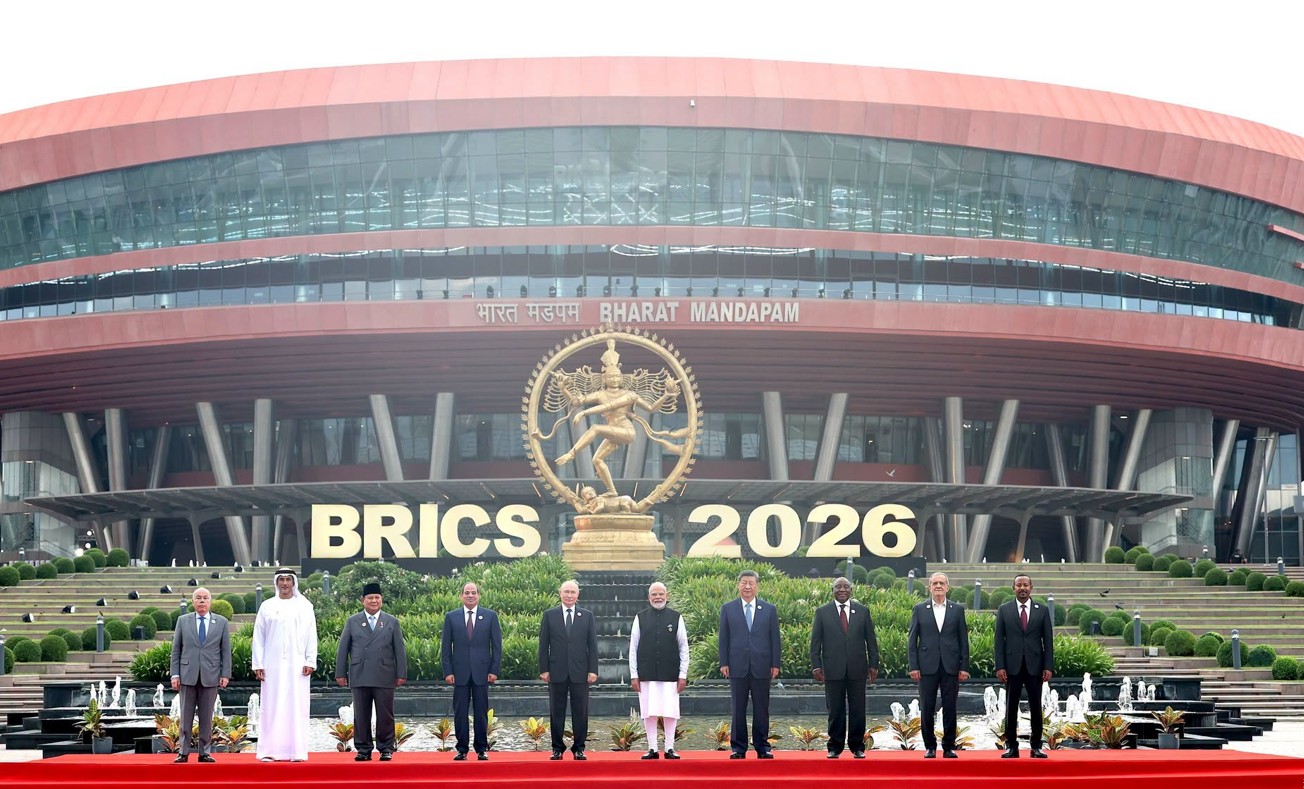
BRICS 2026 reflects the reality that the members can agree on a basic diagnosis of the problems of the existing order but not on what to do about it. Picture source: Narendra Modi, September 13, 2026, Facebook, https://www.facebook.com/photo.php?fbid=1889595112534712&set=pb.100044527235621.-2207520000&type=3.
Prospects & Perspectives No. 53
The BRICS Summit 2026: Cracks and Momentum Amid Global Instability
By Nick Bisley
The images beaming out of New Delhi’s Bharat Mandapam were unmistakable. The gleaming structure that fuses ancient Indian symbolism with modern engineering was the perfect backdrop for BRICS’s message: a block representing the world’s great civilizations can provide leadership in the face of global uncertainty. Against Trumpian wars, tariffs and the sclerotic North Atlantic world, the BRICS group, orchestrated by the Modi government, sought to make the case for multilateralism, moderation and a more inclusive global order.
This was also the first time Chinese leader Xi Jinping had visited India since their border tensions boiled over seven years ago. It is the first major summit outside Russia that Vladimir Putin has attended since the 2022 invasion of Ukraine. While on the sidelines of the summit Iran’s president, Masoud Pezeshkian,met with Abu Dhabi’s crown prince, the first high level meeting between Iran and the UAE since the Iran conflict began.
Despite the benign language of inclusion and multilateralism, BRICS is increasingly associated with illiberal and authoritarian governments that want not just to restructure international institutions but to do so in a manner that is more supportive of illiberal policies globally.
Building BRICS
Established in 2009, the group initially comprised India, Brazil, Russia and China with South Africa joining the following year. It was formed in the shadow of the 2008 Global Financial Crisis which put wind in the sails of the large emerging economies that had ambitions to remake the institutional architecture of the global economy.
After a largely uneventful first decade and a half several developments have given the BRICS grouping greater weight and ambition. First, it has expanded with Egypt, Ethiopia, Iran and the UAE joining in 2024 and Indonesia acceding the subsequent year. Representing half of the world’s population, 40% of global GDP and a geographically diverse group of countries, the body has reached critical mass.
Reflecting this, the 2026 summit attracted high-level participation from its official partners Belarus, Bolivia, Cuba, Kazakhstan, Malaysia, Nigeria, Thailand, Uganda, Uzbekistan and Vietnam. Saudi Arabia is not formally a member but regularly sends a senior delegation with its foreign minister attending this year. Regional institutions represented at a very senior level included the Gulf Cooperation Council (GCC), the African Union, ASEAN and Community of Latin American and Caribbean States (CELAC). The UN Secretary General and the heads of the WHO, WTO, the Asian Infrastructure Investment Bank (AIIB), and the New Development Bank (NDB) also took part in the summit. The BRICS speaks for a large and diverse swath of humanity and this attracts global attention.
Second, the behavior of the Trump administration has also given BRICS an opportunity. India and Brazil have been targeted by Washington and it is not surprising that they have seen the grouping as providing a means to advance an alternative agenda. Third, the shortcomings of the existing institutional setting — from the non-functional WTO dispute settlement mechanism to the unrepresentative nature of the UN Security Council — are palpable and they have been compounded by the damage caused by Washington’s recent hostility. This is especially frustrating to the emerging powers in the Global South. BRICS senses that it has a moment in the sun.
A sprawling and vague consensus
While the summit garners the media attention, it was the high point of India’s year as BRICS chair. The program of activity entailed more than 400 meetings held across India involving regional political leaders, policy makers, experts, business groups, universities, think tanks and many other groups. This is similar to other institutions that seek to advance collaboration across a wide spectrum of activities. ASEAN, for example, has more than 1,000 meetings per year. This scope reflects the larger ambitions of the grouping to drive a wide range of cooperation to underpin the macro-level strategic and economic work that sits at the heart of the summit.
The summit’s biggest achievement was the consensus reached among the members on the New Delhi Declaration. Given that the BRICS foreign ministers had failed to agree at a preparatory meeting earlier in the year, many observers had anticipated continuing divisions. The declaration is exhaustive and, to some degree, exhausting. Nearly 50 pages in length, its 140 paragraphs and nearly 18,000 words are divided into three main sections: inclusive global governance and strengthening multilateralism; international and regional peace and security; and culture and people-to-people cooperation.
The declaration refers to an extraordinary range of topics. Some of these relate to specific work programs, others flag longer-term ambitions while many send clear diplomatic signals about issues of the day. Here the group studiously avoided any mention of Ukraine, while “deep concern” was expressed about “tensions in the Middle East/West Asia.” Nearly two pages were devoted to Palestine, including the group’s support for a Palestinian state and membership of the UN.
Significant concern was expressed about unilateralism in relation to tariffs, sanctions and the dysfunction of the WTO, as well as obvious frustrations about the U.S. war on Iran, yet the U.S. was studiously not named, with the document falling back on either a high-minded tone of concern or the use of the passive voice. Few would fail to realize the subject of their ire but as a piece of diplomatic signaling it was notable. According to reports, Indian officials worked hard to find common ground with Modi putting a premium on issuing a statement to which all could agree. The price for consensus appears to have been a watering down of the language.
BRICS is at its most ambitious, and at times loquacious, in its stated desire to reconstitute the key pillars of the international order. The aim is to remake the UN and Bretton Woods institutions to reflect the interests and values of BRICS members and the broader outlook of the Global South. This means, ideally, changes to the UN Security Council, more inclusive representation in the leadership of UN agencies as well as wholesale changes to the international financial institutions. Given the group’s increasingly illiberal qualities, were they to achieve this ambition the international order would take on a very different quality, one that would challenge liberal ideals globally.
The most obvious division in BRICS relates to the larger purpose of the grouping. Russia and China in particular want the body to be geopolitical; a means through which they can advance their desire to recenter the global balance of political and military power. Most of the other members, however, are more focused on economic coordination, with India the most visible driver of this agenda. Yet even though all the members can agree on the basic aim to reform global governance institutions, such as the UN, IMF and World Bank, there are vastly divergent views as to how this should occur and what reformed institutions should look like.
Problems of demand and supply
BRICS exists not just because of Trumpian mercurialism or the ambitions of Xi and Putin. There is a strong demand for technical cooperation, particularly in relation to the broader systems of economic governance. The current institutional operating system is either outdated, broken — or both. The ambition of the grouping’s “big three” is real and has the potential over the medium term to advance these goals if there is no better offer of reform from the existing bodies.
Several developments warrant close observation as they will reveal whether the potential that exists within the grouping is being realized. The first relates to the efforts to develop international payment systems that link the innovative digital systems of some members such as UPI in India, Pix in Brazil and Russia’s SBP, among others. BRICS is not about to replace dollar hegemony, but it may well be at the forefront of linking highly efficient digital payment systems in ways that obviate the need to engage with the dollar payment system. A second place to look is to watch for BRICS coordination with global institutions. That may be about efforts to place staff in key roles, support one another or drive reform.
BRICS 2026 reflects the reality that the members can agree on a basic diagnosis of the problems of the existing order but not on what to do about it. It is an achievement that the 10 members all agreed to a very long declaration that covers huge areas, from UN reform to alternative university ranking systems, but it was only able to do this because of the vague, imprecise and at times bland quality of the statement. Like a house resting on unstable foundations that is putting on a good face, the cracks have been plastered over, but they remain not far below the surface. This has long been a cause of complacency among the liberal states who designed the existing order. In the activity of BRICS this year and in the evident enthusiasm to take part in the grouping, one sees the potential to reconstitute the system. That this would put illiberalism in a stronger global position is just one of the reasons this development should be taken seriously.
(Nick Bisley is Pro Vice-Chancellor for Research and Professor of International Relations at La Trobe University, Australia.)
相關文章
In a Year of Global Upheaval, ASEAN Scrapes by, Divided but Resilient
Elections in India and Indonesia: Implications for the Indo-Pacific
The Limits of Declaratory Summitry: Another Year, Another ASEAN Meeting
東協峰會、G20和APEC後的東北亞情勢
Crisis in the Taiwan Strait: Imperatives for the Philippines
The Coup Has Upended Myanmar’s Relations with Regional Partners and Taiwan
東協對緬甸二月政變的態度與影響
 Facebook
  Youtube
  Twitter
  Podcast