



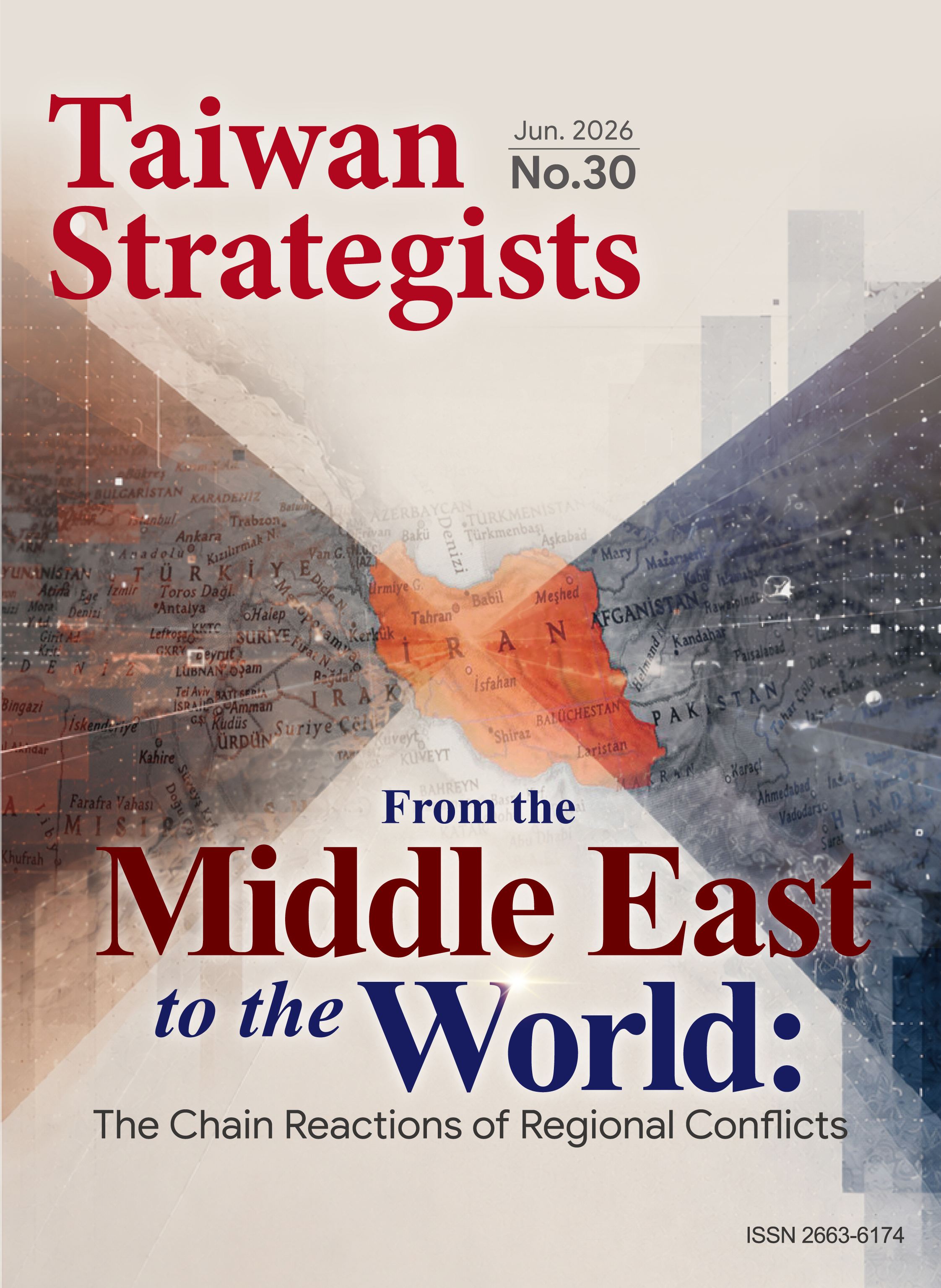
Taiwan Strategists No. 30


- PDF1. The U.S.-Israel-Iran War, the Trump-Xi Summit, and Shifting Dynamics in U.S.-China Relations
- PDF2. The U.S.-Israel-Iran Conflict and the Restructuring of the Middle East Security Order
- PDF3. East Asian Responses to the Middle East Conflict Energy Security, Supply Chains, and Strategic Choices for Taiwan, Japan, and South Korea
The U.S.-Israel-Iran War, the Trump-Xi Summit,
and Shifting Dynamics in U.S.-China Relations
Chin-Fu Hung
Professor, Department of Political Science,
National Cheng Kung University
Abstract
This paper examines how the U.S.-Israel-Iran War and the May 2026 Trump-Xi summit have affected U.S.-China relations. It argues that the war has not turned the two powers into partners, nor does it simply benefit China by distracting the United States. Instead, it changes the bargaining environment. The conflict exposes China’s dependence on Gulf energy and the Strait of Hormuz, while also demonstrating U.S. military capabilities and the burdens of U.S. global leadership. Iranian oil sanctions, maritime security, Taiwan, technology, rare earths, and trade mechanisms have become more tightly linked. The summit’s formula of a “constructive China-U.S. relationship of strategic stability” is therefore best understood as conditional and transactional, not as strategic trust. The new Boards of Trade and Investment may manage limited economic issues, but they do not resolve deeper conflicts. The result is competitive crisis management: sharper rivalry combined with selective coordination when disorder becomes too costly.
Keywords: U.S.-China Relations, Iran War, Strategic Stability, Strait of Hormuz, Competitive Crisis Management
The U.S.-Israel-Iran Conflict and the
Restructuring of the Middle East Security Order
Mor Sobol
Associate Professor,
Department of Diplomacy and International Relations, Tamkang University
Abstract
This paper examines how the U.S.-Israel-Iran War accelerated an ongoing reconfiguration of the Middle East security order. It argues that the region is moving neither toward restored American hegemony nor fragmentation, but toward a posthegemonic order of modular co-defense: selective operational integration in air and missile defense, intelligence, maritime security, energy-route protection, and crisis coordination. The war exposed the erosion of Iran’s forward-defense doctrine, as Israel’s multi-front campaign damaged key elements of Tehran’s “Axis of Resistance.” At the same time, it deepened U.S.-Israeli operational integration and pushed Gulf states toward visible security coordination, even as they avoided formal alliance commitments and pursued hedging strategies with China and other middle powers. The paper further argues that while the Palestinian question has returned as a major legitimacy constraint, it is not the organizing principle of the emerging security architecture. Energy corridors and chokepoints, especially the Strait of Hormuz, have become central arenas of coercion and deterrence. The result is a militarized, corridor-based regional order in which U.S. power remains indispensable but increasingly shares space with Israeli security provision, Gulf strategic autonomy, Iranian disruption, Chinese strategic enabling, and competing middle-power frameworks.
Keywords: Israel, Iran, Middle East, Great Power Rivalry, Security
East Asian Responses to the Middle East Conflict: Energy Security,
Supply Chains, and Strategic Choices for Taiwan, Japan, and South Korea
Chia-Yi Lee
Professor, Department of Diplomacy, National Chengchi University
Abstract
The recent Iran war and the resulting disruptions in the Strait of Hormuz have triggered sharp increases in global energy prices and exposed the vulnerabilities of countries that rely heavily on imported energy and maritime trade routes. This paper shows how energy security has become increasingly intertwined with the semiconductor and AI industries, both of which require stable and reliable electricity supplies. It demonstrates that geopolitical crises not only disrupt global supply chains, but also accelerate the energy transition, supply chain restructuring, and international cooperation. Focusing on Taiwan, Japan, and South Korea, it analyzes how East Asian countries have responded to the crisis through different strategies aimed at strengthening energy resilience and reducing dependence on the Middle East. Taiwan has prioritized short-term supply stability and long-term diversification plans, Japan has emphasized regional cooperation and renewable energy development, and South Korea has adopted more interventionist policies, including price controls, export restrictions, and expanded nuclear energy. The three cases demonstrate that enhancing energy resilience and diversifying energy sources have become essential for maintaining economic stability, technological competitiveness, and national security in an era of growing geopolitical uncertainty.
Keywords: Iran War, Middle East, Energy Security, Supply Chains, East Asia
 Facebook
  Youtube
  Twitter