

A Bridge Between Two Theatres: G20 Foreign Ministers and the Interlocking Realities of European and Indo-Pacific Security


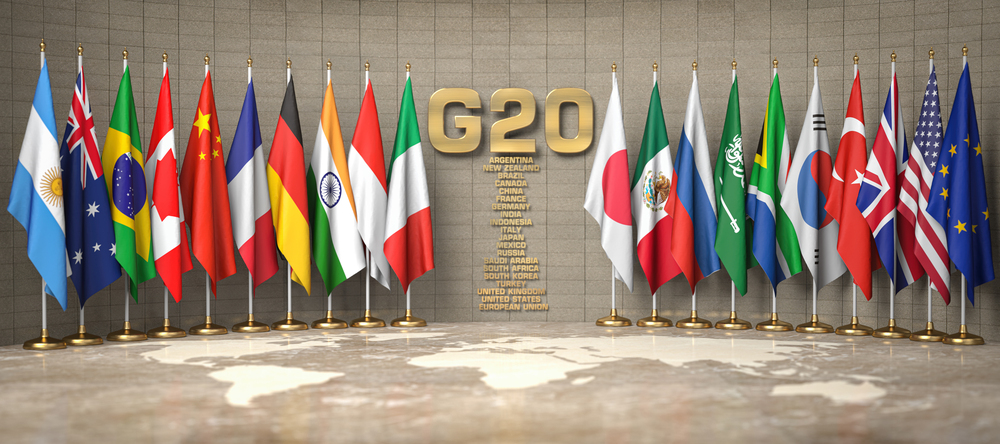
Once celebrated as the premier platform for global coordination, the G20 now operates under the shadow of heightened and erratic geopolitical competition. Nowhere is this tension more pronounced than in the strategic interplay between European security and the stability of the Indo-Pacific. Picture source: Depositphotos.
Prospects & Perspectives No. 59
A Bridge Between Two Theatres:
G20 Foreign Ministers and the Interlocking Realities of European and Indo-Pacific Security
By Amelia Hadfield
Is the invitation in the mail?
As foreign ministers assemble for the 2026 Group of Twenty (G20) in Miami in December, the gathering serves less as a venue for global consensus and rather more as a barometer of a deeply fractured international order. Part of this is U.S. President Trump’s own approach.
Trump boycotted the South African G20 summit in November 2025 and sought to bar South Africa’s president from attending the Miami meeting. The remaining 19 G20 members proceeded without the U.S. to sign the Johannesburg declaration, reaffirming their commitment to multilateral co-operation. More recently, Trump has signaled his wish to make the Miami G20 more “concentrated," suggesting a narrower, more transactional agenda. However, that may be difficult given Trump’s ambitious attendee list. Secretary of State Marco Rubio confirmed last month that the U.S. had invited Russian President Vladimir Putin to attend the Miami G20 in December, arguing that “In order to solve problems, you have to meet with people you disagree with or the people that you might have issues with.”
If Putin attends, this would mark a major departure from his absence at every G20 since the 2021 edition, and could create an unlooked-for forum for direct engagement on European security — most notably the war in Ukraine — between Russia and Western powers. Rather more realistically, Xi Jinping is also expected to attend the Miami G20, following on from his Washington visit earlier this year and Trump’s own meetings in Beijing. While unlikely, the prospect of both Putin and Xi at the same table with Western leaders presents an unusual opportunity for dialogue on both European and Indo-Pacific security.
Getting the show started
Once celebrated as the premier platform for global coordination, the G20 now operates under the shadow of heightened and erratic geopolitical competition. Nowhere is this tension more pronounced than in the strategic interplay between European security and the stability of the Indo-Pacific.
For decades, traditional security doctrines treated the Euro-Atlantic and Indo-Pacific as two distinct geopolitical theatres, governed by separate alliance structures and geographic priorities. Today, however, that separation has evaporated. While the U.S.’ priorities for the G20 in Miami are focused on the “core mission of driving economic growth and prosperity to produce results” by focusing on regulatory issues, supply chains and emerging technologies, European and Indo-Pacific democracies in attendance may value the opportunity to redefine a vision increasingly in sync with each other.
European security and deterrence dilemmas
At the core of the European agenda at the G20 is the ongoing imperative to secure the continent against Russian aggression. European states have made substantial strides in ramping up defense expenditures, yet the continent faces persistent challenges in turning financial commitments into immediate combat power and structural strategic autonomy.
The European approach is further complicated by shifting dynamics within the transatlantic alliance. While Washington remains the cornerstone of NATO deterrence, European capitals are acutely aware of the need to hedge against potential recalibrations in American strategic focus. Consequently, European foreign ministers at the G20 are likely to favor a portfolio approach: reinforcing NATO’s eastern flank while simultaneously bolstering internal European Union defense initiatives, improving UK-EU security coordination, and seeking out new and established bilateral defense pacts.
The normative background to the strife in Ukraine, however, have barely shifted since Russia’s invasion of the country in 2022. European leaders recognize that defending the rules-based order on their home continent cannot occur in isolation. The military-industrial partnerships linking Moscow with Beijing, Pyongyang, and Tehran have demonstrated to European policymakers that threats to continental stability are increasingly backed by broader authoritarian coordination across Asia. Expect European foreign ministers at the G20 to continue to frame the war in Ukraine not just as an ongoing regional conflict, but as a central battleground for global norm preservation.
The Indo-Pacific axis: Enhanced European engagement?
For European powers, including the United Kingdom, Indo-Pacific security is no longer an optional secondary theatre or distant diplomatic posturing; it is an economic and security imperative. The Taiwan Strait, for example, represents one of the world's most critical maritime arteries, carrying over half of global container traffic and acting as the nexus of global semiconductor supply chains. Any escalation or unilateral disruption of cross-strait stability would trigger catastrophic economic shockwaves that would dwarf recent European energy crises.
Rather than pursuing unilateral power projection to force such issues, European voices at the G20 are likely to herald the opportunities to be had with minilateralism and bespoke institutional partnerships. The significant expansion of dialogue between NATO and its Indo-Pacific partners (including the “IP4” which consists of Japan, South Korea, Australia, and New Zealand), alongside the evolution of trilateral security partnerships like AUKUS (strengthening UK, U.S. and Australian defense capabilities, information and tech-sharing) reflects a growing web of overlapping security arrangements. European ministers — and other counterparts — are also likely to reiterate previous G20 messages, including the critical importance of international law, specifically the United Nations Convention on the Law of the Sea (UNCLOS), and reaffirming that freedom of navigation and the peaceful resolution of disputes are non-negotiable principles applicable equally to the Black Sea and the Taiwan Strait.
The G20’s own structural dilemma: Multi-polarity or multi-opportunity?
The G20 now reflects a fragmented global order, producing structural friction that hampers coherent multilateral action, with three informal strategic alignments visible:
First, a Western democracies and Indo-Pacific allies bloc emphasizes likeminded cooperation: strengthening deterrence, upholding established international law and norms, and protecting democratic sovereignty from revisionist coercion.
Second, an authoritarian realignment — notably with Beijing and Moscow — seeks to undercut Western cohesion. These powers leverage multilateral forums and alternative governance narratives to weaken Western-led alliances, promote rival institutional architectures, and encourage bloc formation that challenges the existing security order.
Lastly, a cohort of Global South and middle-power states across Latin America, Africa and Southeast Asia — including Brazil’s new leadership — resists binary geopolitical alignments, and focuses instead on immediate economic resilience, climate finance, and trade stability rather than siding in great-power rivalry.
Together these three strands reveal the G20’s core dilemma: it remains an essential platform for in-person diplomacy, but its capacity to forge unanimous, action-oriented communiqués on high-stakes security matters remains in question. The diplomatic centre of gravity has shifted from traditional multi-member meetings to informal side-channel dialogues, minilateral formats, and public agenda-setting rather than broad multilateral consensus, reflecting today’s complex multipolar landscape of competing blocs, revisionist actors, and pragmatic nonaligned states. Whether this translates into foreign progress remains to be seen.
(Amelia Hadfield is Dean International, Head of Department of Politics and the Director of the Centre for Britain and Europe at the University of Surrey.)
Related Content
Old Partners and New Friends: Despite Steady Growth, Taiwan-Europe Relations Need ‘Futureproofing’
Boycotts, Power Politics, and the Future of the G20
Geostrategic Implications of the Indo-Pakistani Conflict: Military Dynamics, International Responses, and Future Trends
From Crisis to Capacity: Europe’s Defense Evolution Amidst Transatlantic Strains
Germany’s Political Shift Rightwards: Implications for Berlin’s Indo-Pacific Strategy
APEC Peru 2024: Key takeaways
The BRICS Summit 2024: Overshadowed by Divergent Perspectives
Germany’s Shifting Indo-Pacific Strategy: From Indo-Pacific Guidelines to the Strategy on China
近期美中合縱連橫評析

東協峰會、G20和APEC後的東北亞情勢
The Significance of the Biden-Xi G20 Meeting
Observations on the 2022 APEC Leaders’ Summit and the Outlook for APEC in 2023
 Facebook
 Youtube
 Twitter