

The Mecca Joint Defense Agreement and the Changing Security Landscape of the Middle East


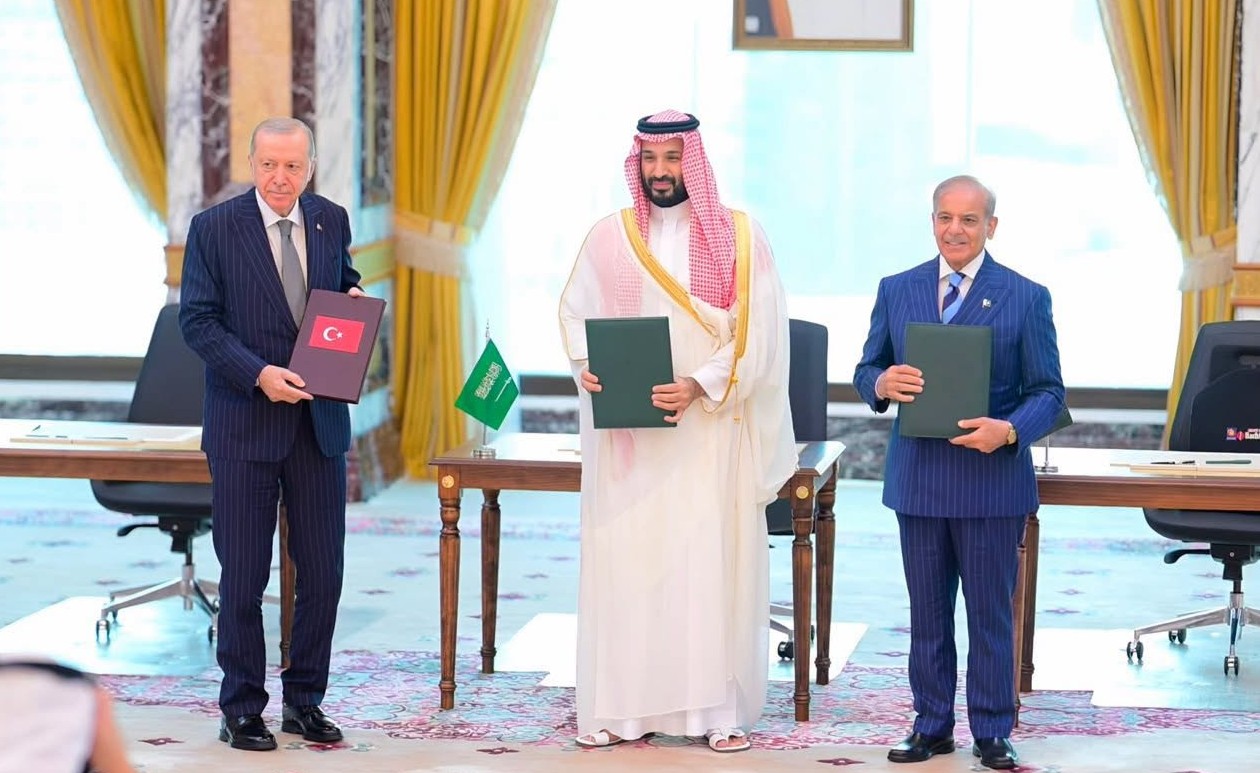
The Mecca Joint Defence Agreement (MJDA) inked on August 7, 2026, brings together three regional states with significant economic, military, and technological capabilities. This alliance is not an overnight agreement merely reacting to regional instability; rather, it is also the result of weakening confidence of Middle East states toward their long-term international allies. Picture source: Mian Shehbaz Sharif, August 7, 2026, Facebook, https://www.facebook.com/photo/?fbid=1663140041848233&set=pb.100044567583584.-2207520000.
Prospects & Perspectives No. 49
The Mecca Joint Defense Agreement and the Changing Security Landscape of the Middle East
By Ching-An Chang
The Mecca Joint Defence Agreement (MJDA) inked on August 7, 2026, brings together three regional states with significant economic, military, and technological capabilities. This alliance is not an overnight agreement merely reacting to regional instability; rather, it is also the result of weakening confidence of Middle East states toward their long-term international allies. The agreement also reflects the changing dynamics of the Middle East in foreign policy formation, in which the consideration of security is crucial in terms of their foreign policy delineation. The MJDA represents a shift toward regional security diversification in the Middle East: while it may strengthen deterrence and reduce dependence on Western security providers, it could also encourage counterbalancing and deepen bloc competition. Also, the external powers’ leverage in the region may, to a certain extent, encounter stronger impediments. This is because the region’s power structure is no longer fragmented; rather, two of the region’s major powers are now in an allied form.
Regional instability: Israel-Iran-related conflicts
The 2023 Hamas attacks on Israel sparked extensive military operations by Israel that resulted in serious humanitarian consequences in Palestine. It also contributed to wider regional instability involving Syria, Lebanon, and Iran. During the first two years of the conflict, the Gulf states were not subjected to direct military confrontation, unlike their counterparts in the Levant and Iran.
This situation changed following Israel’s bombing of Qatar on September 9, 2025. The attack was significant not only because Qatar had generally been perceived as a relatively secure Gulf state, but also because it demonstrated that the geographical boundaries of the conflict were becoming increasingly difficult to maintain. Later, the outbreak of the U.S.-Iran war in 2026 further intensified these security concerns. Gulf states were caught in the crossfire and became targets of Iranian attacks, which Iran described as retaliation for U.S. military action.
Rather than viewing regional conflicts as geographically limited to certain areas, Gulf states increasingly have to consider the possibility that conflicts in non-Gulf areas in the region may directly affect their own political and economic stability. In this context, the formation of new security arrangements can be understood as an attempt to respond to a regional environment in which existing security assumptions have become less reliable.
Weakening confidence in Western allies
The response from Washington to Israel’s attack on Qatar in 2025 was particularly significant in terms of how it affected the way Gulf states viewed their Western allies. The reaction from the West, which was perceived as consisting largely of verbal criticism toward Israel, may have contributed to doubts among other Gulf states regarding the credibility of U.S. security commitments. The Strategic Mutual Defence Agreement between Saudi Arabia and Pakistan, reached less than 10 days after the attack, can be viewed as an early indication of Saudi Arabia’s effort to diversify its security partnerships to strengthen its national defence. Following further attacks on Gulf states during the U.S.-Iran war, Saudi Arabia’s search for additional partners became even more significant. The subsequent formation of the trilateral agreement suggests that regional states may be attempting to reduce their dependence on a single external security provider. Nevertheless, this does not necessarily mean that Saudi Arabia or other Gulf states intend to abandon their relationship with their Western allies. Instead, it may represent a strategy of security diversification, through which regional states seek to maintain existing partnerships while developing alternative sources of military and strategic support.
The flexibility of Middle Eastern foreign policy
The formation of the MJDA also demonstrates the flexibility of Middle Eastern foreign policy and the changing importance of security interests in interstate relations. The relationship between Türkiye and Saudi Arabia is not always in a friendly or cooperative status. For much of the last century, their relationship was characterized mostly by competition, while the killing of Saudi journalist Jamal Khashoggi in Istanbul in 2018 further contributed to tensions between the two countries. Against this historical background, the signing of a defence agreement between the two states that have experienced periods of competition and antagonism is significant. It suggests that interstate relationships in the Middle East should not be viewed as permanently determined by historical rivalry, political disagreements, or ideological differences. Instead, states may adjust their foreign policies when their perceptions of security interests change. The MJDA therefore illustrates a broader feature of Middle Eastern international relations: security considerations can encourage cooperation even among states with a history of political competition.
Conclusion
The MJDA is not simply a military alliance formed in response to immediate regional instability. It reflects a broader transformation in the Middle East, in which regional powers are increasingly seeking to diversify their security partnerships and exercise greater strategic autonomy amid uncertainty over the reliability of traditional external security providers. The MJDA may provide more stability to the region than before, since two of the Middle East’s most influential states have decided to ally with the only nuclear-armed Muslim state. The alliance could strengthen the members’ collective deterrence capabilities while increasing their bargaining power in regional diplomacy. Nevertheless, the MJDA may reduce fragmentation at one level while simultaneously creating a new form of bloc competition at another. Israel and the United Arab Emirates might be the two countries in the region that are not in favor of the MJDA, since both countries’ recent political positions are mostly the opposite of Türkiye and Saudi Arabia.
If these two states form additional alliances or take measures to counterbalance the MJDA, such developments could undermine the alliance and intensify regional competition. Thus, whether this transformation produces greater stability or a new cycle of regional rivalry will depend largely on how Israel, the UAE, and the United States respond. Also, the emergence of the MJDA implies that external powers may have less leverage in terms of regional events, since two of the biggest powers have already decided to ally. The emergence of the alliance in the Middle East with two of its strongest powers in the region, might create more barriers for external powers to influence regional affairs.
(Ching-An Chang is Associate professor and Chair, Department of Arabic Language and Culture, National Chengchi University, Taiwan.)
Related Content
The U.S.–Iran War and Its Impact on the Security Situation in the Middle East
The U.S.–Iran War, Rising Energy Prices and the International Political and Economic Landscape
What Does the U.S. War Against Iran Mean for the Indo-Pacific?
The Impact of the Israel-Hamas Ceasefire on Taiwan

Syria as a Geopolitical Turning Point
The Eternal Pivot
Is China’s Strategy in the Middle East Succeeding?
Gaza-Israel Conflict: What Impact on China’s Regional Role?
Regional Implications of China-Iran Strategic Ties
 Facebook
  Youtube
  Twitter