

Tariffs, Trust, and the Reciprocal Trade Agreement: Taiwan’s Role in American Reindustrialization


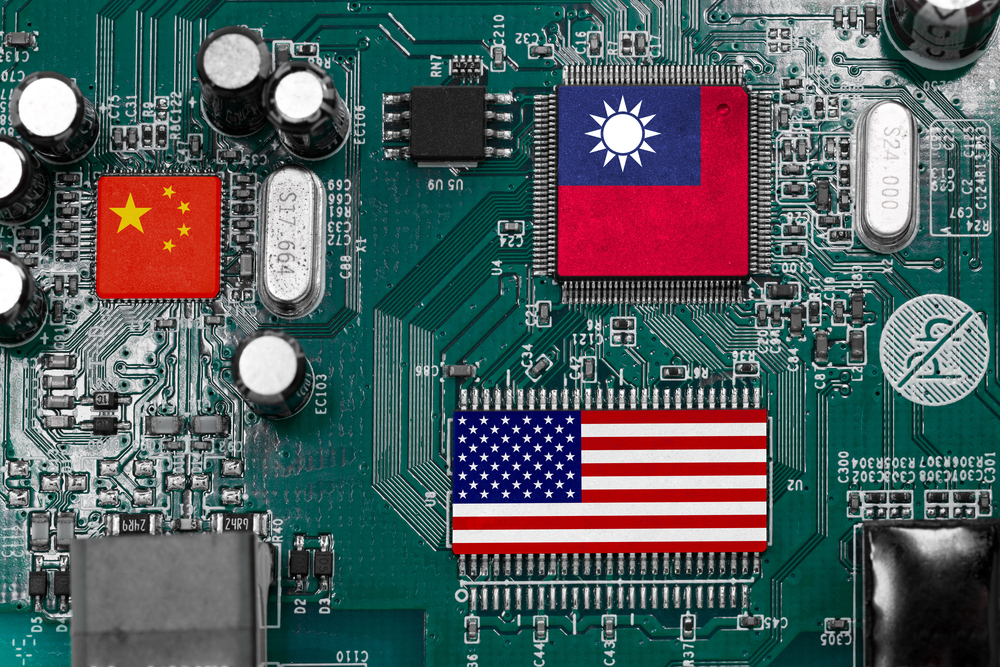
High duties on Taiwanese chips would raise the cost of the inputs American reindustrialization depends on, without creating the design ecosystem, engineering depth or process discipline that took thirty years to build. The more productive path is the one ART has opened: converting a private commercial relationship into a public, institutional one, with reciprocal obligations on both sides — and extending it to the third countries where much of the competition will play out. Picture source: Depositphotos.
Prospects & Perspectives No. 44
Tariffs, Trust, and the Reciprocal Trade Agreement: Taiwan’s Role in American Reindustrialization
By Meng-chun Liu
Since 2024, U.S. President Donald Trump has repeatedly asserted that Taiwan “stole” the American semiconductor industry. Trump restated the charge in a Fox News interview in May 2026, arguing that earlier administrations should have imposed tariffs of up to 200 percent on Taiwanese chips. Two months later, when Wistron inaugurated its first U.S. plant in Fort Worth — already producing NVIDIA’s GB300 Grace Blackwell Ultra — NVIDIA CEO Jensen Huang offered the opposite reading: Taiwan saved the American semiconductor and computing industries, not the other way around.
The gap should be resolved by understanding how Taiwan’s industrial capability was formed, not by rhetoric — and by recognizing Taiwan as a partner in the U.S. reindustrialization and in the pursuit of “peace through strength,” rather than an obstacle to either.
Specialization, not displacement
Taiwan’s industrial growth did not come from taking production away from the United States. It was built on a cross-border division of labor: American firms concentrated on design, software, capital equipment and intellectual property; Taiwanese firms on contract manufacturing, supply-chain coordination, advanced packaging and volume production at scale.
Cost helped create the arrangement, but trust made it durable. The commitment at the heart of Taiwan’s foundry and original design manufacturer (ODM) model is simple to state and extraordinarily difficult to sustain: the manufacturer does not own the brand, does not claim the design, and does not become a competitor to its own customer. NVIDIA, AMD, Qualcomm and Broadcom were able to scale globally in part because they could rely on manufacturing partners that would not compete with them. Taiwan’s most valuable contribution is therefore broader than semiconductors or ICT hardware: three decades of keeping a promise of trust to its customers.
From commercial trust to institutional standing
For most of those three decades, Taiwan’s reliability was a private, commercial attribute, resting on the value of long-term relationships rather than on any bilateral institutional framework. What has changed since January 2025 is not the trust itself, but the form it takes and the audience to which it is demonstrated. Taipei has begun converting a reputation built with customers into standing established through law — codified both in its own statutes and in agreements with Washington.
The first of these came in June 2025, when Taiwan added 601 foreign entities — including Huawei and SMIC — to its Strategic High-Tech Commodities Entity List, requiring domestic firms to obtain approval before exporting controlled items. Taipei framed it as non-proliferation policy, but the instrument matters as much as the rationale: an autonomous list under Taiwan’s own law, not a derivative of another jurisdiction’s controls. Taiwan was not merely complying with restrictions designed elsewhere; it was helping to build supply chains insulated from Chinese control, and to define which of them count as trusted.
The second went further. The Agreement on Reciprocal Trade (ART), signed on February 12, 2026, pairs its tariff provisions with dedicated chapters on economic security and digital trade, together with commitments on forced labor, migrant worker recruitment fees and freedom of association. Those commitments helped reinforce Taiwan’s standing as a jurisdiction able to meet U.S. economic-security and labor standards. When the Office of the U.S. Trade Representative’s forced-labor tariff measures covering 60 economies took effect on July 24, 2026, Taiwan and the European Union received the most favorable treatment. Taiwan is no longer merely a supplier operating inside someone else’s rules; it is being treated as a rule-abiding jurisdiction in its own right.
One capability, two theaters
According to U.S. Department of Commerce materials describing the January 2026 memorandum of understanding, Taiwanese firms have pledged at least US$250 billion in direct investment, supported by up to US$250 billion in credit-guarantee capacity on the Taiwan side. After Taiwan Semiconductor Manufacturing Company (TSMC) announced an additional US$100 billion in July, its publicly disclosed U.S. investment commitments reached US$265 billion. These figures represent announced commitments and financing capacity rather than completed disbursements. Commerce describes the result as an “economic partnership” that will build “world-class” industrial parks in the United States — a “Taiwan model” drawing on Taiwan’s own science-park experience to create industrial clusters through government-to-government (G2G) collaboration. Taiwan is not only supplying what American reindustrialization requires; it is helping to underwrite it.
This is unfolding amid the broadest reorganization of manufacturing geography since the Cold War. Pandemic disruption, geopolitical conflict and tightening export controls have made political risk increasingly important in production decisions, and much of the capacity now in motion is moving toward emerging manufacturing centers across the Global South, which have become increasingly important arenas of U.S.-China economic competition. Southeast Asia, India, Latin America and Africa are not merely alternative production sites but markets where competing approaches to industrial development, digital infrastructure and standards are being tested. These economies are not simply choosing between Washington and Beijing; they are seeking investment, technology and industrial partnerships that expand their own room for maneuver. Beijing holds a long head start in financing and construction; Washington’s advantage lies in technology, capital markets and the credibility of its firms — but it needs partners able to execute on the ground.
The same contract manufacturers now building in Fort Worth and Phoenix have spent two decades expanding into Vietnam, Malaysia, Mexico and India. That is a feature of the business model, not a contradiction of it: their essential assets are customer relationships and process discipline rather than any particular building, so capability travels with the customer. This growing internationalization — “Taiwan+N” — pairs naturally with Taiwan’s New Southbound Policy experience in supplier development, vocational training and park management. Joint U.S.-Taiwan projects in third countries would give both partners something neither can supply alone, and would translate strategic resilience into industrial capacity on the ground.
Implications
Tariffs are a blunt instrument for a relationship of this kind. High duties on Taiwanese chips would raise the cost of the inputs American reindustrialization depends on, without creating the design ecosystem, engineering depth or process discipline that took thirty years to build. The more productive path is the one ART has opened: converting a private commercial relationship into a public, institutional one, with reciprocal obligations on both sides — and extending it to the third countries where much of the competition will play out.
Reciprocity also requires Washington to provide a stable tariff environment, facilitate double-tax relief and skilled-worker mobility, and ensure that overseas expansion complements rather than erodes Taiwan’s domestic innovation base. A weaker Taiwan would not produce a stronger American technology ecosystem.
For Taiwan, the task is to honor its commitments on investment, export controls and labor standards in practice, as it has honored its industrial promises. For the United States, the task is to recognize that a partner willing to invest, align its controls and deploy its capability alongside American firms across the Global South is a strategic asset, not a trade problem. On that basis, the argument between the two narratives of 2026 need not be resolved by argument at all. The record will resolve it.
(Dr. Meng-chun Liu is Director of the First Division, at the Chung-Hua Institution for Economic Research (CIER) in Taipei.)
 Facebook
  Youtube
  Twitter