



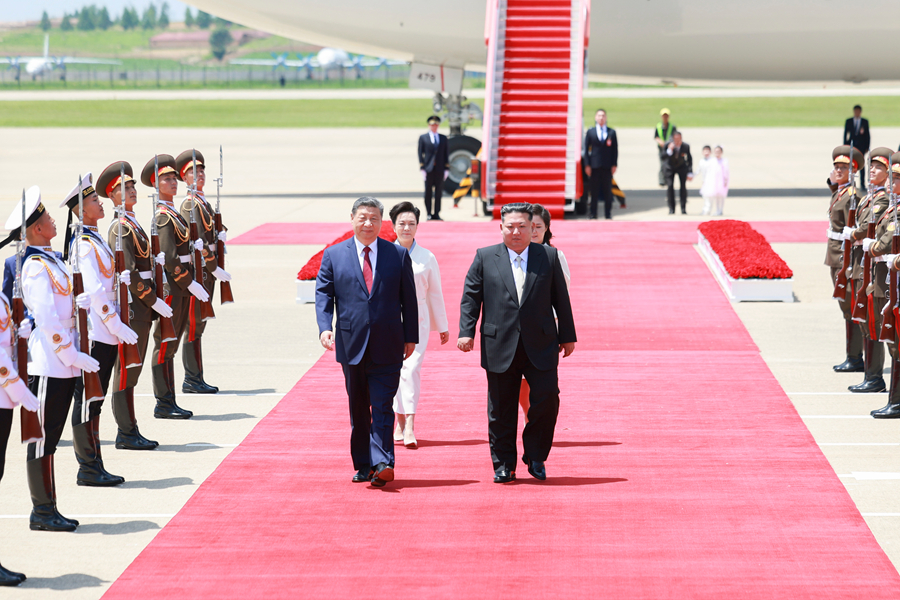
Chinese leader Xi Jinping made an unannounced state visit to North Korea on June 8-9, his first visit to North Korea in seven years. This was also the first overseas visit by Xi this year, which demonstrates the special status that North Korea holds for China. Picture source: CPC News, June 8, 2026, CPC News, https://cpc.people.com.cn/BIG5/n1/2026/0608/c435113-40736233-4.html.
Prospects & Perspectives No. 36
Prospects for China-DPRK Relations After the Xi-Kim Summit
By Mandy Hsiao-chuan Liao
Following U.S. President Donald Trump’s visit to China from May 13 to May 15, Chinese leader Xi Jinping made an unannounced state visit to North Korea on June 8-9, his first visit to North Korea in seven years. This was also the first overseas visit by Xi this year, which demonstrates the special status that North Korea holds for China. After the summit, Xi and Kim Jong Un did not issue a joint statement but only separately published summit summaries by both countries’ official media. This summit further showed that the relationship between China and North Korea is different from that under Kim’s predecessors in at least two aspects.
China’s Evolving Approach to North Korea's Nuclear Status
The first aspect is about the insistence on the denuclearization of the Korean Peninsula. Considering the closeness of the three Northeastern provinces of China, the stability of Northeast Asia, and the possibility of an arms race between Japan and South Korea, China has firmly claimed the policy of denuclearization of the Korean Peninsula. Despite Xi’s repeated claim of promoting denuclearization of the Korean Peninsula, Kim Jong Un formally declared North Korea a nuclear-armed country in 2022. Since then, China has kept a distance from North Korea and even cooperated with the U.S. to impose economic sanctions on Pyongyang.
However, the situation has gradually changed since North Korea’s possession of nuclear weapons has been confirmed. Since 2023, the Chinese diplomatic system has made fewer mentions of denuclearization of the Korean Peninsula. In 2025, Xi did not mention the denuclearization of the Korean Peninsula when Kim visited China and held a public meeting with Xi. This was the first time that the highest figure in China did not mention the denuclearization of the Korean Peninsula. This change may signal that China has made concessions on the issue of nuclearization though not to the degree of admitting a nuclearized North Korea. In such a case, the denuclearization of the Korean Peninsula does not constitute an obstacle for the two countries’ continued engagement. Both countries have met halfway and split the difference. Kim will not feel he is being disrespected every time Beijing promotes the denuclearization of the Peninsula. China also will not feel it is being disrespected whenever Kim loudly asserts North Korea as a nuclear-armed country.
Strategic Pragmatism in China–DPRK Relations
The second aspect is about more realistic behavior and less about ideological appeal. North Korea has become very close to Russia since 2023. North Korea has been under sustained international pressure as Kim insisted on the development of his nuclear program. The U.S., the Biden administration, along with its allies such as Japan and South Korea froze trade with North Korea. China also followed this policy for two reasons: maintaining smooth relations with the U.S. and punishing North Korea for its refusal to respond positively to China’s appeals. North Korea has since been desperate for food, resources, and energy.
Russia also needs military personnel and weapons for the Russo-Ukraine war. Hence, the two old partners saw an opportunity to collaborate. They deepened military cooperation and signed a new treaty on comprehensive strategic partnership in 2024. Both countries promised mutual military assistance in times of contingency. If either country is subjected to armed aggression by other states and enters a state of war, the other country must immediately provide military and other assistance with all available means. They also pledge not to sign any treaties with a third country that infringe upon the other’s interests. Neither country allows any nation to use its territory to harm the other’s security and sovereignty. This treaty has effectively made the two countries military allies.
The deepening of Russo–DPRK relations has alarmed China. From a geopolitical perspective, the growing alignment between Russia and North Korea could impose a strategic constraint on China's vast northern territory. This could also isolate China from the authoritarian camp and have a negative impact on China’s international status and influence. Hence, China has adjusted its North Korean policy and lifted its economic sanctions on North Korea. In the summaries of the summit this year, promotion of strategic interests and expansion of cooperation in the areas of politics, economy and culture between the two countries are emphasized.
Additionally, China has also become more practical and realistic in its relationship with North Korea. Fewer ideological references or historical obligations from the Korean War are used in the diplomatic system. More terms like mutual security and mutual interests are stressed. Both countries are seemingly in a more equal relationship rather than one of subordination. Their cooperation is based on realistic and strategic considerations, not on ideological similarities or gratitude for past actions.
Future Prospects for China–DPRK Relations
Overall, the official summaries of the two summits—Kim Jong Un’s 2019 visit to China and Xi’s 2026 visit to North Korea—substantiate the developments outlined above. From the perspective of North Korea, the competition between China, Russia and the U.S. has provided Pyongyang with a great opportunity to break its international isolation due to its development of nuclear weapons. It introduces Russia as a means to balance the North’s heavy dependence on China, and utilized Russia’s needs for the war to overcome U.S. sanctions. This approach greatly increased North Korea’s autonomy in the international system. From China’s perspective, a friendly and dependent North Korea is better than an economically fragile North Korea with which it has no communication, even a North Korea that is more closely allied with Russia and armed with nuclear weapons.
Under these conditions, if the international structure remains as it is today, in which competition among the big three continues, North Korea can take advantage of this situation and strengthen its security and development as a nuclear-armed country. However, if the Russo-Ukraine war ends and North Korea’s value to Russia diminishes, we could see a return to the earlier dynamics, one in which North Korea loses its independent diplomatic space and resumes its asymmetrical dependence on China. Either way, China will continue to be the most valuable partner for North Korea and leave the nuclearization issue for the West to deal with.
(Mandy Hsiao-chuan Liao is Associate Professor at National Taiwan University.)
 Facebook
  Youtube
  Twitter