

Airspace Weaponization, China’s Lawfare, and the Limits of International Law


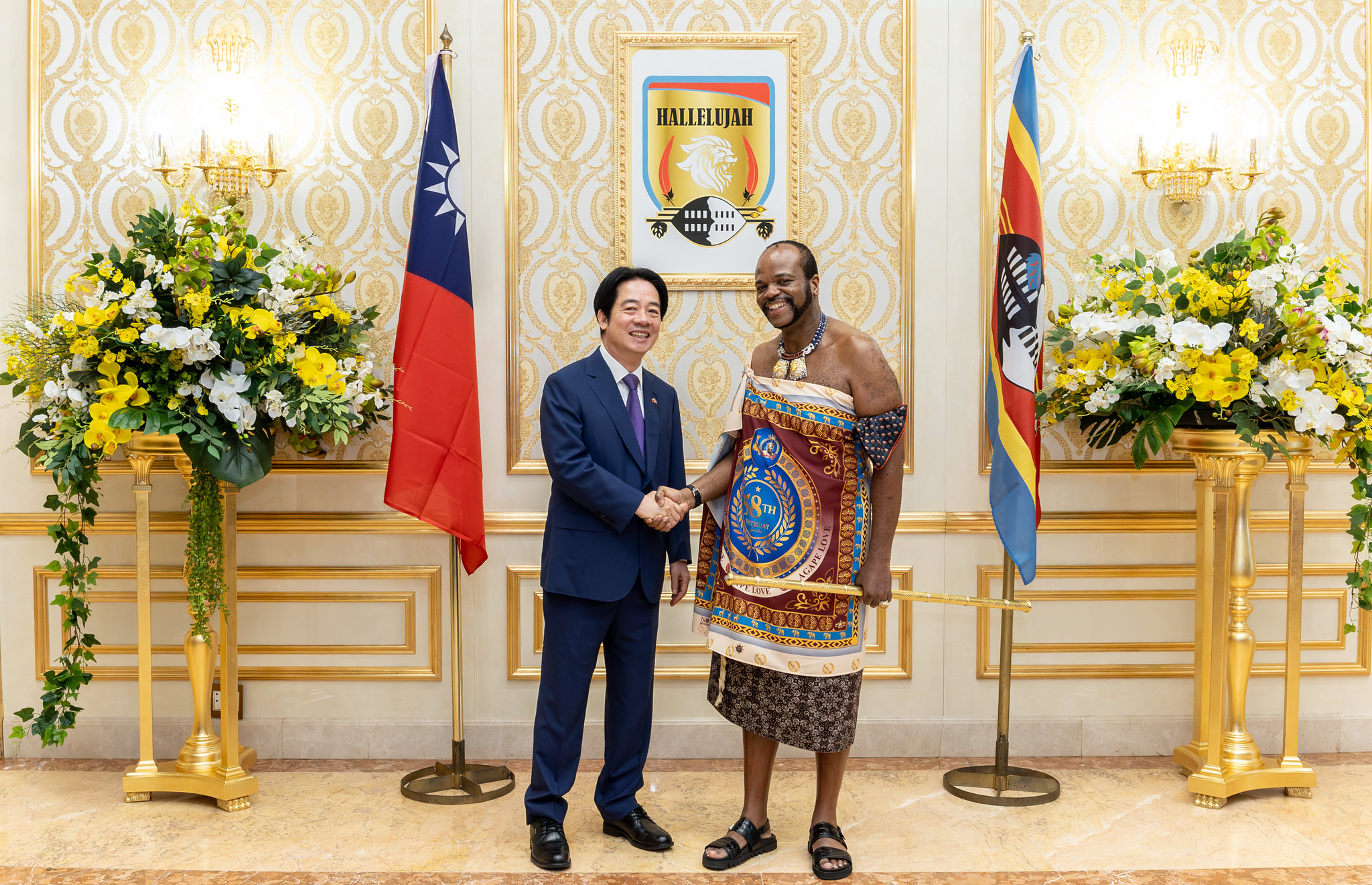
On the evening of April 21, 2026, Taiwan’s Presidential Office announced the abrupt cancellation of President Lai Ching-te’s scheduled visit to Eswatini. The reason was not a security threat or a scheduling conflict. It was the weaponization of airspace in light of China’s recent intensified tactics in deploying warfare to adversely impact Taiwan’s international space. Picture source: Office of the President, May 3, 2026, flickr, https://www.flickr.com/photos/presidentialoffice/55244961818/in/album-72177720333446394.
Prospects & Perspectives No. 28
Airspace Weaponization, China’s Lawfare, and the Limits of International Law
By Ching-Fu Lin
On the evening of April 21, 2026, Taiwan’s Presidential Office announced the abrupt cancellation of President Lai Ching-te’s scheduled visit to Eswatini, Taiwan’s only remaining official diplomatic ally in Africa. The reason was not a security threat or a scheduling conflict. It was the weaponization of airspace in light of China’s recent intensified tactics in deploying warfare to adversely impact Taiwan’s international space. Specifically, Seychelles, Mauritius, and Madagascar had revoked overflight clearances for the presidential aircraft at the last minute without prior notice, which Taipei explicitly attributed to “intense pressure from the Chinese authorities, including economic coercion.” Days later, President Lai ultimately reached Eswatini through alternative arrangements, arriving unannounced after a covert diplomatic operation. But the damage to the rules-based international order had already been done.
While this might appear at first glance as yet another tactic employed by China as part of its lawfare against Taiwan, a closer examination suggests something more consequential, as this series of coercive measures could create a precedent-setting effect that undermines Taiwan’s international space and unduly interferes with third states’ sovereign functions, and weaponizes airspace and sea lanes, fundamentally eroding the rules-based international order.
The non-intervention principle and China’s double coercion
Since the United Nations (UN) General Assembly adopted the Friendly Relations Declaration (Resolution 2625) in 1970, the non-intervention principle has been firmly embedded in customary international law and reflected in the UN Charter. UNGA Resolution 2625 explicitly prohibits any State from “interven[ing]… directly or indirectly, for any reason whatever, in the internal or external affairs of any other State” or from using “economic, political or any other type of measures to coerce another State in order to obtain from it the subordination of the exercise of its sovereign rights.” Such prohibition extends well beyond armed force and covers “all other forms of interference or attempted threats,” such as debt leverage and diplomatic intimidation.
The United States has criticized China’s pressure on the African countries involved in the foregoing incident, which were “acting at the behest of China by interfering in the safety and dignity of routine travel by Taiwan officials.” A senior Taiwanese security official stated that Beijing’s pressure included threats to suspend financing or revoke debt relief, among other economic coercive measures. China has not formally admitted to pressuring these countries, but it need not have done so. A statement by China’s Ministry of Foreign Affairs spokesperson Guo Jiakun publicly commended the three African countries for upholding its self-proclaimed “One China Principle,” all but confirming the nature of the exchange. The pattern of Beijing’s expanding strategic presence in the Western Indian Ocean, built through overlapping webs of infrastructure loans and debt dependency, provides exactly the kind of leverage that makes explicit threats unnecessary. The compliance was expected due to the structural power asymmetry that facilitates economic coercion.
China’s coercive conduct in this incident operates on two dimensions with double harm, as it not only pressures Taiwan but also conscripts vulnerable states into its coercive apparatus by converting their formal sovereign powers into instruments of third-party interference. For one, it interferes with the international relations of Seychelles, Mauritius, and Madagascar regarding the matters of airspace management and aviation safety. That is, through economic coercion, China effectively subordinates the sovereign will of these African states, compelling them to weaponize their airspace management functions in service of Beijing’s political agenda rather than the aviation safety considerations that alone should govern such decisions. The non-intervention principle as enshrined in the UN Charter, embedded in customary international law, and explicitly upheld in UNGA Resolution 2625, readily applies to this dimension.
For another, it directly curtails Taiwan’s ability to conduct normal international relations, an exercise of what international law recognizes as the sovereign right of every state to engage freely with the world. The objection that Taiwan is not a UN Member State and therefore falls outside the remit of these norms is unavailing. UNGA Resolution 2625 was deliberately crafted to apply universally and extend beyond the UN Charter’s scope, applying to all states independent of UN membership, to reflect obligations that inhere in the international community as a whole. China’s act in sabotaging President Lai’s visit to Eswatini, an expression of Taiwan’s right to conduct normal international relations, cannot escape the reach of the non-intervention principle on the ground that Taiwan lacks UN membership or that Taiwan’s statehood is to be contested (which is not the case). The very universality of the non-intervention principle cannot be overstated.
The thin relevance of the Chicago Convention
The more legally sophisticated dimension of this incident concerns the (in)applicable aviation law framework. The 1944 Convention on International Civil Aviation (commonly known as Chicago Convention) establishes the architecture and fundamental principles of international civil aviation. Some may argue that the Chicago Convention applies and disciplines those African countries’ abuses of aviation safety and airspace management. It should be noted, however, that the Chicago Convention has a carve-out provision (Article 3), which stipulates that “the Convention shall be applicable only to civil aircraft, and shall not be applicable to state aircraft.” Here, “state aircraft” means any aircraft owned and operated by a government or public body (ownership-and-operation approach) or any aircraft over which the State exercises control and which is deployed exclusively in the performance of a public task or sovereign function (purpose-based approach). On either view, President Lai’s presidential aircraft — state-controlled and operating as the official conveyance of a head of state on a diplomatic mission — falls within the definition of a state aircraft, to which the Chicago Convention does not directly apply.
This might create a dilemma for Taiwan’s international legal strategy. If Taiwan argues that the revocation of overflight clearances violated the Chicago Convention, as several Western partners seemed to suggest in statements emphasizing that “overflight rights constitute a fundamental aspect of international civil aviation,” it might risk implicitly conceding that the presidential aircraft is a civil rather than a state aircraft. That concession carries significant costs on Taiwanese statehood.
Some may argue that even if the Chicago Convention does not apply by its letter to state aircraft, its spirit — and in particular its foundational relevance commitment to aviation safety — should still inform how states exercise their airspace management functions (which might be supported by reading together the Convention’s preamble on the prevention of abuses that can lead to “threat[s] to the general security” as a constitutive purpose of the international aviation regime) and guide state practices with a general, systemic obligation that overrides the civil/state aircraft classification. In this sense, a regime in which overflight clearances can be revoked for political rather than safety reasons is inconsistent with the Convention’ object and purpose. Such precedent, once set, does not stop at aircraft or Taiwan: it opens the door to the weaponization of airspace and sea lanes alike, at mounting cost to every state that depends on a stable, rules-based international order.
Conclusion
Other international law obligations, notably the United Nations Convention on the Law of the Sea (UNCLOS) guarantee of freedom of overflight over exclusive economic zones and the high seas, and prohibition on abuse of rights may be worth examining to reinforce the case against China’s new lawfare and economic coercion in incidents as such (a full treatment of this is beyond the scope of this article). The incident is not an isolated episode of diplomatic friction, but a stress test of the international legal order. At the time of writing, President Lai has just returned from his “arrive then announce” state visit to Eswatini — made possible by boarding King Mswati III’s official aircraft to circumvent Beijing’s interference — marking a meaningful diplomatic success. Yet beyond this immediate success, going forward, Taiwan should resist the temptation to reach for the most intuitive legal argument at the cost of its statehood claims, and instead pursue a more carefully crafted approach to grounding its case in the non-intervention principle, a nuanced interpretation of the Chicago Convention, and perhaps other international obligations such as the law of the sea and general principles of good faith. Its democratic partners must move beyond condemnation and begin generating real institutional costs for coercive conduct, starting with sustained advocacy for Taiwan’s participation in International Civil Aviation Organization (ICAO) and a strengthened framework for collective resistance to the weaponization of the global commons — airspace, sea lanes, and beyond.
(Dr. Lin is Professor and Director, Institute of Law for Science and Technology, National Tsing Hua University, Taiwan.)
Related Content
Strengthened Yet Threatened Relations: Taiwan’s Diplomatic Ties with Latin American Countries
The Eswatini Incident: Is China Changing Its Pressure Campaign Against Taiwan?
Ketagalan Forum 2024: Highlights and Achievements
The Core Aim of China’s Threat to Taiwan is the Attempt to Move From a Land to Sea Power
Taiwan Enters a New Age: Continuity and Change

Taiwan’s Presidential Elections: More Continuity than Change in Taiwan’s Relations with the World
Promoting the Japan-Taiwan Partnership After Taiwan’s Presidential Election
The Future of U.S.-Taiwan Relations After the January Elections
The 2024 Elections and the Politics of Divided Government
Continuity and Change in Taiwan’s Historic 2024 National Elections

 Facebook
  Youtube
  Twitter