



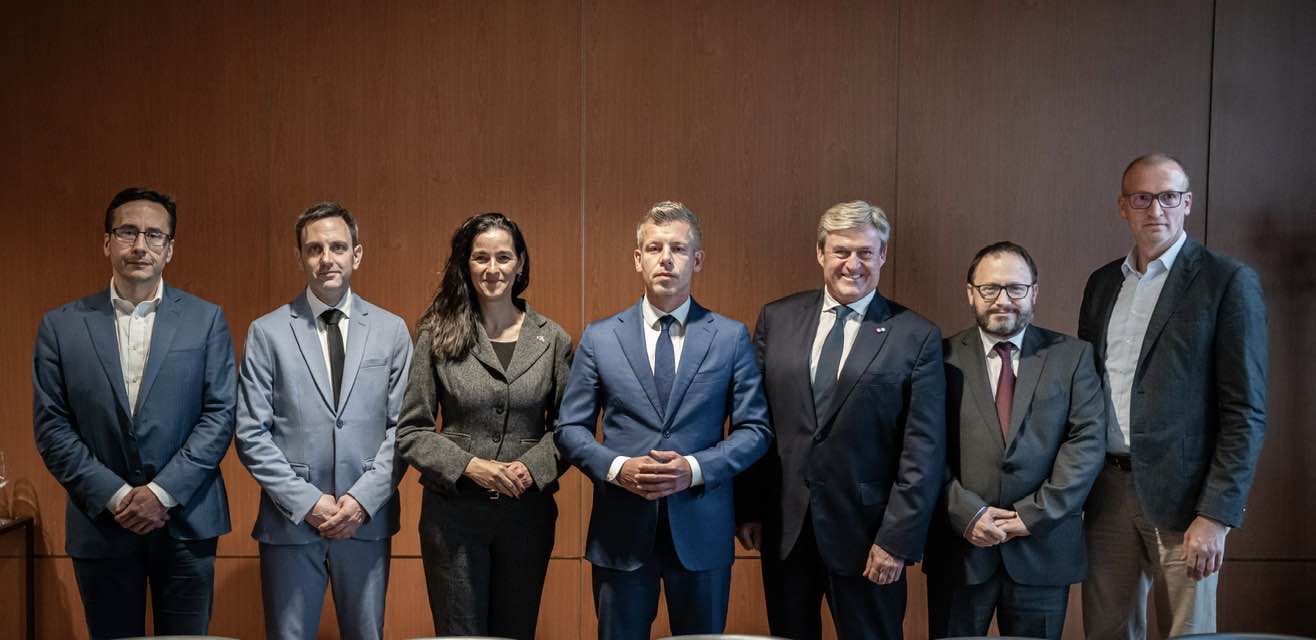
The significance of the April 2026 Hungarian elections was multi-layered, but one fact stands out: Structures built over 16 years by Viktor Orbán, carefully balanced power relations, institutional mechanisms and actors—everything that only yesterday had seemed solid, if not indestructible—lost their robustness in an instant. Picture source: Péter Magyar, April 19, 2026, Facebook, https://www.facebook.com/photo.php?fbid=27132635769677514&set=pb.100000733720126.-2207520000&type=3.
Prospects & Perspectives No. 21
Orbán’s Defeat:
When the Impossible Becomes Possible
By Tibor Dessewffy
The significance of the April 2026 Hungarian elections was multi-layered, but one fact stands out: a system that had seemed eternal collapsed in a single night. It did not simply weaken, did not gradually lose ground—it collapsed. Structures built over 16 years by Viktor Orbán, carefully balanced power relations, institutional mechanisms and actors—everything that only yesterday had seemed solid, if not indestructible—lost their robustness in an instant.
The system that Orbán had built was precisely that: not merely governance, but a complex political ecosystem, state captured, with its own media universe, cronyism, economic hinterland, deeply embedded institutional networks, and a distinctive interpretation of reality anchored in the concept of “illiberal democracy.” This was a model in which, to borrow a well-known phrase, everything is legal, but not everything is democratic; where the formal structures remain in place, yet their operation is organized around a single, central will. Systems like this do not usually vanish overnight.
Historic result
And yet: on April 12, it did not fade away—it evaporated.
If one had to explain this to a distant audience, one would have to put aside all metaphors and start with the numbers. A historic record 80 percent voter turnout indicated that this was not the decision of a narrow, mobilized base, but that of a broad societal majority. However, the truly telling figure is the scale of dominance: the Respect and Freedom Party, or Tisza Party, not only crossed the threshold of an absolute majority on the national list, it also won 96 out of 106 individual constituencies. That is roughly 91 percent of the districts—an extraordinary level of control even by the standards of previous two-thirds victories. A parliamentary group of 141 seats in a 199-seat legislature does not merely constitute a supermajority; it opens up an almost unrestricted horizon for political action, including the possibility of redesigning the system itself.
These numbers do not simply describe an electoral victory. They mark the disintegration of one political order and the birth of another.
What is particularly striking is that this was not the endpoint of a long process of erosion. The system had appeared stable for years—indeed, stronger than ever on the surface. The dominance of political communication, the depth of institutional capture, the reach of economic networks all suggested a structure built for the long term. And yet, at a certain point, social support simply slipped out from underneath it. Political systems sometimes behave like this: for a long time nothing seems to happen, and then everything happens at once.
Péter Magyar’s achievements
In this context, the rise of the Tisza Party’s Péter Magyar can be understood as the convergence of three developments that would each have seemed unlikely on their own, and together appeared almost impossible.
The first is the speed and nature of organization-building. In modern politics, parties are not born; they are constructed—slowly, expensively, layer by layer. Infrastructure, local networks, activists, logistics: these are typically the work of years. Here, by contrast, a nationwide political force emerged in less than two years, one that was not only present across the country but capable of winning decisively. This was not classical party-building but a hybrid formation: the dynamism of a movement combined with the framework of a party. Rapid diffusion, low barriers to entry, strong emotional identification. One of the key lessons of digital-era politics is that organization is no longer always a precondition for success—sometimes success itself generates the organization.
The second “impossibility” is ideological expansion. Hungarian politics had long been structured by deep fault lines—not just competing opinions, but mutually exclusive identities. Magyar did not emerge from the traditional opposition camp but from a center-right starting point, and from there expanded in both directions. This was not simply a tactical move, but a redefinition of the political space. A situation emerged in which the old categories—left and right—lost part of their explanatory power, and were replaced by a new dividing line: between the old system and a new alternative.
The third factor is personal resilience. The level of pressure faced by such a challenger is usually enough to derail a political project before it truly begins. The intensity of the attacks—across media, informal channels, and through sustained character assassination—was the system’s defensive reflex. What is striking is that these attacks did not weaken him; they reinforced his political persona. The attacks became a narrative, and the narrative generated credibility. Where others might have been crushed by such sustained pressure, Magyar appeared almost energized by it—able to convert the attacks into a resource for building personal authenticity: if someone is attacked this relentlessly, then those in power must genuinely fear him.
The foreign policy dimension of the story also deserves attention. During the campaign, Orbán placed an unusually strong emphasis on international politics, above all on the question of war. This logic had worked in 2022: uncertainty, fear, and the message of “staying out” delivered a political majority. Four years later, however, the same narrative no longer resonated. What had once sounded like a promise of security increasingly came across as a strategy of isolation. Central to this was the doctrine of “connectivity”—the idea that Hungary should build relations in all directions, acting as a bridge between East and West. In peacetime, this might have been a viable strategy. But in a wartime environment, amid the bloc formation triggered by Russian aggression, this position became increasingly ambiguous within Europe, seen by many as a form of disloyalty. It is no coincidence that in the final phase of the campaign, crowds increasingly chanted “Russians go home”—the iconic slogan of the 1956 revolution—signaling that foreign policy had suddenly become a deeply domestic issue.
‘Soft populism’: the new paradigm
Political landslides of this magnitude, of course, never have a single cause. They are always the result of multiple forces converging: economic tensions, social discontent, political innovation, and personal trajectories. In other words, this is a kind of mixture, where—as in a well-made cocktail—the proportions ultimately matter most. But if one were forced to single out a defining element from this complex process, it would likely be what we might call the triumph of “soft populism.”
Populism did not disappear—it transformed. A less ideological, less exclusionary, yet still powerfully mobilizing political language emerged. One that does not rely on the refined idioms of political correctness, but on direct address, personal presence, and the experience of authenticity.
Péter Magyar captured this with striking simplicity: “People need to be looked in the eye, the work has to be put in, and the country has to be walked through. Many say this is populism. If it is, then it is a good kind of populism. Because this is what politics should be about. Not ornate language, not politically correct phrasing, but honesty, humanity—about people themselves.”
If this victory felt almost miraculous, there is little doubt that the task facing the new governing majority is anything but. It may, in fact, require miracles of a different kind. They must rebuild a state that has, over many years, been reshaped to serve a particular political logic and filled with clientelist networks; restart the economy; dismantle and hold accountable entrenched systems of corruption; raise living standards; and at the same time rewire Hungary’s foreign relations. The collapse of the Orbán system was swift and dramatic. The reconstruction of democracy—and the consolidation that must follow—will almost certainly not be.
(Tibor Dessewffy is the Director of the Digital Sociology Research Center at Eötvös Loránd University in Budapest. He is an ECFR Council Member.)
 Facebook
  Youtube
  Twitter