



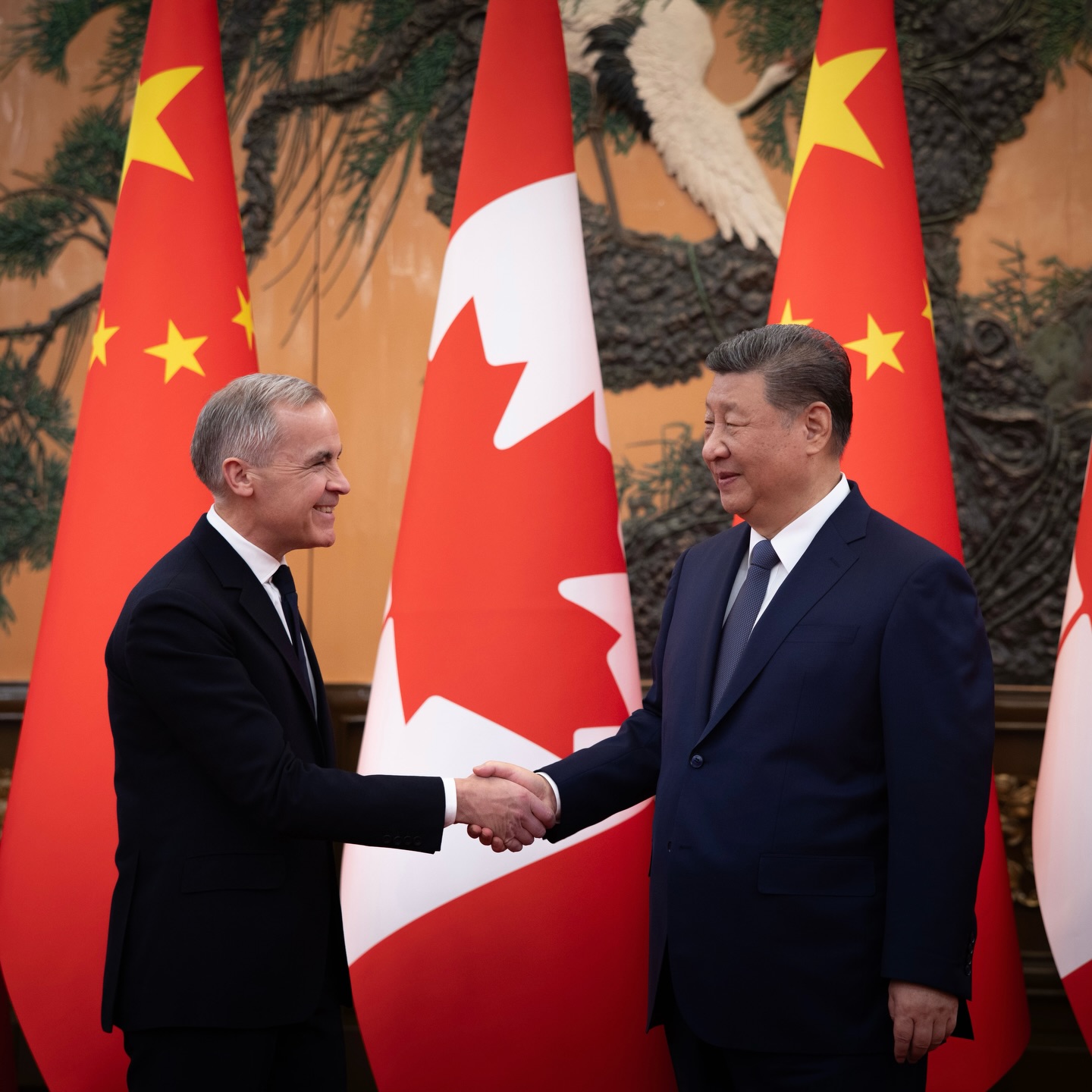
It is understandable that Canada would seek to diversify its trade options in the face of an American government that has weaponized trade, and China, for all its pitfalls, remains an alluring market. Be that as it may, there is no place for China in the alliance of middle powers that Carney is proposing. Allowing China in would be akin to letting the fox into the hen house. Picture source: Mark Carney, January 18, 2026, Facebook, https://www.facebook.com/photo?fbid=122206943954512671&set=pb.61565380151960.-2207520000.
Prospects & Perspectives No. 9
PM Carney’s Bold New Vision:
The Good and the Bad
By J. Michael Cole
Canadian Prime Minister Mark Carney’s “Principled and pragmatic: Canada’s path” address at the World Economic Forum in Davos, Switzerland, in January 2026 will no doubt be remembered as a potentially transformational clarion call in a time of tremendous global instability.
In a period of upheaval, the kind of moral clarity expressed by the prime minister, and the vision, even if mainly aspirational at this point, that lies at its center, is more than ever needed if freedom-loving nations are to secure a safe, free, and democratic future for the next generation. For decades after World War II, American leadership served as the foundation stone and main ideational wellspring for a global order based upon notions of freedom and human rights — even when those aspirations were unmet or conveniently neglected.
Middle powers need to step forward
Under the leadership of U.S. President Donald Trump and the disruptive MAGA movement that he leads, those ideals are being sacrificed on the altar of a nefarious mythology that, at home and abroad, undermines human rights, erodes sovereignty, and, to put it bluntly, threatens catastrophe for humanity. The Western alliance as we know it is no more, and the sooner the rest of the freedom-loving world adapts to this new reality, the better positioned we will be to address the sundry challenges that await us, from global warming to resurgent authoritarian powers that, like Trump, are endeavoring to rewrite the rules of governance in ways that are more hospitable to despotism.
Middle powers like Canada, as Carney rightly puts it, are not powerless. However, their ability to uphold international law and to counter the detrimental effects of despotism will depend on the establishment, as soon as possible, of a “united front” of likeminded nations. Such a grouping must, at its core, be focused on preserving a set of rules and values that counteract the cynical realist-transactionalism that currently characterizes the Trump administration’s worldview and that, potentially, of Trump’s successors.
Regardless of whether MAGA-style rule is only a temporary moment in American history or a more durable phenomenon, it is essential that middle powers put their shoulder to the wheel by making the necessary investments in their collective power — soft and hard — so as to make this fledgling alliance a credible and durable one. With or without American leadership, such a bloc will be indispensable for the burden-sharing that today’s and tomorrow’s challenges will require of us. It is now clear that our over-reliance on the U.S., and our expectations of the durability of its leadership, was careless and short-sighted.
The one great flaw in Carney’s vision
There is, however, one worrying item in Carney’s otherwise visionary address: the reference to Canada developing a “new strategic partnership” with China. Simply substituting one ill for another, by strategically shifting away from a (at the moment) morally bereft American ally under President Trump to a dystopian-authoritarian regime under China’s Chinese Communist Party (CCP) is certainly not the solution. In fact, the order that Carney alludes to in his speech could not withstand the presence of the CCP in its midst. Any role for China, a facilitator of Russia’s war of aggression against Ukraine and a support system for repressive regimes around the world, in that new alliance would ensure its failure from the outset.
It is understandable that Canada would seek to diversify its trade options in the face of an American government that has weaponized trade, and China, for all its pitfalls, remains an alluring market. Be that as it may, there is no place for China in the alliance of middle powers that Carney is proposing. Allowing China in would be akin to letting the fox into the hen house. Already Carney’s historic address has been criticized for the contradiction created by his government’s embrace of China. (The misuse of quotes from former Czech president Václav Havel, unnecessary in an otherwise excellent address, also warranted some criticism.)
Including Taiwan
There is, however, a role for Taiwan, a natural ally in Carney’s proposed new order and a middle power in its own right. A world leader in the semiconductor sector and among the world’s top 20 economies, Taiwan has a sizable military and security sector, and a highly involved civil society. All of this can complement much of the heavy lifting that Canada and its allies in the Indo-Pacific will have to do to sustain Carney’s vision. Like the other countries that would comprise this new alliance, Taiwan is committed to the rule of law, democracy, and has a solid track record of striking the right balance between personal freedoms and measures to defend itself against its authoritarian neighbor.
Taiwan’s intelligence agencies, academic institutions, business sector and other parts of society are the best placed, thanks to linguistic and cultural characteristics, to understand what is happening in China and to keep the international community informed about crucial developments within China and the secretive CCP. It is also the best positioned society to share its hard-earned lessons on how to trade with China without forsaking one’s values.
Taiwan is already unjustly excluded from much of the multilateral agencies that are now struggling to remain relevant in this period of rupture, as Carney justly describes the current state of our world. This exclusion only serves to weaken the international community’s ability to meet current and future challenges. Rupture entails a departure from the norm and new, creative thinking, since more of the same will no longer work.
Including Taiwan in this endeavor, pragmatically and still in line with the “one China” policy that guides engagement with Taiwan for Canada and other prospective member states of this alliance, is not only possible: it is essential. The history of Canada’s engagement with China shows us that the optimal time to engage Taiwan is when Canada’s ties with China are at their best. Carney can therefore both improve relations with China in some areas while ensuring that a key player in an alliance of middle powers gets its rightful seat at the table.
(J. Michael Cole is Senior Fellow of the Macdonald-Laurier Institute, Senior Fellow of the Global Taiwan Institute, and Senior Fellow of the University of Nottingham, UK.)
Related Content
Canada’s Indo-Pacific Strategy: Making China Part of the Indo-Pacific
Beijing’s Intensifying Pressure on Taiwan’s Passport and Consular Affairs
What If the Quarantine of Taiwan Has Already Begun?
An Old Dog’s New Tricks? China’s United Front Work and Taiwanese Internet Personalities

Beyond a Rhetorical Defense of Taiwan
The U.S.’ Security Package: Implications for Taiwan and the Indo-Pacific
Taiwan Enters a New Age: Continuity and Change
Taiwan’s Role in the US-Japan-Philippines Alliance
China’s Claim of the Taiwan Strait as ‘Inland Waters’ and the Kinmen Incident
The Impact of China’s Suspension of the ECFA on Cross-Strait Relations
Taiwan’s 2024 Presidential and Legislative Elections: Implications for the Region
The Ukraine War: Lessons in Preparedness for Taiwan
 Facebook
  Youtube
  Twitter