


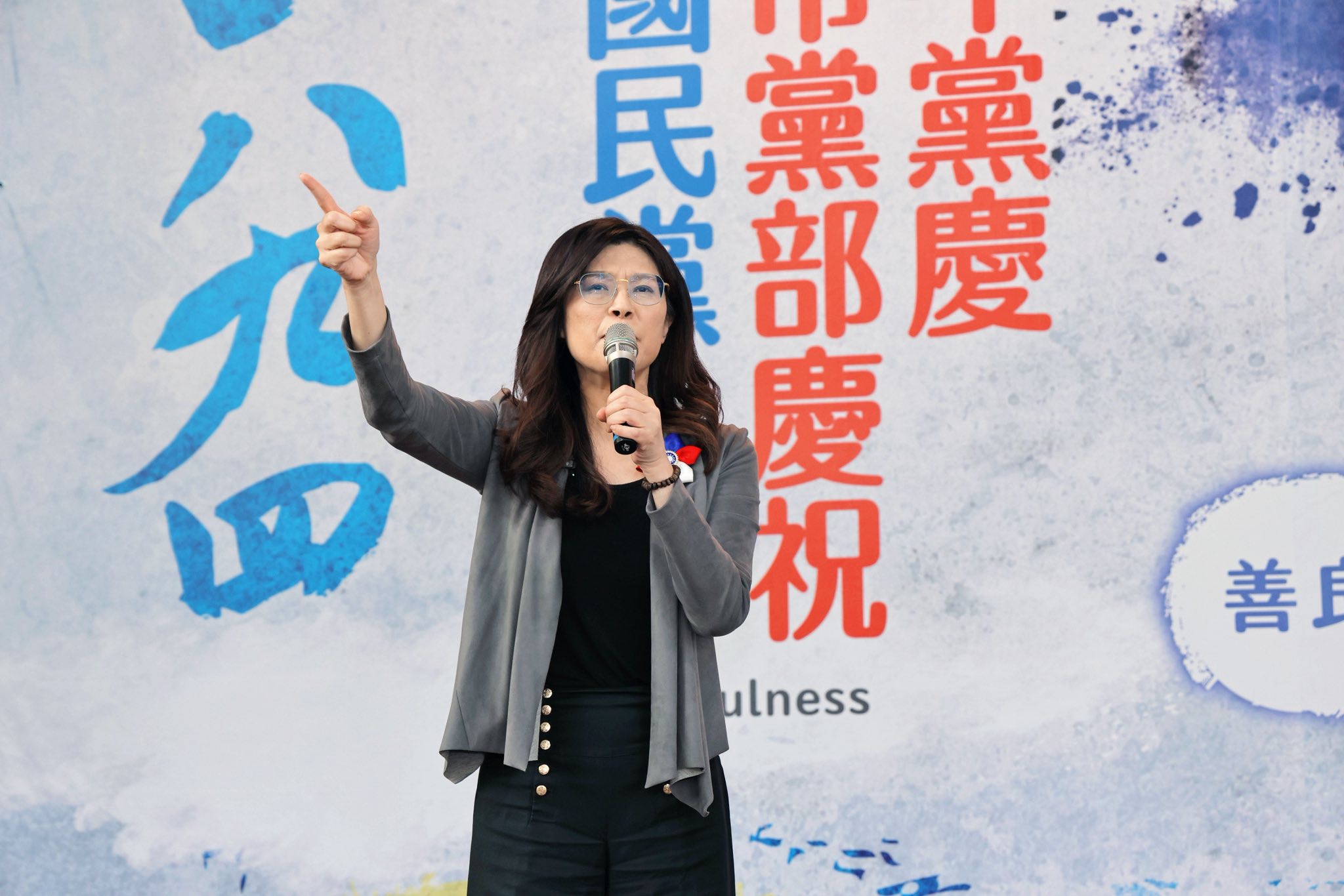
Many supporters expect KMT to perform strongly in the 2026 local elections and eventually regain power in 2028. Against this backdrop, whether Cheng can lead a party widely perceived as “outdated” into a new era, or whether her rhetoric — arguably more pro-China than that of the typical KMT politician — will ultimately backfire, has become a key question. Picture source: 鄭麗文, November 29, 2025, Facebook, https://www.facebook.com/photo/?fbid=1377959340359451&set=pb.100044361942786.-2207520000&locale=zh_TW.
Prospects & Perspectives No. 70
Chairwoman Cheng Li-wun and a Party at a Crossroads
By Ying-Jia Ke
The Kuomintang (KMT) held its party chair election in October 2025. Cheng Li-wun emerged from a six-way race as the winner, becoming the KMT’s second female party chair (not counting acting chairs) after Hung Hsiu-chu. This election attracted considerable attention and was marked by some controversy.
Emerging from the great recall campaign in July and August unscathed, the KMT hoped to seize the momentum to secure victory in the 2026 local elections as a springboard to the 2028 presidential race. After Taichung Mayor Lu Shiow-yen, widely seen as a potential 2028 presidential contender, signaled that she had no intention to run for party chair, the focus within the party shifted to a different question: who could become the “kingmaker” for the next presidential election?
Who is Cheng Li-wun?
Before this election, Cheng Li-wun was not a household name. In her early political career, she was a National Assembly member from the Democratic Progressive Party (DPP). In 2004, following an internal party dispute, she left the DPP and later joined the KMT. Her political stance shifted rapidly from supporting Taiwan independence to adopting what was ostensibly a more pro-China position.
After joining the KMT, Cheng served as an at-large legislator, head of the party’s Culture and Communications Committee, and party spokesperson. In recent years, she frequently appeared on political talk shows as a host or guest commentator. Her combative style and sharp debating skills helped her cultivate a significant base of supporters within her party.
The KMT at a crossroads
Cheng’s main opponent in the race was former Taipei mayor Hau Lung-bin. Compared with Cheng’s background in student activism and her past as a DPP member, Hau comes from a traditional KMT political family. The great contrast in their careers and personalities led many observers to interpret this election as a moment of generational change for the KMT. Cheng’s supporters argue that her willingness to charge ahead and speak bluntly can bring real change to the party. They also believe that the KMT has long been dominated by older politicians from established political families, and therefore place their hopes in Cheng to inject new energy into the party.
Although both candidates take a friendly posture toward China, Hau’s rhetoric is comparatively restrained. He calls on the People’s Republic of China (PRC) to recognize and respect the factual existence of the Republic of China (ROC). He also argues that Taiwan should maintain “equidistant” friendly relations between the United States and the PRC. These positions are usually seen as core values of the “Republic of China” camp within the KMT. By contrast, Cheng has adopted what many regard as a more hostile attitude toward the United States. Her discourse frequently employs terms such as “one China,” “peace,” and “joint prosperity and development,” which are standard wordings in Chinese Communist Party narratives.
During the campaign, senior KMT figure Jaw Shaw-kong, who supported Hau, accused Chinese bots of intervening in the party chair election by artificially boosting Cheng’s online visibility and inflating her popularity. This accusation sparked a heated discussion that crossed parties. Some within the KMT saw it as undermining party unity and harming post-election consolidation. The ruling DPP, on the other hand, said that the KMT was finally getting a taste of the cognitive warfare campaign that the DPP had long been warning about.
Old wine in a new bottle
The “1992 Consensus” has been a highly contentious matter in Taiwan.
On New Year’s Day 2019, Chinese leader Xi Jinping formally declared to the people of Taiwan and to the international community that the “1992 Consensus” means “one China” and “one country, two systems.” That same year, Hong Kong was shaken by the anti–extradition bill movement. The people of Taiwan witnessed firsthand that “one country, two systems” was not a formula that appealed to them. This heightened vigilance toward China not only helped Tsai Ing-wen win re-election in 2020, but also enabled Lai Ching-te and the DPP to achieve an unprecedented third consecutive presidential victory in 2024.
The “1992 Consensus” returned a few years later as Cheng’s signature brand. In campaign debates, she repeatedly emphasized that “both sides of the Strait belong to one China, and the Republic of China is a one-China constitution,” advocating cross-Strait reconciliation and cooperation to build a “century-long foundation of peace.”
Public concerns about Cheng’s seemingly pro-China stance are not unfounded. On political talk shows, she has claimed that People’s Liberation Army (PLA) drills encircling Taiwan are “protecting Taiwan.” She has repeatedly insisted that people in Taiwan should identify themselves as Chinese. Compared with typical KMT politicians, her discourse aligns more closely with Beijing’s view of history and national identity.
After becoming party chair, she went on to argue that Vladimir Putin is an elected leader rather than a dictator, and contended that because of China’s rapid rise, “time is not on Taiwan’s side.” She opposed President Lai’s proposed US$40 billion special defense budget, asserting that such spending would be a heavy burden and might not actually enhance Taiwan’s security. Taken together, these statements, which often echo Beijing’s narratives, have led many to regard her posture as “looking up to China.”
Recently, talk of a possible “Cheng–Xi meeting” began to circulate. Some media outlets claimed that Beijing was willing to arrange a meeting between Cheng and Xi around the Lunar New Year holiday, but laid out several preconditions, including helping to block U.S. arms sales. The KMT and Cheng later strongly denied these reports, calling them pure fabrication. Yet, the idea of a “Cheng–Xi meeting” has already sparked controversy, deepening public speculation and concern about her relationship with Beijing, and further fueling doubts over whether the KMT’s cross-Strait route will be bound even more tightly to China.
Kingmaker or dealbreaker?
Many supporters expect the party to perform strongly in the 2026 local elections and eventually regain power in 2028. Against this backdrop, whether Cheng can lead a party widely perceived as “outdated” into a new era, or whether her rhetoric — arguably more pro-China than that of the typical KMT politician — will ultimately backfire, has become a key question.
If the KMT hopes to return to the Office of the President in 2028, it will inevitably face the core battlefield of cross-Strait discourse. The “1992 Consensus” may still resonate within the KMT, but it is unlikely to win over a majority of voters. At a time when Taiwanese society’s commitment to autonomous defense continues to grow, a stance that opposes arms purchases is also bound to face scrutiny and questioning.
Cheng’s personality and fighting spirit allowed her to stand out in the party’s internal power struggle. Whether these traits can be transformed into those of a successful kingmaker, or instead become an obstacle to the KMT’s efforts to expand its electoral base, is something that the 2026 local elections may reveal.
(Ying-Jia Ke is co-editor of U.S.-Taiwan Watch.)
Related Content
President Lai’s Second-Year Address and Prospective Developments in Cross-Strait Relations
China’s Claim of the Taiwan Strait as ‘Inland Waters’ and the Kinmen Incident

The Future of U.S.-Taiwan Relations After the January Elections
The 2024 Elections and the Politics of Divided Government
Continuity and Change in Taiwan’s Historic 2024 National Elections

The Impact of China’s Suspension of the ECFA on Cross-Strait Relations
【Event】PF & CNAS Seminar - Taiwan, Evolving World & Cross-Strait Relations (September 7)
Why Taiwan’s Envoys in Hong Kong Refused to Sign the ‘One China Pledge’ and Possible Consequences
Pineapples, 22 Agricultural and Forestry Measures, and Integration through Human Interactions, Special Privileges, and Emotional Ties
A Discourse on China’s Temporary Halt to Taiwan Pineapple Imports

Xi Jinping Is Riding the Back of the Tiger
M503 Flight Route Disputes
 Facebook
  Youtube
  Twitter