



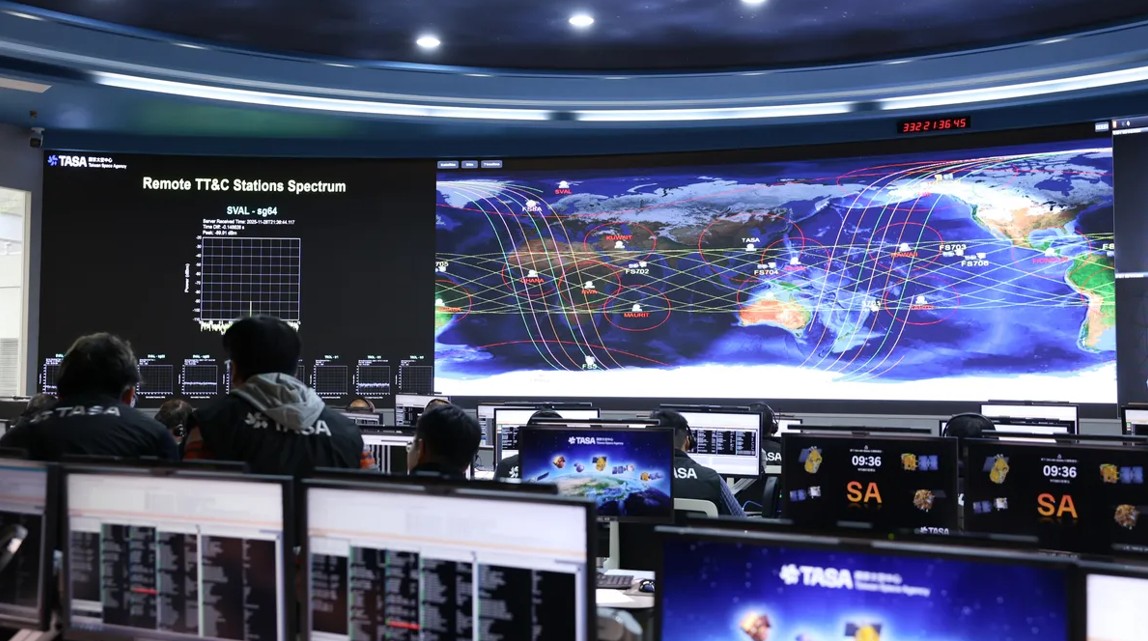
Taiwan’s military and political leaders must reframe investments around survivability and interoperability, incentivize quick procurement cycles for space and unmanned systems, and institutionalize joint wargaming with U.S. and allied partners that centers space-enabled targeting. Picture source: TASA, November 29, 2025, TASA, https://www.tasa.org.tw/zh-TW/announcements/detail/a593228f-23f0-446a-8ab4-c00c51a0a439.
Prospects & Perspectives No. 68
The Real Shield Is in Space: Taiwan’s Path to a Resilient ‘Kill Web’
By Holmes Liao
Amid efforts by the Lai administration to strengthen Taiwan’s ability to defend itself and recent moves by his government to substantially increase defense spending, the major question that is being asked among many analysts is: “What would — or should — Taiwan’s armed forces do with all that extra money?” Some have argued for further spending to expand legacy platforms and existing systems, or to acquire more high-profile defense systems from the U.S. Others, as this author does, would prioritize a new approach to warmaking, one that builds on emerging technologies.
A paradigm shift
With a broader modernization effort in mind, U.S. defense assistance to Taiwan should encourage the latter’s senior military leadership to move from outdated paradigms by embedding multi-domain operations, joint training and campaign-level wargaming. The Pentagon’s most valuable contribution to this shift would be doctrinal and architectural: helping Taiwan develop a kill web — a distributed sensor-to-shooter network that spans space, air, sea and shore, linked by resilient communications, edge AI and decentralized command-and-control to find and hit targets fast, even under electronic and kinetic attack. That shift would augment Taiwan’s defense effectiveness and conceivably reduce the likelihood that U.S. military personnel would be drawn directly into a conflict in the Taiwan Strait. Enhanced interoperability with U.S. forces — through shared communications; common positioning, navigation, and timing (PNT) resilience standards; and compatible command and control (C2) links — would make coalition responses faster, less risky, and more lethal.
Space is the backbone of that network. Satellites provide persistent maritime domain awareness, cueing other airborne and surface sensors, enabling wide-area tracking and improving time-sensitive targeting. In Taiwan’s cramped theater — where the Taiwan Strait compresses approaches and the People’s Liberation Army (PLA) already fields a dense surveillance canopy — sovereign space capabilities are not a luxury; they are existential. Low Earth orbit radar satellite constellations can see through clouds, track ship movements, and monitor launch signatures; signal intelligence (SIGINT) satellites can geolocate emissions and reveal posture. Resilient space assets transform uncertainty into actionable cues for near-shore sensors and shooters.
When President Lai revived the “Cheng Hai” program, which aimed to produce high-displacement surface combatants, the decision was regarded as a sign of resolve. However, big naval vessels, which are highly visible, valuable, and vulnerable, would be high-priority targets the moment conflict begins. China’s anti-ship capabilities integrate a network of space cues with airborne and maritime sensors and a growing inventory of anti-ship missiles and submarines. In such a mosaic, large hulls are liabilities. Taiwan’s smarter course is a distributed, space-enabled kill web that survives opening salvos and continues to sense, decide and strike.
A new triad
That means three space-first shifts.
First: invest in sovereign, layered overhead sensing. Optical and radar satellites provide persistent wide-area surveillance; SIGINT and electronic-intelligence satellites map adversary networks and emissions. These constellations must be “taskable,” frequently refreshed and integrated into a real-time battle management system. Space alone will not deliver final-stage, weapons-quality targeting — but it can reduce uncertainty, cue near-shore sensors, and compress the sensor-to-shooter timeline.
Second: prioritize PNT resilience. Modern munitions, sensors, unmanned systems, and command networks depend on precise timing. China can and will jam or spoof GPS signals in a crisis. Taiwan should deploy eLoran-style terrestrial timing grids, hardened atomic clocks in satellite and ground nodes, and multi-source timing fusion so weapons, communications and critical civil infrastructures keep operating under duress. PNT resilience enables decentralized operations: when satellites are contested, mission command still functions.
Third: make space communications redundant and resilient. Multi-path satellite communications (SATCOM) — combining commercial low earth orbit (LEO) constellations, medium earth orbit (MEO) relays and terrestrial line-of-sight backups — keeps data flowing. Frequency hopping, low-probability-of-intercept waveforms, mesh networks and store-and-forward edge processing lessen the burden on any single link. Edge AI computing should pre-process sensor feeds aboard satellites and at forward nodes, sending only actionable cues to shooters to reduce bandwidth and speed decisions.
Integrating space with air, surface and undersea sensors accelerates targeting cycles. Satellites cue aerial drones and high-altitude platforms; those platforms feed refined tracks to surface and subsurface sensors; and an underwater acoustic layer clarifies submarine and amphibious movements at night or under jamming. Passive RF ground stations and passive radar can triangulate emitters without declaring their own positions. This sensor fusion — spanning space to seabed — produces time-sensitive targeting that can be executed by dispersed shooters before adversaries can react.
A space-enabled kill web flips the cost-exchange ratio. Instead of buying one large hull, Taiwan can field constellations of satellites, distributed coastal missile batteries, tens of thousands of expendable aerial and surface drones, and robust C2 nodes. Cheap, numerous platforms force an adversary to waste expensive interceptors and guided munitions. When satellites are used primarily for wide-area sensing, inexpensive kinetic and non-kinetic effects can be orchestrated from dispersed shooters guided by near-real-time space cues.
Necessary changes elsewhere
Doctrine and industrial policy must follow. Procurement should favor rapid, modular buys — “buy commercial now, tune continuously” — and prioritize satellite tasking rights, hosted payloads and tactical space services. Live-virtual-constructive exercises that integrate space data into campaign wargames will teach mission command how to operate when links are degraded and decoys abound. Civilian infrastructure — microgrids, hardened SATCOM for critical services, distributed manufacturing — becomes part of the warfighting system: a resilient economy sustains a resilient kill web.
Operational resilience also demands battlefield-level hardening. Every firing unit should carry electromagnetic shields, counter-drone kits and GPS-resilient timing and navigation. Passive sensing and emission control reduce detectability; deception and abundant decoys force adversaries to spend precision munitions on fakes. An underwater acoustic layer and seabed sensors add a night-and-noise-resistant dimension to detection, while mobile, shoot-and-scoot coastal batteries complicate targeting.
The leadership challenge is cultural as much as material. Taiwan’s military and political leaders must reframe investments around survivability and interoperability, incentivize quick procurement cycles for space and unmanned systems, and institutionalize joint wargaming with U.S. and allied partners that centers space-enabled targeting. The United States can accelerate this transition by sharing doctrine, providing access to tactical space services and advising on resilient architectures.
Time is short: investments made now in sovereign satellites, PNT resilience and integrated space-to-seabed command architecture will shape deterrence for decades. Prioritize space, and Taiwan survives. Act decisively, now, together.
(Holmes Liao is the founder of Taiwan Advocacy, an organization dedicated to Taiwan’s security.)
Related Content
Taiwan’s Unmanned Systems Industry: Contributions to National Security and Future Development
Re-Establishing Deterrence in Taiwan’s Maritime Periphery Following the China-Indonesia Naval Exercise
Key Takeaways for Taiwan from the Pentagon’s PLA Report
 Facebook
  Youtube
  Twitter