



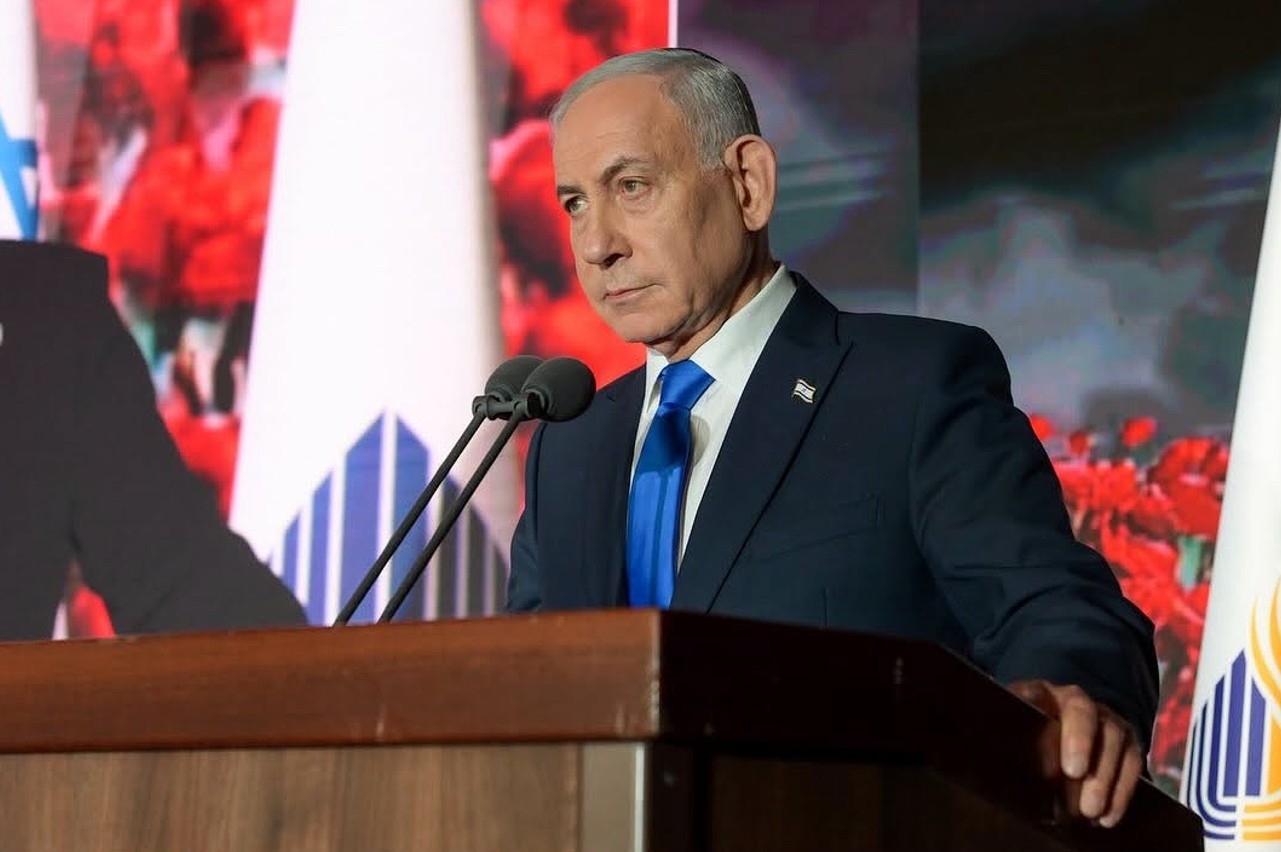
In Israel’s nearly eight-decade history, no election has been more eagerly anticipated than the general election scheduled to take place on October 27. Many Israeli voters have been waiting for this election for a long time, hoping for an opportunity to oust Israel’s current government from power and evict Prime Minister Benjamin Netanyahu from office. Picture source: Benjamin Netanyahu, October 5, 2026, Facebook, https://www.facebook.com/photo?fbid=1678515063644297&set=pb.100044574573209.-2207520000.
Prospects & Perspectives No. 57
Israel’s Legislative Elections: A Challenge to Bibi’s Long Tenure?
By Dov Waxman
In Israel’s nearly eight-decade history, no election has been more eagerly anticipated than the general election scheduled to take place on October 27. Many Israeli voters have been waiting for this election for a long time, hoping for an opportunity to oust Israel’s current government from power and evict Prime Minister Benjamin Netanyahu, Israel’s longest-serving leader, from office (he has been in office for a cumulative total of nearly 19 years). Many people around the world are also hoping for a change of government and a new leader in Israel. Will these hopes be fulfilled?
Netanyahu’s recent track record
Following the last general election in Israel in November 2022, Netanyahu formed a coalition government comprising his Likud party and ultra-nationalist and ultra-Orthodox parties. This government is the most right-wing in Israel’s history and includes the most extremist parties in Israeli politics: Otzma Yehudit (Jewish Power) led by Itamar Ben-Gvir and Religious Zionism led by Bezalel Smotrich. These two far-right politicians not only became Netanyahu’s indispensable coalition partners, but also powerful government ministers able to exercise a major influence on how Israel treated Palestinians in the West Bank and Gaza Strip, as well as its own Palestinian citizens (who comprise about 21% of Israel’s citizens).
During its four years in office, Netanyahu’s government attempted to push through a controversial overhaul of Israel’s judiciary that would weaken the country’s Supreme Court and undermine its independence, sparking months of massive protests. It also presided over the worst security failure in the country’s history when the Palestinian Islamist group Hamas attacked southern Israel on October 7, 2023, resulting in the massacre of over 1,100 Israelis and the abduction of 250 hostages, and sparking a devastating Israeli military campaign in Gaza in which more than 70,000 Palestinians were killed. Nevertheless, the ideological cohesion of Netanyahu’s far-right and religious government enabled it to stay in power for a full term in office, a rare feat in Israeli politics.
The possible rise of Gadi Eisenkot
While the election is still weeks away, and voter turnout on election day will be a decisive factor, if the polling data is to be believed, it looks likely that Netanyahu’s Likud party and his coalition partners will not be able to form the next government. Most polls have consistently shown that they will collectively receive less than the 61 seats necessary to have a parliamentary majority (there are a total of 120 seats in Israel’s parliament).
If Netanyahu is unable to form the next government, the most likely candidate to replace him as Israel’s prime minister is Gadi Eisenkot, the head of the center-right Yashar (Hebrew for “straight” or “honest”) party, which has been leading in most polls.
Eisenkot, a former Israel Defense Forces (IDF) chief of staff (2015-2019), is, in many respects, Netanyahu’s antithesis. Unlike Netanyahu, who has been in politics for more than three decades, Eisenkot is a political novice. He served in the IDF for 41 years, rising through the army’s ranks, and entered politics only in 2022. As a member of Benny Gantz’s centrist Blue and White party, he was a cabinet minister for eight months in Netanyahu’s war cabinet, leaving the cabinet in June 2024. Eisenkot founded the Yashar party in September 2025. According to its official website, the party’s platform calls for the establishment of a State Commission of Inquiry “to investigate the October 7 massacre, the decade leading up to it, and the conduct of the war [in Gaza].” It also calls for mandatory military or civilian-national service for all Israeli citizens, including ultra-Orthodox Jews and Arabs. Both of these demands are broadly supported by Israelis.
Unlike Netanyahu, Eisenkot is widely regarded as honest, trustworthy, and authentic. He lacks Netanyahu’s charisma and rhetorical skills but projects integrity and decency. He has a working-class background and is the son of immigrants from Morocco, which could make him Israel’s first prime minister of Mizrahi or non-European origin. Adding to his popular appeal is public sympathy for the personal loss he suffered during Israel’s war in Gaza, in which his youngest son and two nephews — all combat soldiers — were killed.
The challenges of coalition-building
While polls show that Israeli voters would prefer Eisenkot to Netanyahu as prime minister, whether Eisenkot becomes prime minister will depend on whether he can assemble a governing coalition. This will be relatively easy if the Jewish-majority parties in the so-called bloc of change — consisting of Yashar, Be’Yachad (Together) headed by Naftali Bennett and Yair Lapid, Yisrael Beiteinu (Israel is Our Home) headed by Avigdor Lieberman, and The Democrats Party headed by Yair Golan — win at least 61 seats. But that is very unlikely to happen, so if they fall short, then Eisenkot will need the support of an Arab-majority party to reach a parliamentary majority (unless the ultra-Orthodox Shas party defects from Netanyahu’s coalition). This support will most likely come from the Ra’am (United Arab List) party, led by Mansour Abbas. Ra’am was previously a member of the Bennett-Lapid government that briefly held power in 2021-2022.
However, Eisenkot has publicly ruled out forming a coalition that includes Ra’am, and two of his other potential coalition partners, Naftali Bennett and Avigdor Lieberman, are staunchly opposed to joining a government with Ra’am in it. Thus, even if Eisenkot’s party wins the election, it is far from certain that he will be able to form a government. The inter-party negotiations and coalition building following the election will determine that.
If Eisenkot fails to form a government, Netanyahu, ever the political survivor, will most likely get the chance. And if he is unable to do so, there will have to be another election, allowing Netanyahu to remain in office in the meantime as caretaker prime minister. This scenario is very possible, as Israel previously went through multiple inconclusive elections between 2019 and 2022. Thus, even if his bloc loses the upcoming election, Netanyahu may well manage to stay in power.
(Dov Waxman is the Rosalinde and Arthur Gilbert Foundation Chair of Israel Studies at the University of California, Los Angeles.)
Related Content
Back to the Future: Déjà‑Vu Politics in Thailand’s 2026 Election

Electoral Stability and Foreign Policy Direction: Thailand After the 2026 General Election
 Facebook
 Youtube
 Twitter