
The World Alliance for Disaster Management and its Implications for Taiwan’s International Participation


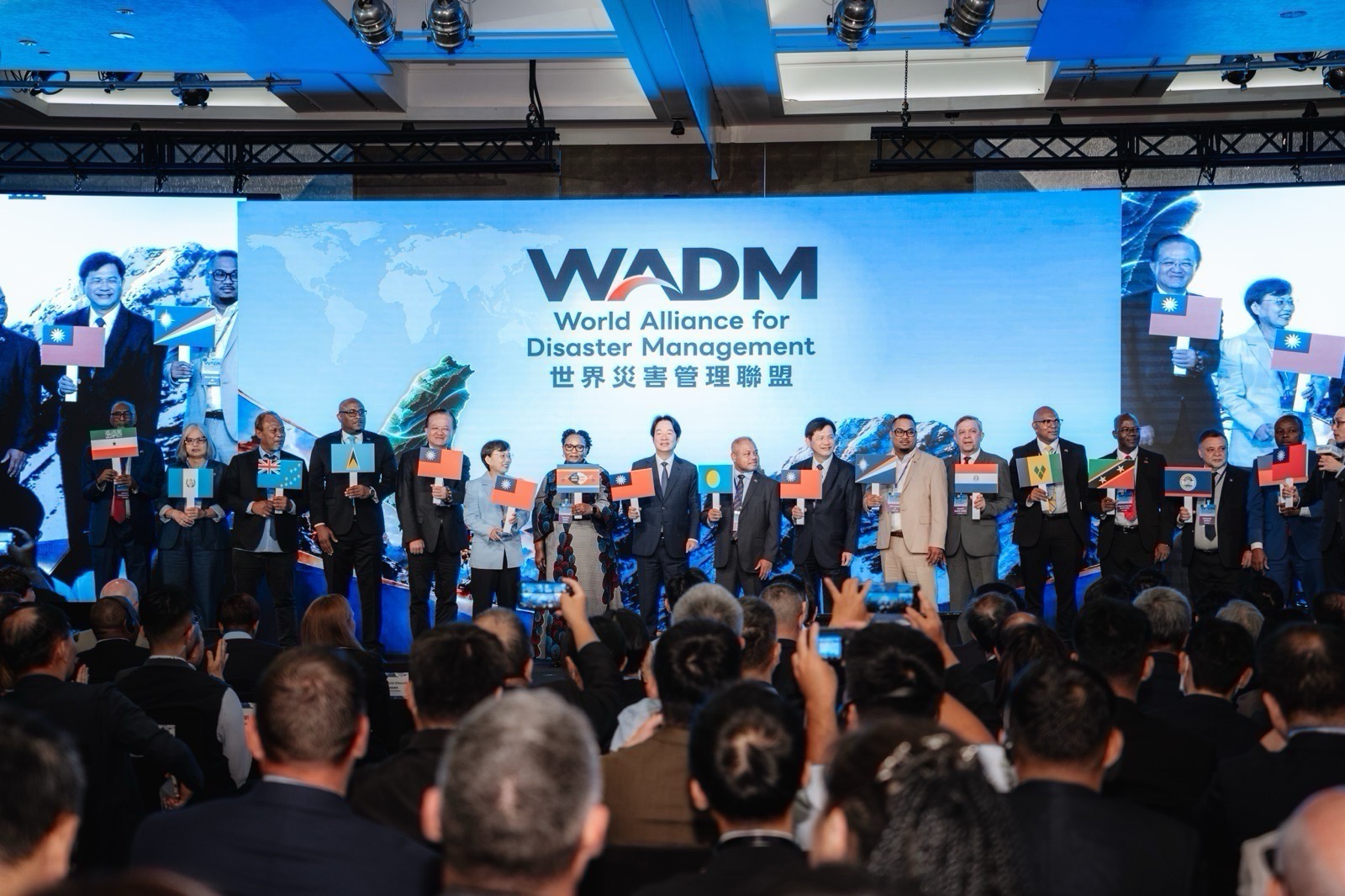
On September 19, 2026, the Taiwanese government launched the World Alliance for Disaster Management (WADM). The WADM represents a groundbreaking development in Taiwan’s international participation. Picture source: Ministry of the Interior, ROC(Taiwan), September 19, 2026, Ministry of the Interior, ROC(Taiwan), https://www.moi.gov.tw/News_Content.aspx?n=4&s=341055.
Prospects & Perspectives No. 56
The World Alliance for Disaster Management and its Implications for Taiwan’s International Participation
By Yen-Pin Su
The Formation and the Functional Logic of WADM
On September 19, 2026, the Taiwanese government launched the World Alliance for Disaster Management (WADM). The WADM represents a groundbreaking development in Taiwan’s international participation. Following the Food and Fertilizer Technology Center for the Asian and Pacific Region (established in 1970) and the Asian Vegetable Research and Development Center (now WorldVeg; established in 1971), the WADM is the third inter-governmental international organization headquartered in Taiwan. After the 1999 Chi-Chi earthquake, 38 rescue teams from 21 countries came to help Taiwan, and President Lai Ching-te presented WADM as Taiwan’s turn to give back.
The WADM has 13 founding members, including Taiwan, Taiwan’s 11 diplomatic allies excluding the Vatican, and Somaliland. Seventeen observers and 11 partners also participated in the WADM, including organizational actors from countries such as the United States, Japan, the United Kingdom, Germany, the Netherlands, Poland, Türkiye, and the Philippines. According to the official introduction of the WADM, the organization’s main goal is to work with partners to coordinate early warning, disaster response and post-disaster recovery by promoting joint training, joint exercises, mutual assistance, and information sharing. Taiwan’s National Fire Agency Training Center in Zhushan, Nantou County, will serve as an important training hub. Taiwan expects to leverage its strengths in fields such as artificial intelligence, satellite applications, unmanned vehicles, and communications technology to work with international partners in enhancing global disaster management capabilities.
Opportunities for Taiwan’s international participation
Taiwan’s exposure to earthquakes and typhoons has forced it to build strong capacity in early warning, seismic monitoring, and urban search and rescue. Based on these experiences, Taiwan can rely on the WADM as an alternative way to expand its international engagement through functional cooperation, professional networks, and the provision of public goods. More specifically, the WADM provides two opportunities for Taiwan’s international participation.
First, the establishment of the WADM implies a new international participation strategy for Taiwan. For decades, Taiwan’s access to international organizations such as the World Health Organization, the International Civil Aviation Organization, and INTERPOL has remained vulnerable to interference by China. Taiwan attended the World Health Assembly as an observer from 2009 to 2016, but it has received no invitation since 2017. In these inter-governmental organizations, Beijing has rejected all requests for allowing Taiwan’s participation.
The WADM reverses this pattern. It represents an effort by Taiwan, as a sovereign state, to exercise greater agency in international affairs by initiating an inter-governmental platform. Instead of being a passive applicant whose participation depends on the approval of existing members, Taiwan becomes an institutional entrepreneur that defines the rules, priorities, and forms of cooperation from the beginning. The WADM not only reduces Taiwan’s dependence on international organizations in which China possesses substantial influence, but also allows Taiwan to demonstrate that it is capable of coordinating multilateral cooperation and contributing concrete resources to the international community. In this sense, the WADM offers Taiwan an opportunity to move from seeking international space to helping create international space.
The second opportunity is that the WADM can serve as a bridge for Taiwan to expand its international participation. Although Taiwan cannot join most UN bodies in the field of disaster management, such as United Nations Office for Disaster Risk Reduction (UNDRR) and the UN Office for the Coordination of Humanitarian Affairs (OCHA), the WADM can still connect with the standards and networks the existing organizations maintain. One channel is technical alignment. The WADM could adopt International Search and Rescue Advisory Group (INSARAG) standards for urban search and rescue and WHO standards for Emergency Medical Teams. This would improve interoperability and provide Taiwanese responders with more opportunities for engagement with the global disaster-management system.
A second channel is the Asia-Pacific Economic Cooperation (APEC) framework. The WADM could bring its training programs and exercise results to the APEC Emergency Preparedness Working Group. A third channel is regional cooperation. Given that several WADM members also participate in the Caribbean Disaster Emergency Management Agency (CDEMA) and the Coordination Center for the Prevention of Disasters in Central America (CEPREDENAC), the WADM creates collaboration opportunities for joint training and early-warning projects with these regional disaster management organizations.
Challenges
The opportunities mentioned above must be weighed against several challenges. The first challenge is institutional sustainability. Questions about the WADM’s legal personality, budget contributions, voting rules, and staffing remain open, as does the issue of its narrow membership base. The WADM also enters a crowded field of international cooperation. For instance, the INSARAG sets standards for rescue teams, and regional organizations such as the ASEAN Coordinating Centre for Humanitarian Assistance on Disaster Management (AHA Centre) coordinate collective responses for disaster management. If WADM duplicates these bodies, member states and observers will have little reason to invest in it.
The second challenge is pressure from Beijing. Beijing has consistently opposed international arrangements that it believes could strengthen Taiwan’s sovereignty status. At the time of writing, even though China has made no direct comment on the WADM, there is a high likelihood that it will pressure foreign governments to limit participation in the WADM and discourage their officials from attending WADM events. Moreover, given that the WADM depends heavily on Taiwan’s formal diplomatic allies, changes in diplomatic recognition could also weaken the organization.
Conclusion
The formation of the WADM is a milestone in Taiwan’s long search for international space. It moves Taiwan from the position of an applicant to that of an organizer, in a field where its capacity is notable. The prospects of WADM deserve cautious optimism. Currently, the new organization has a narrow membership base and still lacks a fully developed institutional structure. Beijing may try to limit its expansion, and existing disaster-management organizations already occupy much of the policy field. Yet Taiwan has real expertise in disaster management, and the global demand for international disaster cooperation is growing. The WADM is an experiment to determine whether functional leadership can open up more space for Taiwan’s international participation. If the WADM can further institutionalize, attract participants beyond Taiwan’s diplomatic allies, and produce useful outcomes in disaster preparedness and response, it could strengthen Taiwan’s international visibility in a way that is based on actual contribution rather than on diplomatic recognition alone. More importantly, it could show that Taiwan can expand its international role through sustained contributions to global governance.
(Dr. Su is Distinguished Professor and Chair, Department of Political Science, National Chengchi University, Taiwan.)
 Facebook
 Youtube
 Twitter