

Taiwan’s Urban Resilience Exercises: From Preparedness Messaging to Institutional Learning


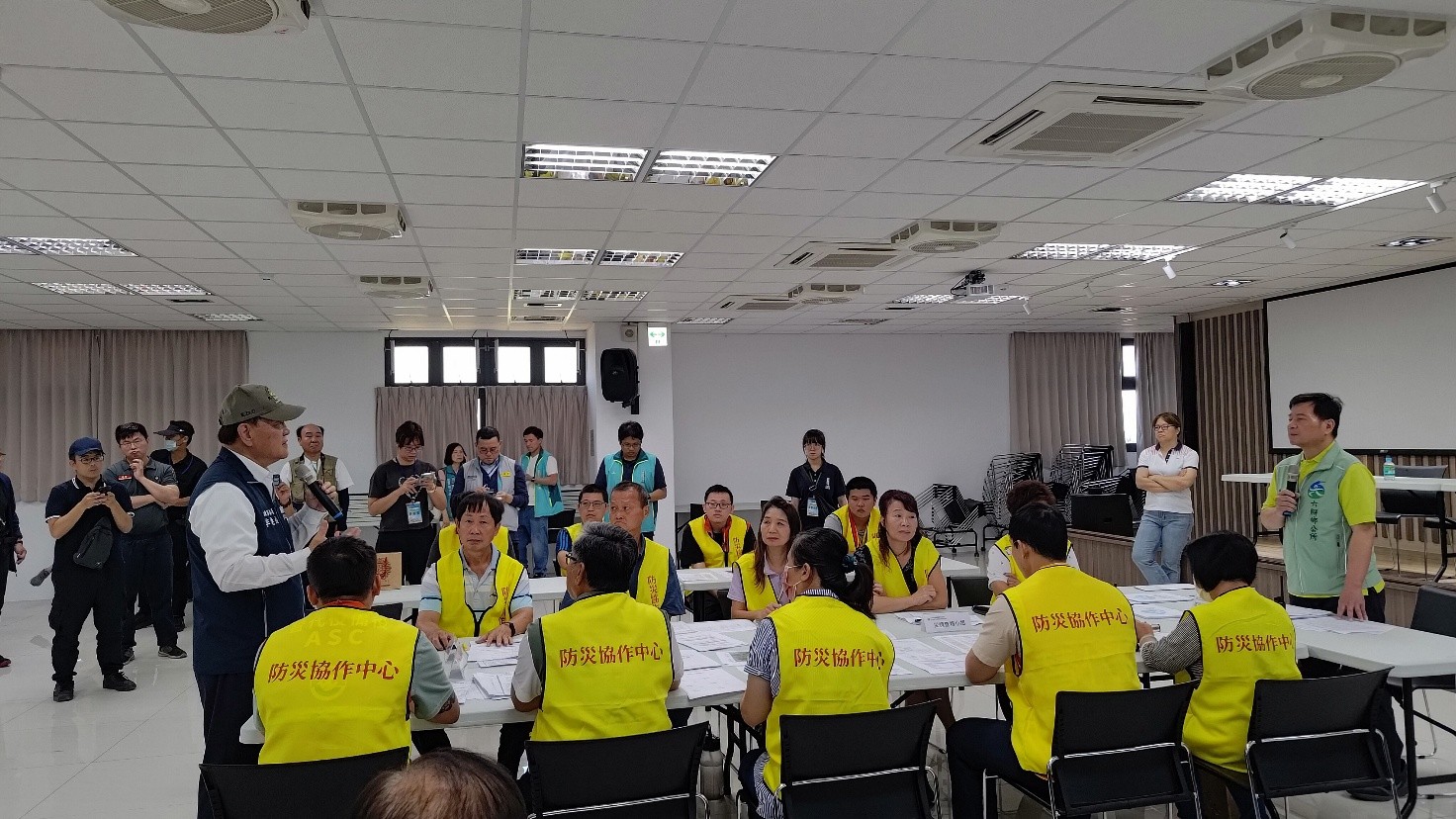
Taiwan’s 2026 Urban Resilience Exercises should be read as more than an upgraded civil-defense drill. The nationwide cycle, running from April through August, increases the share of conflict-based scenarios, raises exercise intensity, and expands public participation through first-aid stations, relief centers, and rationing stations. Picture source: Executive Yuan, May 29, 2026, Executive Yuan, https://www.ey.gov.tw/Page/9277F759E41CCD91/11f430d8-e8ff-450f-b9ff-ed0ba83827e2.
Prospects & Perspectives No. 35
Taiwan’s Urban Resilience Exercises: From Preparedness Messaging to Institutional Learning
By Marcin Jerzewski
Taiwan’s 2026 Urban Resilience Exercises should be read as more than an upgraded civil-defense drill. The nationwide cycle, running from April through August, increases the share of conflict-based scenarios, raises exercise intensity, and expands public participation through first-aid stations, relief centers, and rationing stations.
That is progress, and also raises a harder question. The value of these exercises will not be measured by Taiwan's ability to demonstrate preparedness. It will be measured by whether the state can identify and correct the institutional weaknesses that would determine whether government, infrastructure, and daily life continue to function under pressure.
Origins of the exercise
The 2026 exercises emerged from Taiwan’s broader whole-of-society defense agenda under President William Lai. They also represent a practical reworking of older disaster-response, civil-defense, and mobilization systems.
This distinction matters. Taiwan has long had air-raid drills, disaster-response exercises, and mobilization structures. What is changing is the attempt to connect them into a single resilience architecture that treats security crises, natural disasters, infrastructure disruption, and social continuity as interrelated problems.
The shift began to take clearer shape in 2025, when Lai observed a major drill led by the Whole-of-Society Defense Resilience Committee in Tainan. Around 1,500 participants rehearsed responses to large-scale disasters and attacks on critical infrastructure. The exercise signaled a move away from narrow air-raid ritual and toward continuity-of-society planning.
In the 2026 cycle, a crucial institutional innovation has been the establishment of the Central Joint Emergency Operation Center (CJEOC). In practical terms, the CJEOC is designed to serve as Taiwan’s central crisis-coordination mechanism when a national emergency exceeds the scope of ordinary disaster response. It brings together command decision-making, public-order maintenance, shelter and relief operations, medical expansion, transport control, material distribution, civil-military resource integration, and support for military operations. Its purpose is to connect four forms of resilience that are often discussed separately: national defense, livelihood, disaster prevention, and democracy. The underlying logic is continuity: government must keep operating, essential services must remain available, society must stay orderly, and civilian systems must continue supporting national defense.
Moreover, what makes 2026 distinct is the effort to connect this framework to central-local command practice. The CJEOC phase is linked to Han Kuang 42’s command-post exercise, runs across six days and three stages, and brings together a full-function central center with local centers in New Taipei, Yilan, Kaohsiung, and Pingtung.
This is a substantial upgrade from sheer awareness-raising. Supportive Taiwanese commentary has therefore focused not only on realism, but also on institutionalization: we are witnessing standardized procedures, repeatable models, local adaptation, and community resilience networks. That emphasis is correct. Exercises matter most when they stop being special events and start becoming part of governance.
Incorporating lessons from Ukraine
Ukraine offers Taiwan a useful comparison, provided the lesson is specified carefully. The point is not simply that civilians matter in wartime. The more relevant lesson is that resilience depends on whether central authorities, local governments, civil society, and private operators can keep essential functions running when normal systems are degraded.
Ukraine’s decentralization reforms proved important because they gave local governments real authority, fiscal autonomy, and practical room to act within a broader national framework. In the early months of Russia’s full-scale invasion, local authorities organized evacuations, maintained utilities, coordinated humanitarian aid, and supported internally displaced people without waiting for the center to micromanage every decision.
Ukraine’s resilience was demonstrated locally through municipalities, volunteer networks, civil society organizations, and citizens who improvised, collaborated, and learned under pressure. This is not an anti-state argument. It shows that resilience emerges from interaction between formal institutions and informal networks, not from command structures alone.
It also cautions against romanticizing resilience. Ukraine’s local performance has not been uniform. Larger, urban communities often had stronger administrative capacity, better donor access, and greater fiscal room, while smaller, rural, or frontline communities struggled more. Wartime re-centralization has also generated new tensions.
That is where Taiwan’s 2026 design becomes most interesting. The CJEOC/Local Joint Emergency Operation Center (LJEOC) exercise does not merely simulate a missile strike. It tests cyberattacks, internet and power outages, disinformation, preventive evacuation, medical evacuation, expanded emergency medical zones, transport command and control, critical infrastructure protection, strategic-material allocation, daily-necessities distribution, rationing stations, shelters, drone activity, and damage to water and communications systems.
In other words, Taiwan is beginning to test the continuity functions that Ukraine’s war has shown to be decisive.
The harder Ukraine lesson concerns where systems actually break. Subnational governments matter because they understand local needs, can identify at-risk groups, can build multi-actor coordination platforms, and can run periodic simulations. Yet their performance depends on clear mandates, resources, and communication with other levels of government.
Recent research on Ukrainian local communities adds another insight: the main vulnerability in crisis simulations was not the competence of individual participants, but failure at the junction between sectors. Local authorities, security actors, businesses, media, NGOs, and volunteers each might understand their own roles. The question is whether they can reach operational agreement under pressure.
For Taiwan, this means the real test is not whether each agency knows its checklist. It is whether cross-sector agreements hold when communications degrade, information becomes ambiguous, and time pressure rises.
Evaluation and policy recommendations
The 2026 exercises represent real progress because they move Taiwan closer to testing resilience as a governing capacity, not merely presenting it as a policy slogan. The scenarios are more conflict-based, the design is more realistic, and the connection between central and local command structures is more operationally meaningful than in previous formats.
This does not mean the model is already mature. It means the assumptions are finally becoming testable.
One such assumption is that local governments could maintain a high level of command capacity under wartime conditions. Another is that logistics, energy, communications, medical services, and local administrations could coordinate while simultaneously facing disinformation, infrastructure disruptions, and resource scarcity. As some evaluations have highlighted, local governments should maintain as much as 80 percent command capacity in wartime, these are precisely the kinds of assumptions that exercises should expose to pressure.
Yet, that figure is useful less as a benchmark than a question for evaluation: which local governments can sustain high command capacity, under what conditions, for how long, and with what support from the center?
Currently, Taiwan’s local governments may not yet possess the manpower, logistical capacity, or coordination mechanisms implied by the exercise design, especially if strategic material distribution, false information, infrastructure disruption, and central-local friction occur simultaneously.
Thus, the first policy recommendation is procedural. Taiwan needs a standing after-action review mechanism that converts each exercise into traceable institutional correction. Not all findings should be public. But non-sensitive results should be released in summary form, because public trust depends on seeing that exercises reveal weaknesses rather than merely stage confidence.
Second, the Executive Yuan should standardize performance indicators across counties and cities. These should include medical response time, shelter readiness, supply-distribution speed, communications continuity, vulnerable-group access, and time to restore basic local command functions. Without comparable indicators, “whole-of-society resilience” will remain difficult to evaluate.
Third, future exercises should be designed around cross-sector junctions, not only agency competence. Every local exercise should include information-environment injects: disinformation, contradictory instructions, ambiguous gray-zone content, or rumors targeting rationing, evacuation, and sheltering. The official design already recognizes psychological resilience and strategic communication as central tasks. The evaluation model should reflect that.
Fourth, private operators should be embedded as decision participants rather than treated mainly as service providers. Transport companies, telecom firms, hospital systems, retailers, food distributors, warehouse operators, energy providers, and digital platforms are not peripheral to resilience. They need to be recognized as a vital part of the operating system.
The same applies to vulnerable groups. Evacuation, alerts, shelters, first aid, and rationing should be tested for elderly residents, persons with disabilities, migrant workers, Indigenous communities, children, and non-Mandarin speakers. Inclusion is not only a rights issue. It is a continuity-of-society issue.
Finally, Taiwan should be careful with deterrence messaging. The strongest message these exercises can send is not that Taiwan is preparing for urban warfare as spectacle. It is that coercion would fail to paralyze governance, fragment society, or sever civilian support for defense.
That is the logic already implicit in the CJEOC framework: continuity of government, continuity of livelihood systems, and support for defense. Resilience is most persuasive when it appears not as theatrical militarization of everyday life, but as orderly continuity under stress.
The purpose of Taiwan’s Urban Resilience Exercises should therefore not be to prove that society is already resilient. It should be to discover where resilience still depends on assumptions that have not yet been tested.
(Marcin Jerzewski is head of Taiwan Office, European Values Center for Security Policy.)
Related Content
Ukraine’s Accession to the EU: There’s Still a Long Way to Go
The Ukraine War: Lessons in Preparedness for Taiwan

After the ‘Coup’: The Future of the Wagner Group in Africa
Fueling War: China’s Military Assistance to Russia
After the Wagner Mutiny: Impact on Surrounding Areas and Beyond
After Vilnius: Key Take-Aways from the NATO Summit
Building Democracy at Gunpoint – Lessons from Ukraine for Taiwan
Lessons from the Defense of Ukraine for Taiwan: Territorial Defense and Energy Security
Sham ‘Referenda’ in Ukraine: A Quandary for Beijing
 Facebook
  Youtube
  Twitter