
U.S.-China Competition and the Belt-and-Road Initiative: A Perspective of Power Based on Global Network Culture


Taiwan Social Sciences Citation Index(TSSCI)
Prospect Quarterly Vol.20 No.1 (January 2019)

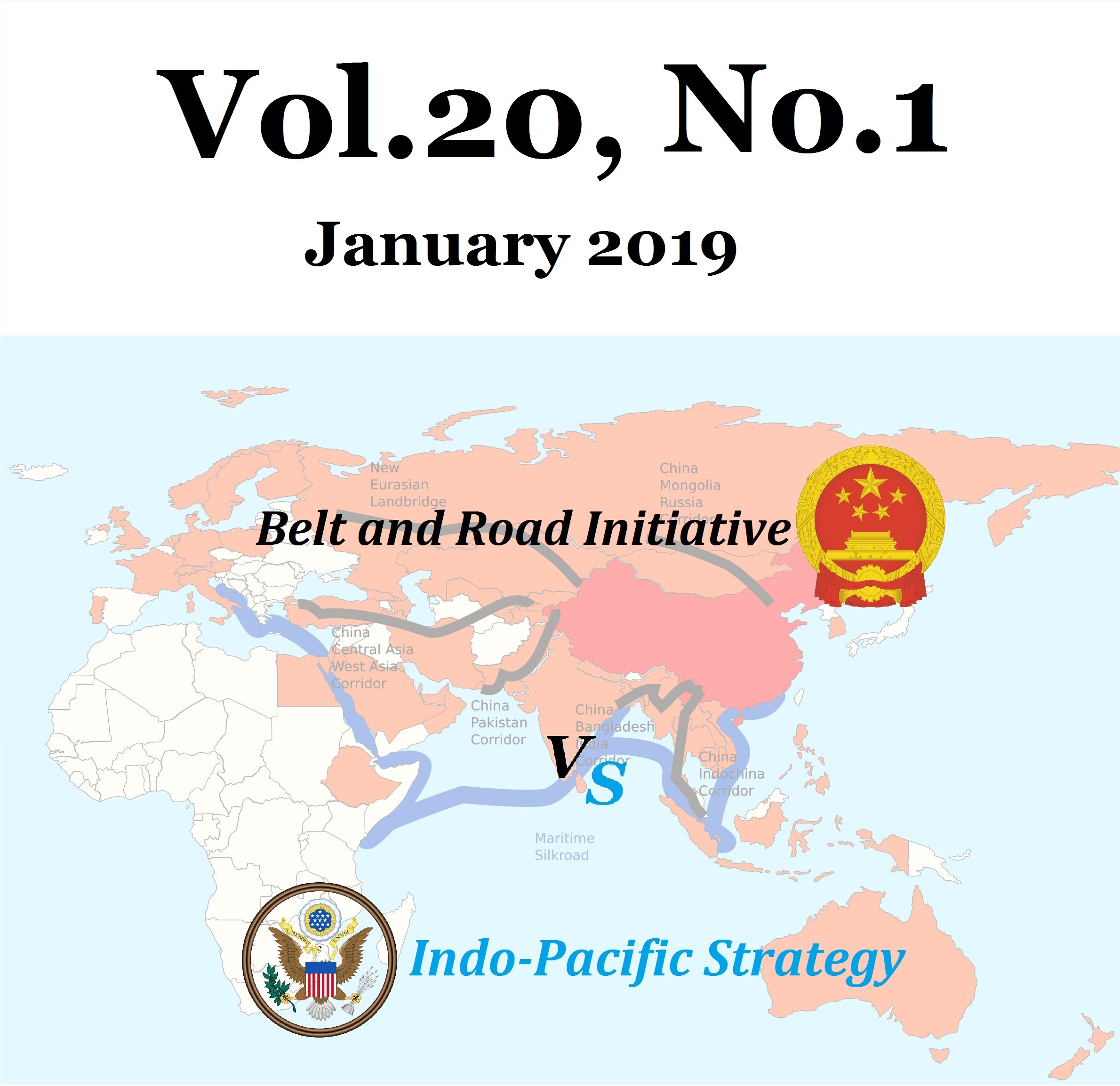
U.S.-China Competition and the Belt-and-Road Initiative: A Perspective of Power Based on Global Network Culture
Source: Wikipedia, Wikipedia, <https://en.wikipedia.org/wiki/Belt_and_Road_Initiative#/media/File:One-belt-one-road.svg>.
U.S.-China Competition and the Belt-and-Road Initiative: A Perspective of Power Based on Global Network Culture
Associate Professor, Department of Mass Communication,
Providence University
Since the spring of 2018, the development of U.S.-China economic relations has become increasingly confrontational. The Trump administration has increased economic pressure on China, and China has sought to win the trade war by appealing to the Belt and Road Initiative set up before. The complexity of relevant issues cannot be explained by traditional International Relations theories rooted in a nation's subjectivity. Therefore, the author adopts the perspective of power based on the analytical approach of a "global network culture" to explore the strategic interaction and possible development of the Belt and Road Initiative in the context of competition between the United States and China. By examining the actions and logic of the actors in the global network, the advantages and disadvantages, and the functions and limitations, of the Belt and Road Initiative can be clarified, so as to provide an assessment of the subsequent developments in U.S.-China competition around the Belt and Road Initiative.
Keywords:Belt and Road Initiative, US-China Trade War, Global Network Culture, Network Society, Global Complexities Theory
The Impact of the Basic Law Interpretation on Hong Kong Under "One Country, Two Systems"
Associate Professor, Graduate Institute of China Studies,
Director, Center for Cross-Strait Relations,
Assistant Research Fellow, Financial Research Institute,
Taiwan Academy of Banking and Finance
"One Country, Two Systems" is a policy to solve a historical issue for the People's Republic of China. It mainly deals with the relationship between the Central Government and the Hong Kong Special Administrative Region upon the return of Hong Kong, and the implementation of the basic principles of the "Hong Kong Basic Law." The Standing Committee of the National People's Congress (NPCSC) has conducted five interpretations of the Basic Law since the Hong Kong handover. However, due to differences in jurisprudential thinking and legal interpretation, the process of interpreting the Basic Law and its results have caused conflicts with Hong Kong. After examining the controversial issue of interpretation, this article finds that when the political situation in Hong Kong changes beyond the baseline of national sovereignty, China will inevitably adopt a tough approach to governing Hong Kong and will influence the rule of law in Hong Kong through its own interpretation.
Keywords:Hong Kong Basic Law, Interpretation of the Basic Law by the NPCSC, "One Country, Two Systems", Interpretation Dispute, Hong Kong's Judicial Independence
North Korea's Strategic Choices with Russia and Japan and the Security Dilemma of Northeast Asia and the Impact of the Korean Nuclear Issue
Associate Professor, Center for General Education,
University of Kang Ning
A security dilemma is used to explain the uncertainty and mutual defense caused by a lack of trust and security mechanisms in the international system, and also to describe the arms race derived from mutual suspicion among nations. The North Korean nuclear issue has heightened the security dilemma in Northeast Asia. To maintain its security, North Korea has developed an interactive strategy with Russia and Japan, while these two countries have also used the North Korean issue to realize their respective interests, despite facing several challenges. All available ways to solve the North Korean issues at the time are risky. There is no single solution that can completely solve the problem, making it impossible to reduce the tension between the Korean Peninsula and Northeast Asia. With heightened uncertainty and mutual fear, nations have strengthened their military preparations in order to protect themselves and to pursue security interests, thereby further deepening the security dilemma in Northeast Asia.
Keywords:The North Korea Issue, Trump-Kim Meeting, Songun/Army-First Policy, Pyngjin/Parallel Development, Security Dilemma
 Facebook
  Youtube
  Twitter
  Podcast