


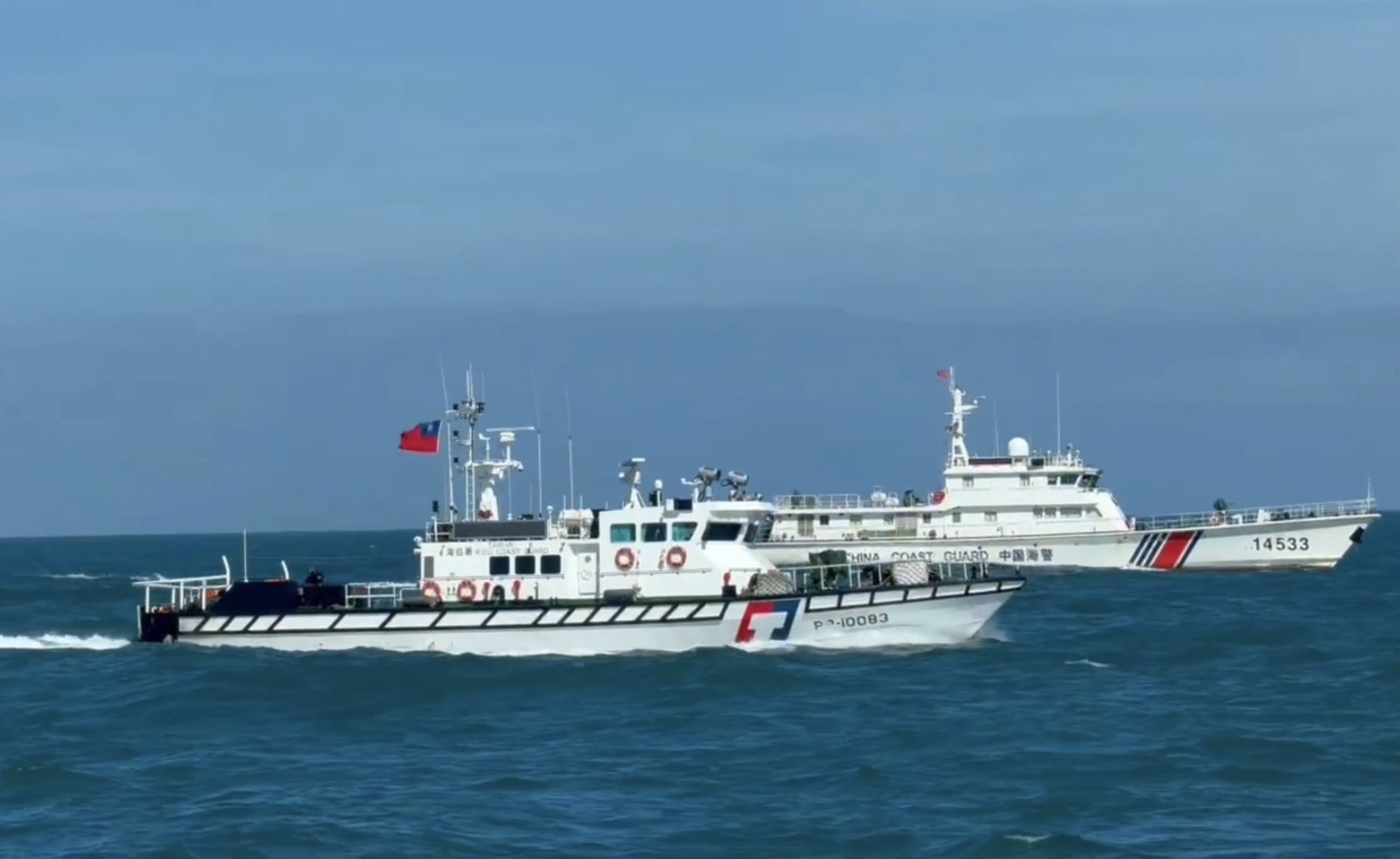
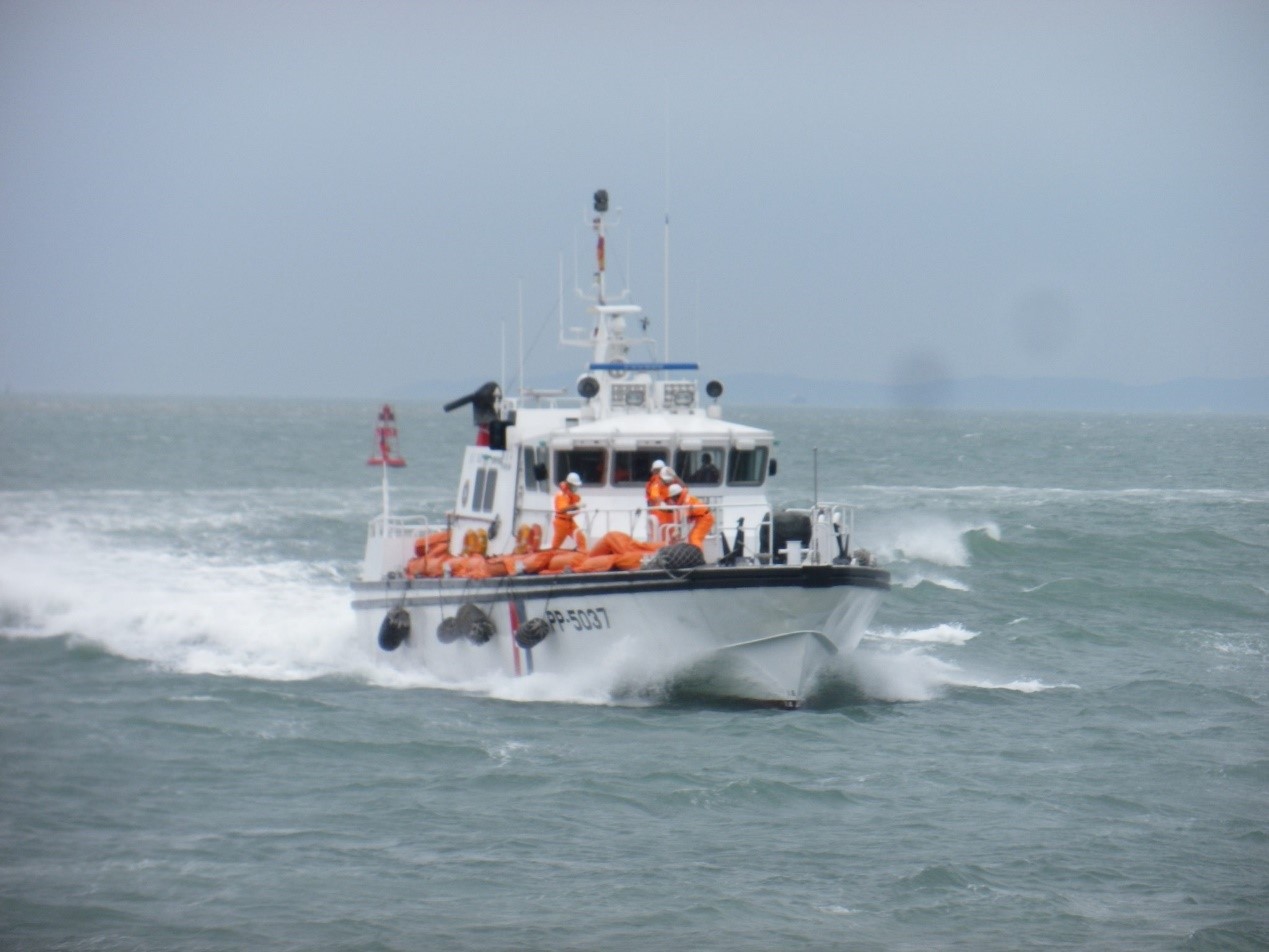
Most of us assume that a quarantine or blockade of Taiwan will begin on a day we can mark on a calendar. That assumption has always been wrong. China is never going to hand us a start date. The quarantine has been growing for years, and we have been watching it happen without calling it what it is: intrusive coast guard patrols, ever-larger military exercises, the steady political and economic isolation of the island-nation. Picture source: Coast Guard Administration, Ocean Affairs Council, July 14, 2026, Coast Guard Administration, Ocean Affairs Council, https://www.cga.gov.tw/GipOpen/wSite/ct?xItem=168424&ctNode=650&mp=999.
Prospects & Perspectives No. 39
What If the Quarantine of Taiwan Has Already Begun?
By Ray Powell
Most of us assume that a quarantine or blockade of Taiwan will begin on a day we can mark on a calendar. Beijing will declare a maritime exclusion zone, publish rules for entry and exit, and dare Washington and its allies to challenge it. The crisis will have a clear beginning.
That assumption has always been wrong. China is never going to hand us a start date. The quarantine has been growing for years, and we have been watching it happen without calling it what it is: intrusive coast guard patrols, ever-larger military exercises, the steady political and economic isolation of the island-nation. Each move was minor enough to start an argument about what to call it rather than what to do about it, and each one Beijing got away with became the new starting line for the next.
The analogy is that of the boa constrictor. A boa does not strike a dramatic killing blow. It wraps around its prey and tightens until the prey cannot circulate blood or draw breath, then holds, then tightens again. No single squeeze looks like the fatal one, right up until the prey stops moving. China has been coiling around Taiwan like this for years. What changed this summer is that we finally felt it — not from an announcement, but from a question over the radio.
When I say “soft quarantine,” I do not mean a declared blockade or a Taiwan cut off from the world. I mean something quieter and, over time, more dangerous: China normalizing its control over the waters around Taiwan and its interference with Taiwan-bound shipping, dressed up as ordinary law enforcement.
The coil we finally felt
What made this summer different was that the squeeze reached commercial shipping. In early June, Chinese government ships east of Taiwan radioed passing merchant vessels and demanded their departure ports, destinations, and crew numbers — by Taiwan’s account, the first such challenges ever aimed at commercial traffic there. Only one ship answered, and even that reply reportedly came from a Chinese crew member offering up the destination, not a shipping company submitting to Chinese authority. No ship was boarded. No cargo was seized. Beijing still claimed its vessels had inspected 198 foreign ships, a number Taiwan and Western governments reject.
It's easy to wave this off as a minor irritant, and that reflex is exactly what China is counting on. The danger is not what those radio calls did. It's what answering them concedes, and what Beijing learns it can do next. Taiwan attributed the queries to a maritime safety ship working alongside coast guard cutters — China putting its whole civil-maritime machine to work building a record of control.
That is why the June challenges matter, not as the moment the quarantine began, but as the wake-up call they should have been for Taiwan and everyone who depends on those sea lanes. From here the coils tighten by degrees, each one defensible on its own: pushier data demands, “recommended” reroutes, selective inspections, attempted boardings, eventually denials of passage. Beijing never has to say the word “blockade”; it only has to insist it is enforcing the law in waters it claims.
Tightening, holding, releasing
If this really is a constrictor strategy, the pressure should come in pulses rather than hold steady, and that is what the ship tracks show. From June 1, two China Coast Guard cutters held a nearly unbroken formation deep in the Pacific east of Taiwan. On July 4, Beijing announced a fresh task group had taken over “to continue law enforcement patrols,” and the tracks confirm a clean handoff to two replacement cutters. Then the pattern broke. As a powerful typhoon swept through in mid-July, the new cutters sheltered on Taiwan's western side, came back east briefly as the storm cleared, and around July 13 dropped off public tracking entirely.
It would be easy to read that as a release, the coil loosening. But going off public tracking is not the same as going home. Taiwan's Coast Guard says plainly that Chinese government ships switch off their transponders as they near Taiwan to dodge tracking, in violation of international rules, and that Taiwan keeps following them by other means. We can't confirm from the outside whether these cutters are gone or just gone dark, and that uncertainty is the whole point of turning the transponders off.
What Beijing has kept alive is the claim. Chinese state media now calls all of this a “new normal” of routine, lawful patrols east of Taiwan, and the work is shifting to lower-profile hulls: a fisheries “research” ship loitered in the same waters in late July while the cutters stayed dark. That is how a soft quarantine matures: the presence gets intermittent while the claim becomes permanent.
The political effect may matter most of all. A declared blockade would force an immediate crisis; a soft quarantine breeds hesitation instead. If shippers price in Chinese challenges, if insurers add premiums, if cargoes reroute or arrive late, Taiwan gets more isolated without a shot being fired. Taiwan's own officials warn that these tactics could create a new status quo the world won't recognize until it's too late, calling it an “anaconda” strategy meant to keep the island from being resupplied. Beijing wins every time we mistake coercion for a legal dispute.
Responding before the squeeze tightens
The response has to start now, while the coils are still loose enough to pry back, not after they have closed.
Governments should say clearly, publicly, and repeatedly that China has no law-enforcement authority over commercial shipping east of Taiwan. Expressions of concern won't do it. Washington said this week that it disagrees with these deployments and has told Beijing so — good, but that has to be echoed by others, not left to stand alone. Flag states and shipping companies need to hear from their own governments that Chinese radio demands in these waters carry no legal weight and shouldn't be answered — because if everyone refuses, Beijing never gets the compliance record it's trying to build.
Taiwan and its partners should do what the Philippines has already shown works: turn on the lights. Publish the incident data fast — the tracks, the hull numbers, the radio transcripts — so Beijing cannot quietly bank a false record of accepted jurisdiction. And treat a ship going dark as an event worth reporting on its own, so the silence does not erase the record. Gray-zone actors live in the dark; sunlight is the countermeasure. Allied coast guards and navies should make the point with presence, not just words: commercial ships can cross these waters without answering to China.
The most dangerous thing we can tell ourselves is that Taiwan's quarantine will begin on a date we can circle. There is no such date, and there was never going to be one. The tightening started years ago and has never really stopped. China's strategy is built to keep constricting until Taiwan cannot breathe, without ever squeezing hard enough to trigger the fight that might still save it. The radio challenges of June 2026 gave us a moment of clarity about how far the coils have already closed. The question is whether we treat that as the wake-up call it is, or roll over and go back to sleep.
(Ray Powell is the director of SeaLight, co-host of the Why Should We Care: Indo-Pacific podcast, and had a 35-year career in the United States Air Force.)
相關文章
Beijing’s Intensifying Pressure on Taiwan’s Passport and Consular Affairs
PM Carney’s Bold New Vision: The Good and the Bad
An Old Dog’s New Tricks? China’s United Front Work and Taiwanese Internet Personalities

Beyond a Rhetorical Defense of Taiwan
The U.S.’ Security Package: Implications for Taiwan and the Indo-Pacific
Taiwan Enters a New Age: Continuity and Change

Taiwan’s Role in the US-Japan-Philippines Alliance
China’s Claim of the Taiwan Strait as ‘Inland Waters’ and the Kinmen Incident
The Impact of China’s Suspension of the ECFA on Cross-Strait Relations
Taiwan’s 2024 Presidential and Legislative Elections: Implications for the Region

The Ukraine War: Lessons in Preparedness for Taiwan
Washington Needs Strategic Clarity and Resolve to Deter Chinese Aggression Against Taiwan
 Facebook
  Youtube
  Twitter
  Podcast