


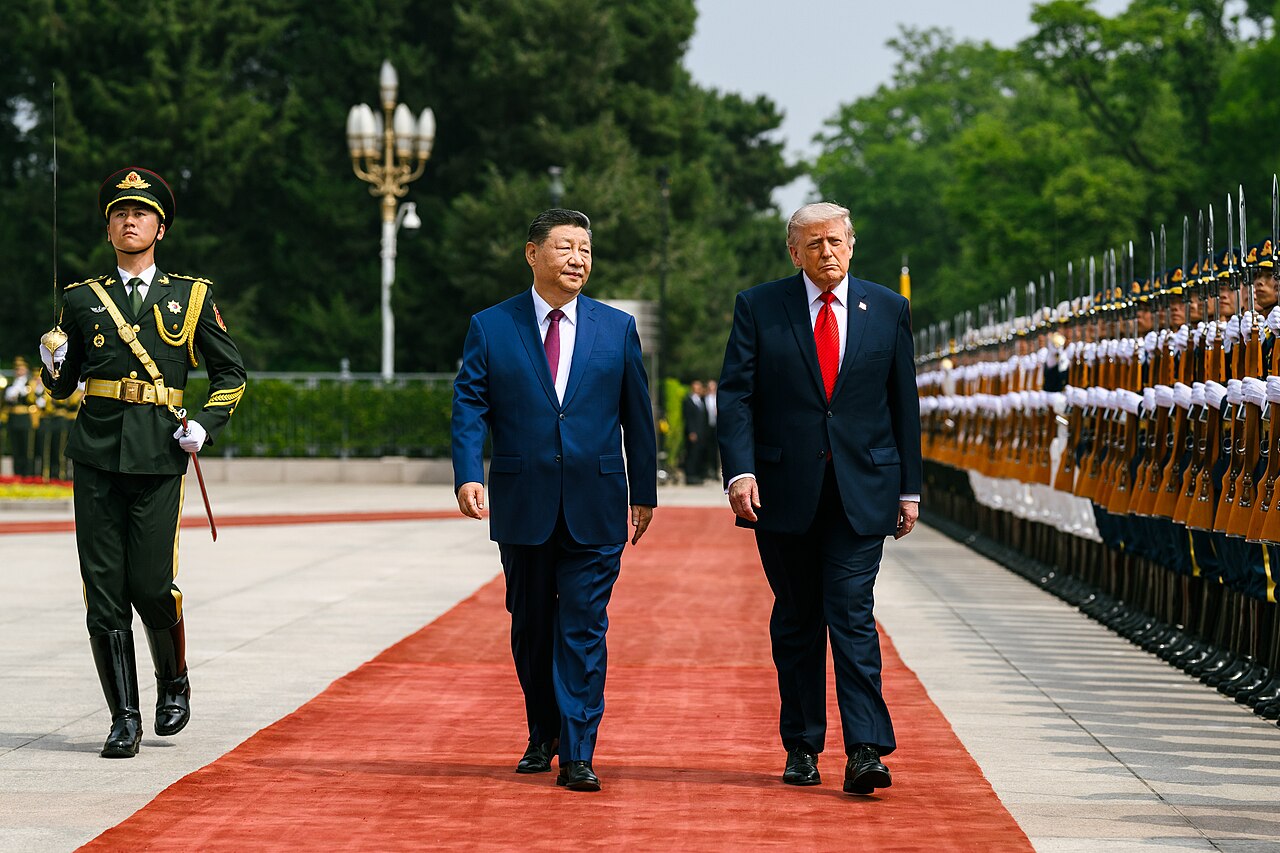
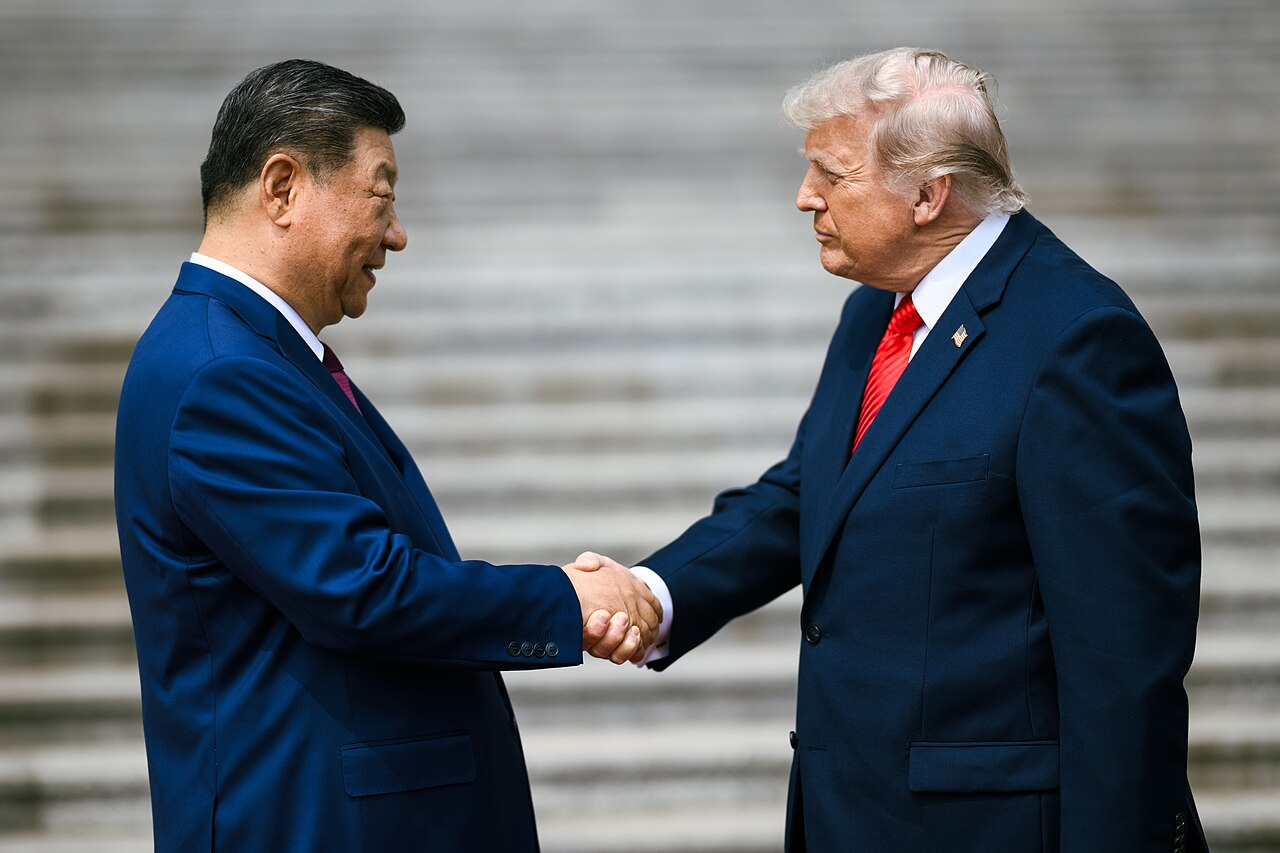
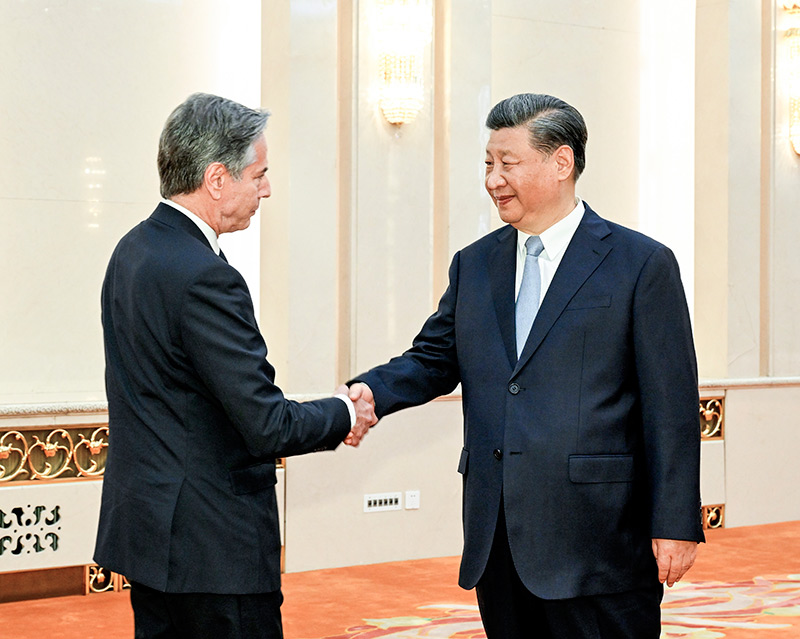
In May 2026, President Trump agreed to Xi Jinping’s proposal to build a “constructive relationship of strategic stability” between the U.S. and China on the basis of fairness and reciprocity. Picture source: The White House, May 13, 2026, Wikipedia, https://en.wikipedia.org/wiki/2026_state_visit_by_Donald_Trump_to_China#/media/File:Welcome_ceremony_of_Trump_by_Xi_Jinping_(3)-20260514.jpg.
Prospects & Perspectives No. 31
Trump-Xi Summit and the Security Situation in the Taiwan Strait
By Cheng-yi Lin
In May 2026, President Trump agreed to Xi Jinping’s proposal to build a “constructive relationship of strategic stability” between the U.S. and China on the basis of fairness and reciprocity. During Trump’s second term, Xi hopes to maintain a relationship with the U.S. based primarily on cooperation, with competition within appropriate limits, and stability within manageable differences. Most importantly, Xi aims to ensure that China and the U.S. would not fall into a “Thucydides Trap,” a conflict similar to the war between Athens and Sparta.
Seeking an elusive stability?
Trump’s second National Security Strategy of December 2025 no longer refers to China as a “strategic competitor,” but this does not mean that China is a “strategic partner.” Even if China were a real “strategic competitor,” it does not negate the need for a “constructive relationship of strategic stability” between the U.S. and China. This does not mean that U.S.-China relations will necessarily be “strategically stable” in the coming years.
Based on a report by the China Institutes of Contemporary International Relations (CICIR), which coined the term “constructive relationship of strategic stability,” six new directions are proposed for both countries: First, to clarify the new positioning of China-U.S. relations; second, to strive for new progress on the Taiwan “issue” to jointly promote progress towards a final resolution; third, to build new bridges for communication and dialogue; fourth, to expand new areas of pragmatic cooperation in areas of global challenges; fifth, to construct a new framework for risk prevention on high-risk issues; and sixth, to solidify a new foundation for people-to-people friendship.
Xi told Trump in Beijing that the “great rejuvenation of the Chinese nation” and “Make America Great Again” can coexist and complement each other. This implies that the world has two superpowers and two camps, meaning other countries may be forced to decide whether to align with the U.S. or China on different issues. After multiple rounds of negotiations on reciprocal tariffs, the U.S. and China reached a truce on trade tariffs and rare earth export controls. Trump exchanged Nvidia chips for Xi’s relaxation of control over TikTok based on commercial regulations. China agreed to purchase 200 Boeing aircraft and US$17 billion worth of U.S. agricultural products annually up to the end of 2028. The two countries also agreed to establish a “Board of Trade” and a “Board of Investment” to manage bilateral economic and trade development.
Probing Trump on Taiwan
Xi, using Beijing as his home advantage, probed Trump’s reaction to the Taiwan issue. He mentioned a potential military conflict in the Taiwan Strait, whether the U.S. would defend Taiwan, and demanded that the U.S. halt arms sales to Taiwan. On May 15, Trump, answering reporters on Air Force One, stated that the commitments made to Taiwan in the 1980s were outdated. Before Trump’s visit to Beijing, he had mentioned that the Beijing summit would discuss arms sales to Taiwan, and after the summit he indicated that he would discuss the issue with the person “that is running Taiwan” before making a final decision. In an interview with Fox News, Trump mentioned that he might sign an agreement for a US$14 billion arms sale to Taiwan, or he might not, describing it as a very good negotiating chip. Trump stated that U.S. policy toward Taiwan remained unchanged, but also mentioned that given Taiwan’s proximity to China and distance from the U.S., he did not want anyone in Taiwan to believe that the U.S. would support them in moving toward Taiwan independence. There is hardly any concrete evidence of President Lai Ching-te in changing the status quo because of the restrictions of current minority government and constitutional provisions.
On May 20, when asked by reporters whether he had spoken with Taiwanese President Lai, Trump mentioned that he would speak with him and would work on the Taiwan arms sales issue with everyone involved (“I’ll speak to him. I speak to everybody [...] We’ll work on that, the Taiwan problem”). Since U.S. arms sales to Taiwan are not solely decided by President Trump, the U.S. Congress also has the power to recommend or lead arms sales to Taiwan. Trump has already sold the first US$11 billion worth of arms to Taiwan in December 2025, and both U.S. Congress and Taiwan’s Legislative Yuan hope that the second package of arms US$14 billion sale can be finalized as soon as possible. Trump may choose a time, preferably within one year of the special provisions promulgated by Taiwan’s Legislative Yuan (before May 10, 2027), to announce the arms sales to Taiwan, in order to avoid greater pressure from the U.S. Congress and severer rebukes from Beijing.
U.S. arms sales to Taiwan are based on the 1979 Taiwan Relations Act, which aims to ensure Taiwan has sufficient self-defense capabilities. Even if arms sales to Taiwan are reduced according to the August 17, 1982, Communiqué, the key prerequisite is that Beijing must commit to handling the Taiwan issue peacefully. President Reagan’s Six Assurances to Taiwan further stated that the U.S. has not agreed to set a date for ending arms sales to Taiwan, nor has it agreed to consult with China on arms sales to Taiwan. The Trump administration’s simultaneous demand for Taiwan to increase its defense budget as a percentage of GDP, while allowing a China that threatens Taiwan to influence U.S. assurances to Taiwan, is undeniably contradictory.
Until next time
At the invitation from Trump, Xi and Peng Liyuan will make a state visit to the U.S. in the fall of 2026. If summits between Trump and Xi could stabilize U.S.-China relations and reduce military tensions around Taiwan, then it should be supported. Although the U.S. and China have a G-2 relationship, the end of wars in Ukraine and the Middles East still depends on the leadership of the Trump administration. However, China has an urgent international responsibility to restore peace and stability to its surrounding areas, such as the East China Sea, the Taiwan Strait, and the South China Sea.
(Cheng-yi Lin is Adjunct Research Fellow, Institute of European and American Studies, Academia Sinica.)
相關文章
The Trump-Xi Summit: What It Was Not is More Important than What It Was
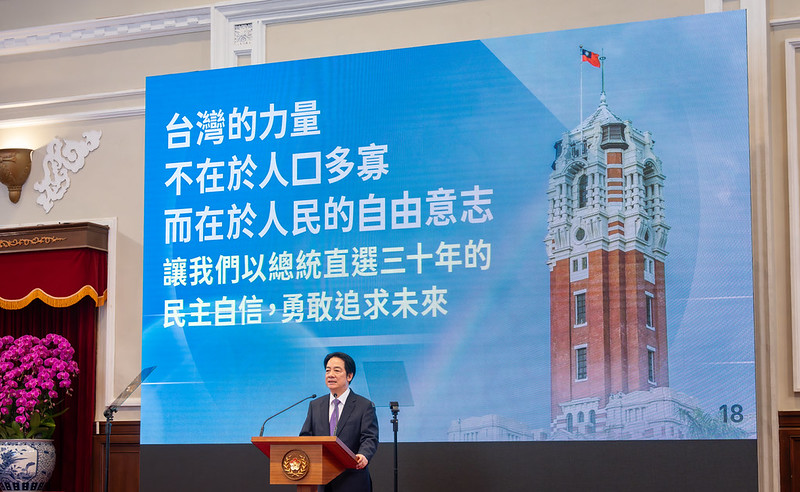
President Lai’s Second-Year Address and Prospective Developments in Cross-Strait Relations
The Indo-Pacific and the U.S. National Defense Strategy: From Rebalancing to Retrenchment
The Implications of the ‘Reagan National Defense Survey’
Four Major PLA Exercises Around Taiwan Since 2022: Significance and Possible Future Trends
The Blinken-Wang Meeting and the 2024 Munich Security Conference
The Future of U.S.-Taiwan Relations After the January Elections
The Biden-Xi Meeting at Woodside: What Was Said about Taiwan?
The Biden-Xi Meeting and U.S.-China Relations
The Biden-Xi San Francisco Summit
Blinken’s Hard-Won Trip Amid U.S.-China Competitive Coexistence
Wendy Sherman’s China Visit Highlights Irreconcilable Gulf between Beijing and Washington
 Facebook
  Youtube
  Twitter
  Podcast