

The Power of Predictability: Beijing Stays the Course at the Two Sessions


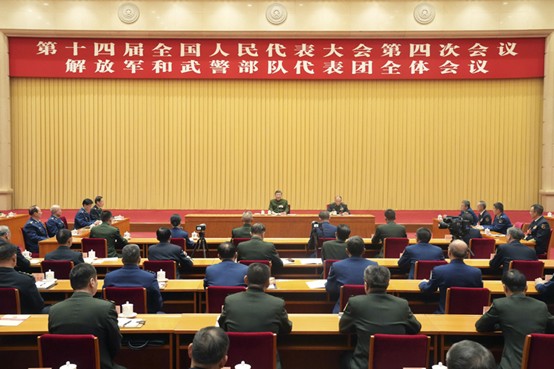
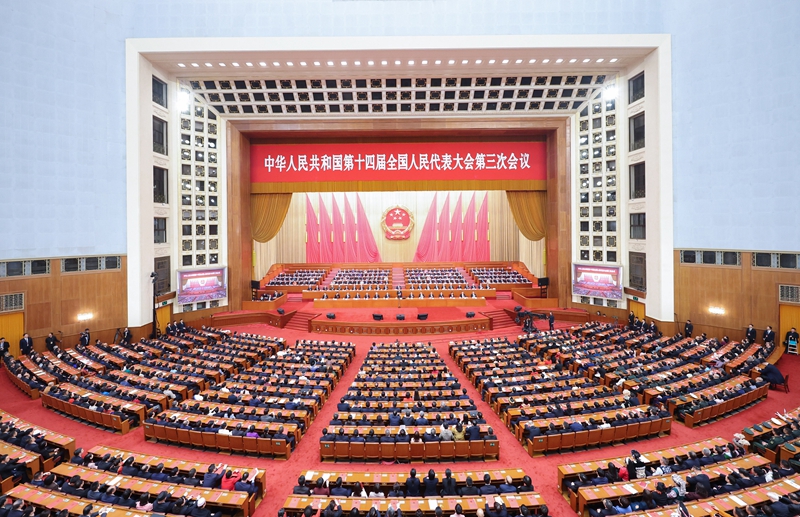
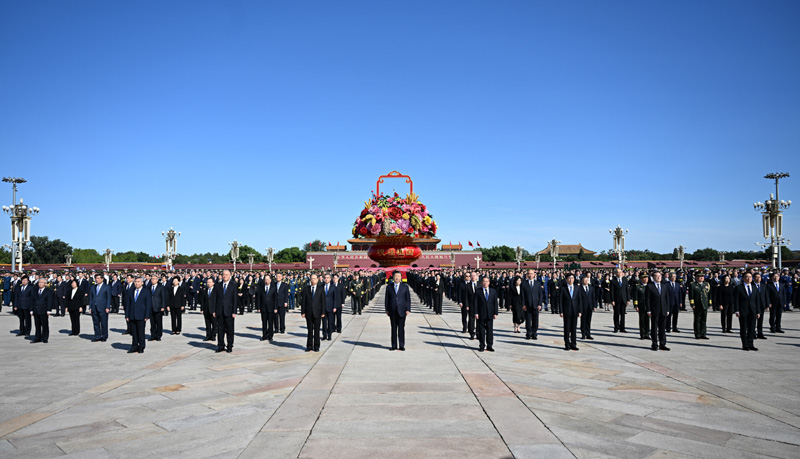
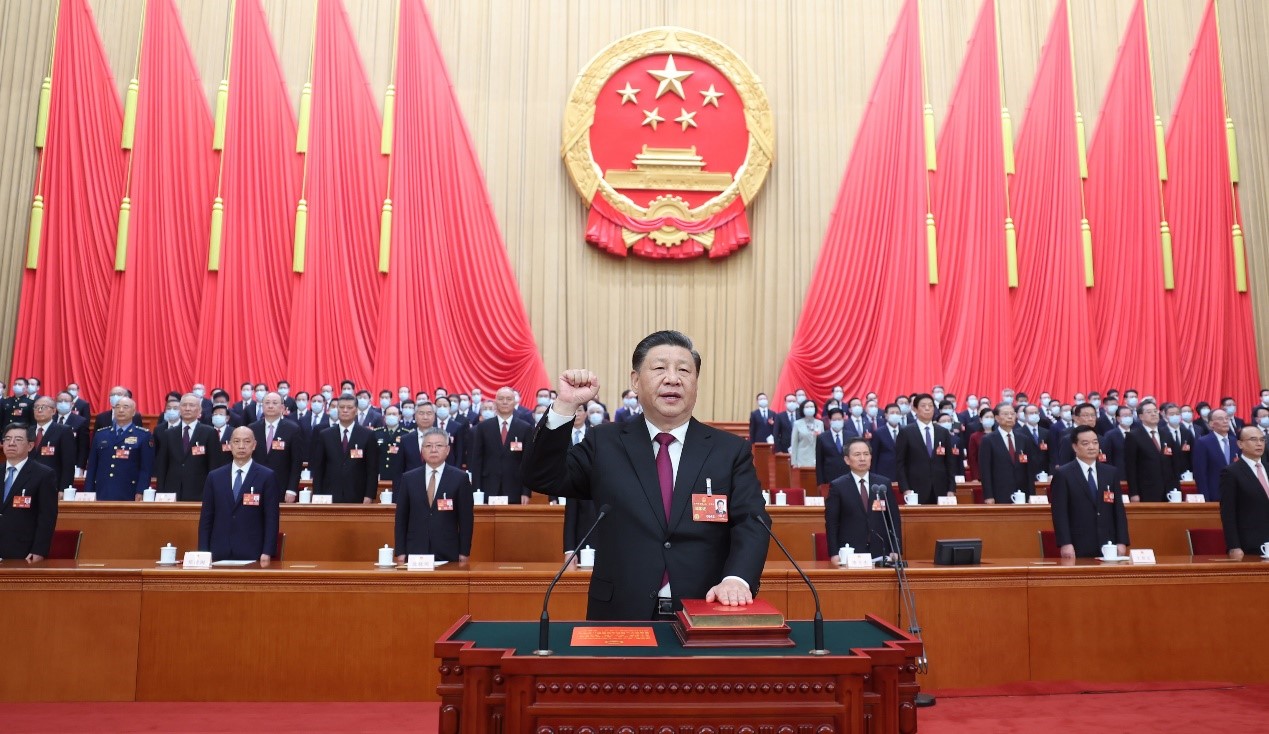
The Two Sessions this year were intentionally predictable and outcomes were consistent with last year’s objectives, targets and strategies. The choreography at the Two Sessions was impeccable. No political gaffes, no distractions from the message, which is exactly what the Party wants. Next year may not be as banal. Domestic politics in Beijing could get sporty ahead of the 21st Party Congress, which is expected to convene in the late fall. Picture source: Chinaxinhuanews, March 7, 2026, Instgram, https://www.instagram.com/p/DVlUqotCjQZ/?img_index=2.
Prospects & Perspectives No. 18
The Power of Predictability: Beijing Stays the Course at the Two Sessions
By Drew Thompson
The closely watched annual meetings of the National People’s Congress (NPC) and the Chinese People’s Political Consultative Conference (CPPCC) — the “Two Sessions” — took place March 4-11 in Beijing. The NPC is the more critical of the two meetings, where the central government sets targets and endorses budgets guiding the work of the massive government bureaucracy for the following year. This year’s NPC also marked the start of the 15th Five Year plan, which sets economic and social development objectives through 2030.
The meetings were supported by an all-out propaganda effort which showcased Xi Jinping’s speeches and meetings along with Premier Li Qiang’s Government Work Report. International audiences are particularly fixated on the annual work report’s announcement of the coming year’s targeted Gross Domestic Product (GDP) growth rate, and the annual increase of the defense budget.
The meetings this year took place in an unsettled political environment shaped by prolonged domestic economic challenges, intensifying competition with the United States and simultaneous wars in Europe and the Middle East affecting China’s diplomatic, economic, and security interests. Considering this global and domestic uncertainty, the two sessions exuded China’s conviction in the absolute correctness of its political system and national strategies. That certainty was manifested in perfectly predictable outcomes that were intended to inspire confidence in the government, its command of the bureaucracy and the appropriateness of its strategies.
The essential work of government – security and economic growth
The NPC delivered predictability in the two outputs most closely watched as an indicator of China’s direction, increased defense spending and economic growth.
The announced 7 percent increase in defense spending was closely in line with 7.2 percent annual increases since 2023, and the 7.1 percent increase in 2022. As in previous years, Xi demonstrated continuity and gave a speech to the NPC delegates from the People’s Liberation Army (PLA) and the People’s Armed Police (PAP). Sitting at a table with General Zhang Shenmin, the Vice Chairman and sole uniformed member of the Central Military Commission (CMC), Xi spoke about political rectification, Party building and loyalty with the official Xinhua summary devoting only one sentence to military training and capabilities.
The government work report set a new GDP growth target range of 4.5 to 5 percent, down from the 5 percent target of the past three years. China’s announced GDP growth figures are inherently political, rather than an objective measure of the actual performance of the economy. The U.S.-based economic consulting firm Rhodium Group estimates that China’s economy grew 2.5 to 3 percent in 2025 and they project it will grow between one and 2.5 percent in 2026. This dichotomy of political targets diverging from likely actual performance underscores the degree of control that Xi exercises over the bureaucracy, if not the economy itself. In 2020, Xi pledged to double the economy by 2035, necessitating a 5 percent annual growth rate that determines the target set at each NPC. There is a precedent for a grand vision of setting annual economic targets in China. Deng Xiaoping set a similar target in 1982 aiming to quadruple the economy by 2000, thereby establishing an annual target of 8 percent GDP growth, which was met until 2011. By setting expectations for steady economic growth and ensuring the government delivers consistent statistics, China’s leaders instill predictability and confidence in China and its markets.
15th Five Year Plan: old wine in a new bottle
The 15th Five Year Plan is another demonstration in policy permanence and predictability. While new buzzwords like “New Quality Productive Forces” animate the current plan, there is strong conceptual continuity between the latest and the previous two plans formulated since Xi came to power. National security, industrial self-reliance and trade resilience carry forward the core contents of previous plans which featured the Made in China 2025 industrial policy and Dual Circulation concept which strives to decrease China’s dependence on foreign markets while making foreign economies more dependent on China.
The former head of the World Bank in China, Bert Hoffman, compared word counts in Xi’s three plans finding high-levels of conceptual consistency, particularly Xi’s prioritization of national security over economic growth and household consumption.

Xi Jinping is the Core
Perhaps the most important indication of continuity at this year’s NPC is Xi’s status as the most important figure in China’s leadership. He is in charge of decision-making and remains the center of attention. The NPC is historically a moment when the Premier — the head of the government — takes a prominent role. While Premier Li delivered the Government Work Report as his predecessors have done, the annual press conference headed by the Premier at the end of the NPC was a much-anticipated ritual regularized in the 1990s, the one time each year the Premier meets global media. That tradition was ended in 2024, further emphasizing Xi’s power and unitary centrality.
NPCs are typically not platforms for high-level political appointments or cabinet reshuffles so there were no expectations that there would be dramatic personnel moves at these meetings. That said, at least nine senior PLA officers lost their seats as NPC deputies, hinting at ongoing purges behind the scenes.
2027 will be more interesting
The Two Sessions this year were intentionally predictable and outcomes were consistent with last year’s objectives, targets and strategies. The choreography at the Two Sessions was impeccable. No political gaffes, no distractions from the message, which is exactly what the Party wants. The unspoken message is also clear. Beijing’s predictability differentiates it from the policy chaos of President Trump’s United States. By being predictable, Beijing exudes self-confidence, demonstrating its control and power.
Next year may not be as banal. Domestic politics in Beijing could get sporty ahead of the 21st Party Congress, which is expected to convene in the late fall. The Party Congress held every five years brings together the 370-odd full and alternate members of the Communist Party Central Committee to elect new members and appoint the Politburo, its standing committee and most importantly the General Secretary of the Communist Party. Xi has already served three five-year terms as General Secretary and is expected to seek an unprecedented fourth. Xi can not expect the 21st Party Congress to be a cakewalk, however.
Xi’s long-running anti-corruption campaign resulting in widespread purges of the military and government may be popular with the general public but it has likely alienated many Party members who have suffered investigations or lost opportunities to amass private wealth. Xi has deposed potential rivals and prevented a younger Party leader from emerging as a successor in a coveted spot on the Politburo, adding to uncertainty about the future.
A significant number of cadre undoubtedly would prefer Xi step down and a more moderate and tolerant leader take over, easing the Party’s control over the economy that slows growth. Relaxation of Party control could enable cadre and their families to personally benefit much more from China’s economic development, which some certainly want. With no heir apparent to usher in, replacing Xi with a more lenient leader is complicated. Undoubtedly, Xi will fight to retain his leadership role and seek another term claiming he has unfinished work to do in pursuit of the China Dream of National Rejuvenation, and if nothing else to hold off a successor regime from coming after him and his family for their own corruption, much as he did to his predecessors and their protégés. Xi politicking for his survival and ambitious cadre jockeying to succeed him without appearing to be ambitious could make 2027 an epic year for watching palace politics in Beijing.
(Drew Thompson is a Senior Fellow at the S Rajaratnam School of International Studies in Singapore. He previously served in the Office of the Secretary of Defense as Director for China, Taiwan, and Mongolia.)
相關文章
The China–North Korea Summit and East Asia’s Two-Theater Challenge
China After General Zhang Youxia’s Purge
The CCP’s 4th Plenum: Is China on the Right Path?
Hot Topics at China’s 2025 ‘Two Sessions’
The Third Plenary Sessions of the 20th National Congress of the Chinese Communist Party: Marching Towards the ‘New Three Red Banners’ Guided by General Secretary Xi Jinping
Another ‘Dialogue of the Deaf’? Evaluating the 24th EU-China Summit
Key Takeaways for Taiwan from the Pentagon’s PLA Report
The Disappearance of Senior Chinese Officials and the Political Situation Under Xi Jinping
The PLA Rocket Force Gets New Leadership
Beijing’s Overreaction to President Tsai’s Transit in the U.S.
China’s Peace Plan for the Russo-Ukrainian War and its Impact on International Security
Analyzing the CCP’s Strategy on Taiwan from China’s Two Sessions Report
 Facebook
  Youtube
  Twitter
  Podcast