


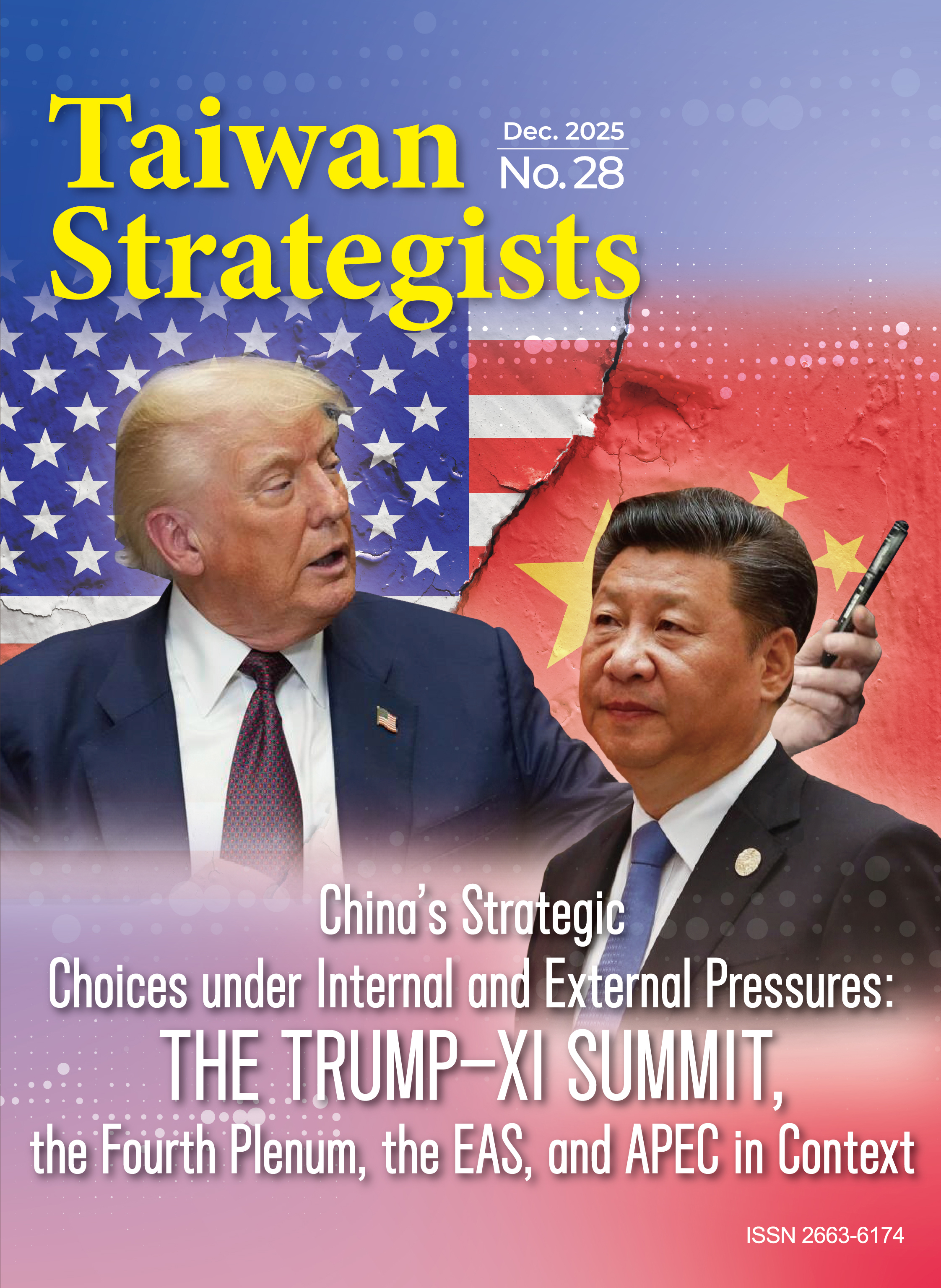
Taiwan Strategists No. 28


Constructing Stability: China’s Multilateral
Narrative Through the EAS and APEC
Frameworks
Hung-Jen Wang
Professor, Department of Political Science, National Cheng Kung University
Executive Director, Institute for National Policy Research
Abstract
This paper analyzes how China redefines its international image through the strategic use of multilateral diplomacy in the East Asia Summit (EAS) and the Asia- Pacific Economic Cooperation (APEC). Facing domestic economic slowdown and property risks, Beijing increasingly portrays itself as a power of stability and predictability, contrasting with what it depicts as Washington’s erratic unilateralism. The study argues that China employs a four-layered mechanism — discourse formation, rule upgrading, agenda setting, and linkage making — to embed the language of openness and cooperation into institutional routines. Through initiatives like CAFTA 3.0 and the APEC “Connect–Innovate–Prosper” agenda, Beijing reframes supply-chain politics as governance technology rather than geopolitical rivalry. This procedural multilateralism transforms rhetoric into operational norms, generating “cooperative inertia” that normalizes engagement with China and backgrounds confrontation. Ultimately, China’s strategy constitutes a calculus of de-conflictualized cooperation: by lowering the emotional intensity of competition and institutionalizing predictability, Beijing turns stability itself into a tradable economic resource and a source of soft power grounded not in values but in procedural reliability.
Keywords: Multilateral diplomacy, Narrative, Stability, East Asia Summit (EAS), Asia-Pacific Economic Cooperation (APEC)
Policy Adjustments at the Fourth Plenary
Session of the 20th CCP Central Committee
Wen-Hsuan Tsai
Research Fellow, Institute of Political Science, Academia Sinica, Taiwan
Abstract
On July 30, the Political Bureau of the Chinese Communist Party (CCP) announced the main agenda for the Fourth Plenary Session of the 20th CCP Central Committee. The agenda included two items, namely: a work report from the Politburo and a study of proposals for the 15th Five-Year Plan.1 The meeting was to assess the current economic situation and outline economic work for the second half of the year. This paper discusses the policy and personnel adjustments made by the CCP at the Fourth Plenary Session and their implications. In matters of policy, the CCP declared its intention to strengthen the development of high technology and hopes to achieve technological self-sufficiency and expand domestic demand. This implies a struggle for technological leadership with the United States and other Western powers. In terms of personnel, the CCP has expelled several generals involved in alleged corruption from the party and the military. Xi Jinping’s anti-corruption campaign targeting the military is likely to continue for some time, with crackdowns on cliques within the People’s Liberation Army.
Keywords: 15th Five-Year Plan, Anti-Corruption, Expanding Domestic Demand, People’s Liberation Army, Technological Self-Reliance
The 2025 Busan Trump-Xi Meeting and the
Future of U.S.-China Relations
Cheng-Fung Lu
Associate Professor, Department of International and Mainland China Affairs,
National Quemoy University
Abstract
U.S. President Donald J. Trump introduced reciprocal tariffs on April 1, 2025, with China facing the highest tariffs and countries with active trade with China also facing increased tariffs. Since Liberation Day, senior U.S. and Chinese economic and trade officials have held five rounds of negotiations in third countries, and Trump and Chinese President Xi Jinping have had four phone calls, discussing not only tariff issues but also meetings and mutual visits between the two leaders. The breadth and depth of the U.S.- China strategic competition have increased, highlighting the importance of building a personal relationship between the U.S. and Chinese presidents, which is crucial both as a communication channel in times of crisis and as the most important relationship for global stability. In November 2026, China will host the Asia-Pacific Economic Cooperation (APEC) forum in Shenzhen, and in December 2026, the United States will host the G20 Summit, with both Beijing and Washington publicly expressing support for each other as hosts. These fora appear to have become an important factor in maintaining the relations between the two countries for the coming year. However, past experience shows that maintaining relations between the U.S. and China is fraught with various possibilities. Although the situation is relatively calm at present, tensions could escalate at any time, and it is not uncommon for both sides to use various means to maintain a certain level of hostility. This paper first focuses on Trump’s return to power and how the leadership in Beijing and Washington has interacted amid this change. Secondly, it discusses the ongoing Russia-Ukraine war and Trump’s maneuvers to drive a wedge between China and Russia. Finally, it looks ahead to the U.S.-China relationship after the Trump-Xi meeting in Busan and offers a conclusion.
Keywords: Trump-Xi Busan Meeting, U.S.-China Relations, Taiwan Security, Trade War, Strategic Competition
 Facebook
  Youtube
  Twitter
  Podcast