



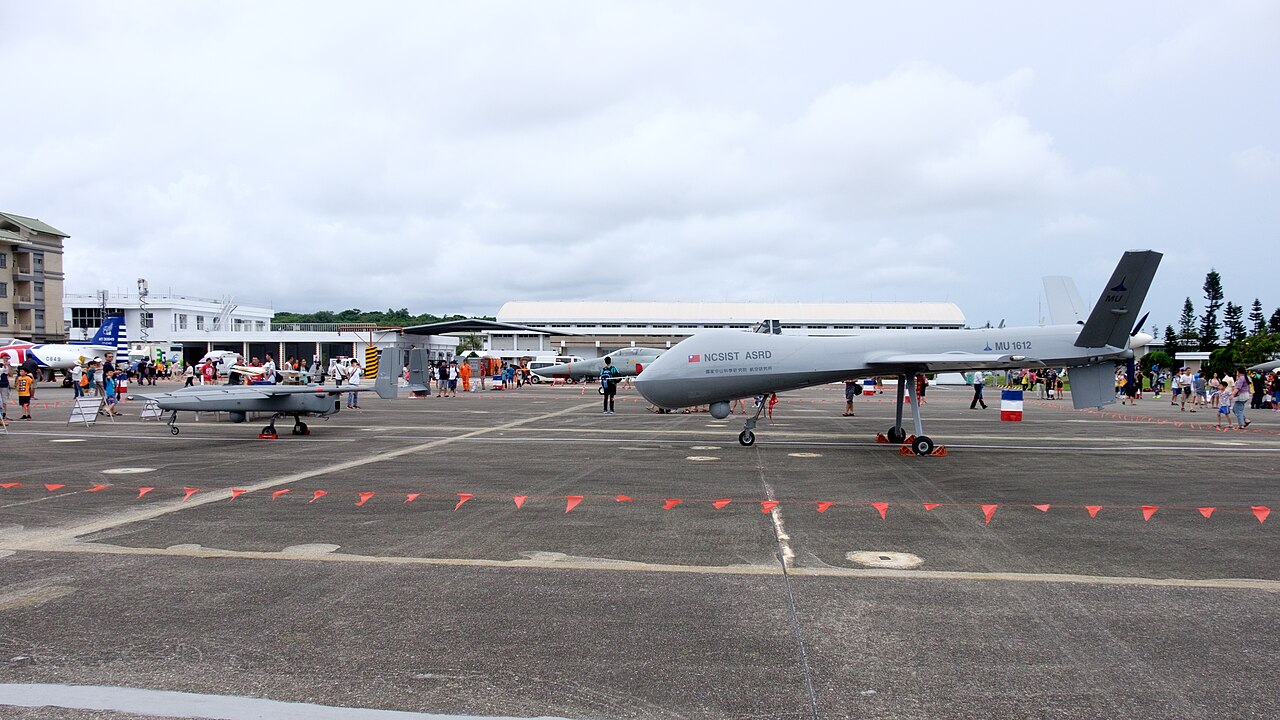
Taiwan’s unmanned vehicle development is moving rapidly. If these efforts can be scaled and expanded to include more international partners at full speed, Taiwan will be able to wield another formidable counterpart to its Silicon Shield. Picture source: 玄史生, August 13, 2016, Wikipedia, https://zh.wikipedia.org/wiki/%E9%8A%B3%E9%B3%B6%E7%84%A1%E4%BA%BA%E6%A9%9F.
Prospects & Perspectives No. 27
Full Speed Ahead: Taiwan’s Unmanned Vehicle Development
By Eric Chan
The rapid use, proliferation, and evolution of unmanned vehicles — ground, sea, and air — in the Russia-Ukraine War has been evident to even the most casual of observers. Ukraine has deftly used unmanned vehicles to repeatedly inflict shocks on invading Russian forces. This includes the indirect use of unmanned aerial vehicle (UAV) as bait to sink the Russian flagship Moskva; coordinated unmanned surface vehicle (USV) maritime strikes to drive out the Black Sea Fleet; ongoing long-range strikes on Russian oil/gas facilities; tactical strikes all across the frontline, with the first unmanned ground vehicle (UGV)/UAV combined attack occurring in April 2026.
The Russia-Ukraine War as a model for development
Ukraine’s experience has much to teach Taiwan, even if the operational and tactical issues that Taiwan must consider are different. In 2022, Ukraine’s desperation for platforms that could offset its numerical inferiority vis-à-vis Russia led to the use of jerry-rigged civilian quadcopters as part of a “high-low” mix with the comparatively high-end Turkish Bayraktar TB2. Throughout 2023 and 2024, a grinding war of attrition meant both sides rapidly expanded their unmanned fleets and engaged in a technological competition, most prominently through the rise of first-person-view(FPV) drones/loitering munitions. By the end of 2024, Ukraine created the world’s first Unmanned Systems Force to produce, organize, train, and integrate these platforms. This has allowed an otherwise disadvantaged Ukraine to fight Russia to a standstill through innovation — an impressive feat, given that Russia is also lavishly funding its own Center for Advanced Unmanned Technologies (better known as “Rubicon”).
The demonstrated versatility and low cost of unmanned platforms is a critical part of Taiwan’s new strategy of erosion. In fact, the evolution of the unmanned platforms and their use present multiple new methods to deter/deny aggression by the People’s Republic of China (PRC).
Accordingly, the National Chung Shan Institute of Science and Technology (NCSIST), Taiwan’s top military research institution, as well as numerous private companies such as Thunder Tiger, have developed a wide variety of UAVs, USVs, and increasingly UGVs. In many ways, this mirrors the Ukraine experience of early 2024: a wide proliferation of technologies, companies, and platforms, with the central government struggling to coordinate and scale these respective efforts.
Scale and integrate
With traditional weapons, the high cost of research/production as well as long development cycles mean there is a high incentive for countries to down-select to one platform and one company. Ukraine has shown a different way: fast iterative development, massive scaling, and only then integration. This strategy relies on treating unmanned platforms more like munitions as opposed to weapon systems: that is, as disposable items where stone-axe simplicity is a positive, not a negative.
This strategy is not without its flaws. It is not budget-efficient; de-prioritization of integration means Ukraine suffers at the operational level of war, which makes it difficult for Ukraine to create decisive effects on the battlefield.
Yet this strategy has been absolutely successful in creating the robust military-industrial scale needed to fight a protracted war. Ukraine has now created a strike complex that is not reliant on U.S. or European input and resilient against Russian attacks, allowing Ukraine to fight on its own terms.
Implications for Taiwan
Taiwan can adapt this strategy to account for its different environment.
First, the issue of scale. Announced Taiwanese efforts in July and September 2025 include the purchase of 100,000 small and medium-sized UAVs over the next two years; the Lai administration has also announced a production goal of 180,000 units a year on a PRC-free supply chain. At the time of this writing, the special defense budget proposed by the administration — which has yet to be approved by the Legislative Yuan — includes a provision for another 1,600 USVs. As a simple numerical comparison, Ukraine produced some 5,000 units in 2022; 3.2 million units in 2024; this year, a production goal of 7.5 million units.
Of course, Taiwan has different battlefield needs from Ukraine; the limited number of viable invasion beaches means that Taiwan would need significantly fewer unmanned units to achieve the same level of density as part of a strategy of denial. However, this calculus changes in a protracted war, where long-range strikes become necessary to force the adversary to the negotiation table (as Ukraine is currently trying to do).
What Taiwan has announced is a good start, but should be seen as just that—a start.
This leads to the second implication for Taiwan: a major diplomatic and economic effort is needed to not only achieve Taiwan’s level of scale, but to also challenge/displace PRC unmanned dominance. Current Taiwanese diplomatic strategy, announced by the Ministry of Foreign Affairs in October 2025, is a “two-phase drone diplomacy” program. Phase 1 is the donation of civilian drones to Taiwanese diplomatic allies; phase 2 would look at increasing unit supply to Indo-Pacific partners such as Japan or the Philippines, and Central/Eastern European countries threatened by Russia.
While admirable, this initiative should be broadened in scope/scale — especially following the extraordinary Middle East interest in unmanned capabilities following the U.S.-Iran conflict. Ukraine has already rushed to capitalize on this interest, sending multiple delegations to share tactics, techniques, and procedures as well as offer Ukrainian interceptor-drones.
This does not mean Ukraine should be seen as Taiwan’s competitor in the unmanned platform market. Taiwan’s own internal needs will likely outstrip domestic production for the immediate future. Instead, there is a significant opportunity for Taiwan to partner with Ukraine — not simply for lucrative gain, but in establishing both a firm global demand signal and supply chain for “non-red” unmanned technologies. Melding Taiwanese dominance in chips and AI infrastructure with Ukrainian unmanned tech production/battlefield tested data could strike a decisive blow against PRC’s Da Jiang Innovations (DJI) stranglehold over the global UAV market, create additional strategic global space that Taiwan needs, and assist with Taiwan’s industrial scale problem.
Taiwan’s unmanned vehicle development is moving rapidly. There are already partnerships for development between Taiwan’s Aerospace Industrial Development Corp and the U.S.’ Shield AI; between NCSIST and AeroVironment, and more. If these efforts can be scaled and expanded to include more international partners at full speed, Taiwan will be able to wield another formidable counterpart to its Silicon Shield.
(Eric Chan is a senior non-resident fellow at the Global Taiwan Institute.)
相關文章
The Awakening of a Resolute Europe: How Ukraine is Forcing Europeans to Take Their Own Security Seriously

Appeasement or Strength: The Challenges of American Mediation in the Russia–Ukraine War

Support Behind the Façade of Neutrality: How China Shapes the Course of the Russia-Ukraine War
No More Carrots: U.S. Leverage Needed to End Russia’s War
From Crisis to Capacity: Europe’s Defense Evolution Amidst Transatlantic Strains
The EU Parliament Elections: What Kind of EU Will Emerge?
Putin’s State Visit to China and the Prospects for Sino-Russian Relations
Ukraine’s Accession to the EU: There’s Still a Long Way to Go

 Facebook
  Youtube
  Twitter
  Podcast