

The U.S. Supreme Court Rules on Trump’s Tariffs: What Does This Mean for Taiwan?


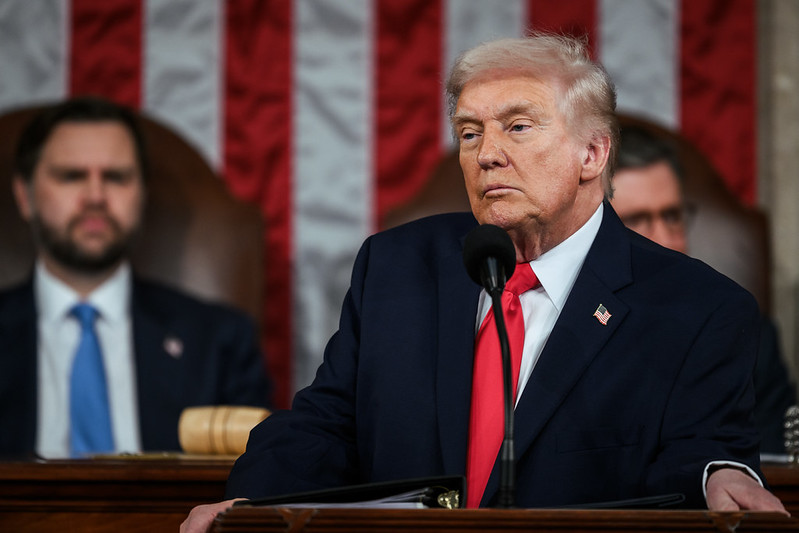
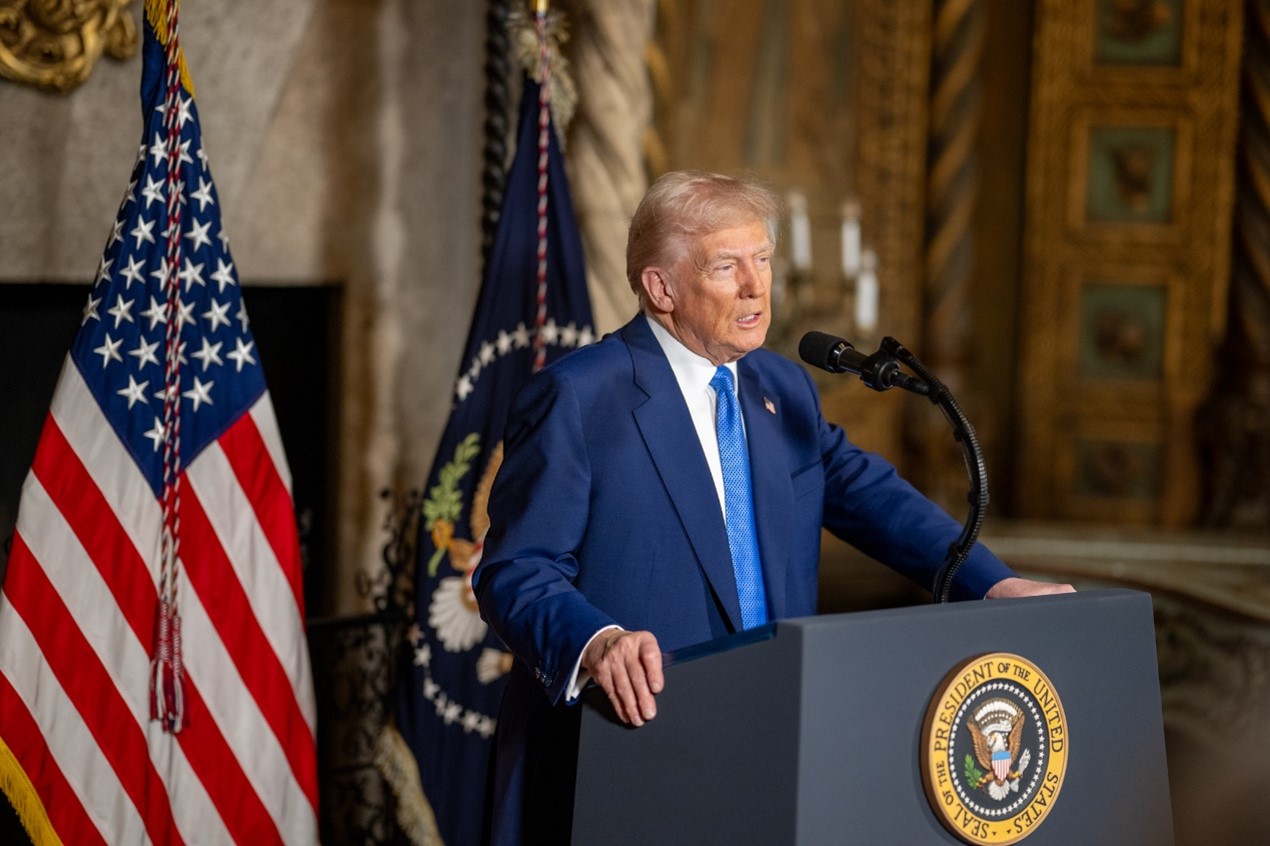
The U.S. Supreme Court ruled that it was unconstitutional for the president to invoke the International Emergency Economic Powers Act to impose tariffs. Immediately following the decision, Trump invoked Section 122 of the Trade Act of 1974 to sustain global tariffs at a temporary level of 15 percent for 150 days, unless extended by Congress. Picture source: The White House, February 24, 2026, flickr, https://www.flickr.com/photos/whitehouse/55115994565/in/album-72177720332205887.
Prospects & Perspectives No. 13
The U.S. Supreme Court Rules on Trump’s Tariffs: What Does This Mean for Taiwan?
By Zoe Weaver-Lee
Almost one year after U.S. President Donald Trump announced sweeping tariffs on global trade partners, a date he marked as “Liberation Day,” the U.S. Supreme Court ruled that it was unconstitutional for the president to invoke the International Emergency Economic Powers Act (IEEPA) to impose tariffs. Immediately following the decision, Trump invoked Section 122 of the Trade Act of 1974 to sustain global tariffs at a temporary level of 15 percent for 150 days, unless extended by Congress.
Taiwan, along with many of the United States’ trade partners, is now looking for clarity and certainty as central questions remain. Will the revenue collected from IEEPA tariffs since April 2025 be refunded, and how? Are agreements reached under the duress of tariff threats still valid, and should partner countries hold true to them? And for Taiwan, how does this decision uniquely impact the U.S.-Taiwan economic relationship moving forward?
ART: Ill-timed or a ticket to negotiation?
Following months of discussions at the onset of Trump’s “Liberation Day” tariffs, the United States and Taiwan reached an agreement on February 12, 2026, for a reduction in tariffs and barriers, as well as purchase and investment commitments. The Agreement on Reciprocal Trade, or ART, is set to eliminate up to 99 percent of tariff barriers and commits Taiwan to US$85 billion in purchases from the United States as well as US$500 billion in investment. Negotiations for the agreement were mainly fueled by the imposition of a 20 percent tariff (down from 32 percent earlier in the year) on certain goods from Taiwan, while more than half of goods were exempt pending Section 232 investigations. The signing of ART thus reduced the U.S.’ tariff rate from 20 to 15 percent.
As such, the Supreme Court’s ruling and subsequent swift action from the Trump administration to extend the tariffs at 15 percent notably carries little impact on Taiwan at face value. In fact, some may see the irony in the ruling party’s long-labored efforts to lower the tariff through bold commitments, only for the global rate to reflect the same treatment regardless. For several reasons, the ART negotiations and subsequent agreement will not be in vain.
Following the ruling, Taiwan’s Vice Premier Cheng Li-chiun remarked that the agreement creates more space for flexibility in negotiating, especially as Taiwan still awaits the outcome of the Section 232 investigations. In this way, the Lai administration believes those who have already reached agreements will have an advantage moving forward. Outside of monetary commitments, the agreement also outlines much-needed cooperation on the areas of security, regulations, and China. Additionally, the vice premier’s travel to Washington, DC, during the negotiation process also signified a small but noted change in U.S. policy regarding high-level visitors from Taiwan, marking the importance and urgency of these discussions.
In addition to the merits of the agreement, analysts and negotiators seem confident that the Trump administration will continue to use other tools at its disposal, and in turn the agreement will likely not be renegotiated so soon. Taiwan is not unique in this situation. Indeed, the Trump administration has stated that so far no countries have stepped forward to renegotiate agreements reached under the IEEPA tariff threat. This is likely due to the fact that trading partners expect tariff rates to possibly remain the same through other legal means, or that other barriers will be used as leverage in future discussions. As such, walking back or paring down previous commitments may be met with different consequences, even if not sky-high tariff rates.
Regardless of ongoing discussions between the United States and Taiwan, ART is still at the behest of Taiwan’s Legislative Yuan, which has yet to confirm the agreement. Opposition parties in the legislature have requested a more thorough review before its implementation, which may significantly change how much Taiwan can commit in terms of investment and purchases. Considering recent legislative battles over the budget, the ruling party may not be able to solidify the agreement as it stands now.
Unique implications for Taiwan
Although the recent Supreme Court ruling will likely not significantly change pre-existing economic agreements between the United States and Taiwan, the ongoing section 232 investigations as well as the institutionalization of semiconductor cooperation will likely require attention.
Ongoing discussions regarding Taiwan’s silicon shield have centered around maintaining Taiwan’s irreplaceable role in the semiconductor supply chain to raise the stakes of a potential cross-Strait contingency. Under the Trump administration, campaigns to foster American innovation and build up capacity on U.S. soil fueled tariff initiatives, but stood to complicate these debates. Investment commitments from Taiwan in an effort to lower the tariff indeed include those from the semiconductor sector, prompting opposing analysts and officials to declare a “hollowing out” of Taiwan’s industries. Despite this, official marketing of this investment in the United States has centered around a narrative of “partnership,” even if the United States’ own narrative does not reflect the same sentiment.
The Supreme Court ruling will put a mirror up to the intentions of growing Taiwan chip investments in the United States. Despite Taiwan’s significant chip investments on U.S. soil prior to “Liberation Day,” ART further solidified U.S.-Taiwan semiconductor integration. Have these agreements been reached under the threat of tariffs, or were private sector forces and incentives more at play? If the Trump administration no longer has the “stick” to force a greater integration of the U.S. into the semiconductor supply chain, will carrots be enough? Overall, Taiwan officials have reassured the public and private sector that the majority of Taiwan’s advanced capacity will remain at home. In many ways, this prowess will remain a significant source of leverage if negotiations are to continue in the wake of the ruling.
What next?
Like most of the United States’ trading partners, Taiwan will spend the near future navigating the wake of the Supreme Court ruling with uncertainty and caution. Logistical and legal concerns regarding possible refunds of tariff revenues, the possibility of other economic and policy tools that may keep tariffs high, and the outcome of Section 232 investigations all remain major forces at play. In the meantime, Taiwan should continue to work directly with its exporters and consumers to alleviate the effects of the changing policy, as well as work through domestic discussions of the agreement in its legislative body.
(Zoe Weaver-Lee is an Adjunct Fellow with the Global Taiwan Institute.)
相關文章
Washington Reassures (and Worries) Taiwan
Implications of the U.S. Tariff Policy on Global Economics and Taiwan’s Response
A Geopolitical Inflection Point: The Deeper Implications of the U.S.-Taiwan Reciprocal Tariff Agreement for Bilateral Relations
President Lai Ching-te’s One Year Mark: Navigating Uncertainty
Washington’s Sharp Shift in Ukraine Policy: Implications for Taiwan
Navigating Turbulence: China and Taiwan During Trump 2.0
The Future of U.S.-Taiwan Relations After the January Elections
 Facebook
  Youtube
  Twitter
  Podcast